Screen, Games and Quran: Helping Children Choose Better Without Daily Battles
This is now one of the most common Muslim parenting challenges as raising their children in a world full of screens is hard, and it's not about one bad device or one weak parent. Here's is guidelines and parenting tips
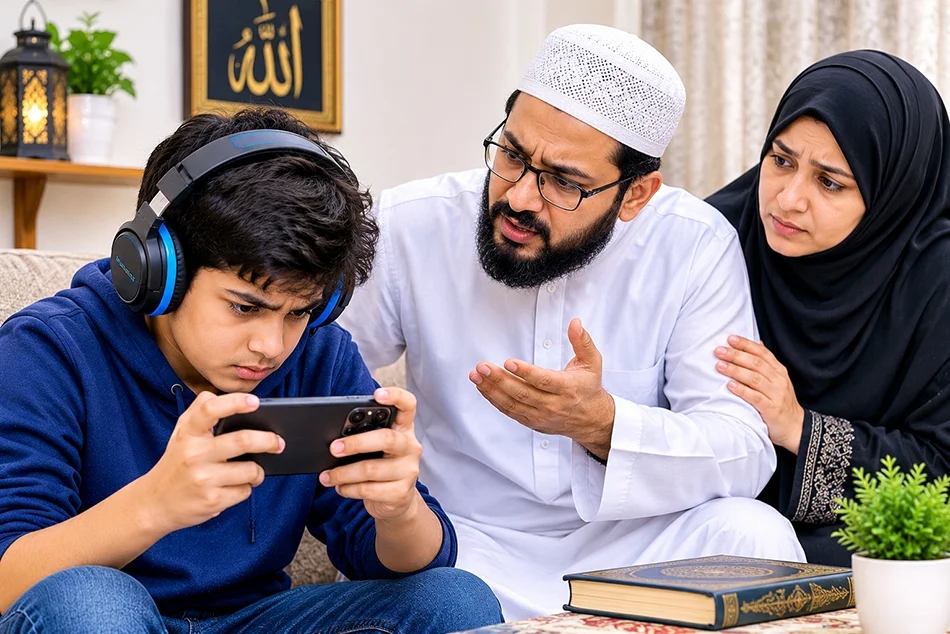
It's 7 p.m. Dinner is on the table. Your child is on a tablet, one more game, one more video, and every request to stop turns into a negotiation. You raise your voice. He cries. You feel guilty.
Sound familiar?
This is now one of the most common Muslim parenting challenges. Raising Muslim children in a world full of screens is hard, and it's not about one bad device or one weak parent. It's about a home where screens are faster, louder, and more rewarding than almost everything else competing for a child's attention, including Quran time.
The short answer:
Screens win because they give instant reward, endless novelty, and a feeling of control. The Quranic answer is not a total ban. It's balance, replacement, and example: a structured Quran habit, clear home rules, real play instead of passive watching, and parents who model what they ask for.
Why Screens Win (And Why Lectures Don't)
A game gives a child a point, a sound, and a next level within seconds. A video ends and the next one starts by itself. A child who feels powerless at school and small at home feels powerful inside a game. That's a hard combination to beat with a lecture.
And here's the thing. Lectures don't work because they fight feelings with words. A child doesn't stop wanting the tablet because you explained why it's bad for him. He stops when something better, clearer, and more regular takes its place. I've seen this with students again and again. The homes that win this battle rarely have stricter bans. They have better routines.
There's a second problem.
Boredom.
Children today almost never sit with nothing to do. Every empty minute gets filled by a screen. So when Quran time comes, it feels like an interruption, not a habit. The child isn't rejecting the Quran. He's rejecting the interruption.
What Screen Time Does to Attention, Eyes, and Sleep
Parents should also know that children's screen time does more than eat hours. It shapes the mind and body behind those hours.
Attention and Thinking: Screens train the brain for fast switching. A new picture every few seconds, a new sound, a new reward. After that habit sets in, a child gets bored fast with slow work. Reading the Quran, memorizing a lesson, reading a book, all of these need steady attention, and steady attention is exactly what heavy screen time weakens. The brain gets strong at what it practices. Screens practice fast switching, not deep thinking.
Eyesight: Long hours looking at a close screen tire the eyes, dry them out, and bring headaches. And a child who stays indoors on a screen all day misses outdoor light and distance vision, both of which the eyes need to stay healthy. That's why weak eyesight shows up more in children with heavy screen habits.
Sleep: Screens at night push sleep later. The light and the excitement keep a child awake past bedtime. He sleeps late, wakes tired, and walks into the next day cranky and slow at learning. Poor sleep alone can drag down a child's mood and memory.
Body and Speech: Sitting all day weakens muscles, hurts posture, and adds weight. And a child who watches silently for hours misses real talk and real play, which is how language and social skills grow. Small children feel this effect most.
This is general parenting guidance. For a child's specific health problem, a doctor is the right person to ask.
What the Quran Says About Time and Idle Pursuits
The Quran opens the conversation with time itself.
"By time, indeed, mankind is in loss" (Surah Al-Asr).
That's not a small claim. Time is the one thing we can't earn back, and the Surah measures our lives by how we spend it.
Then there's a verse parents quote less often.
"And they who turn away from idle talk" (Surah Al-Mu'minun, 23:3).
The word used is laghw, idle pursuits that waste the hours without giving anything back. Not every game is laghw. Not every video is wasted time. But hours of scrolling with no purpose, no learning, and no rest? That's exactly what the verse points at.
A third verse completes the picture.
"Indeed, the wasteful are brothers of the devils" (Surah Al-Isra, 17:27).
Waste here isn't only about money. Wasted attention counts too. A child's evening is a trust. Pouring all of it into a screen is a form of waste, even when nothing "bad" is being watched.
Notice what these verses don't do. They don't name a device. They don't give a minute limit. They give a principle: guard your time, drop what's idle, and spend the hours on what lasts.
The Prophet's Balance: Play Was Never the Enemy
This is where many parents get it wrong. They think Islamic parenting wants them to ban play. The Seerat says the opposite.
The Prophet (peace be upon him) raced with Aisha (may Allah be pleased with her). He let his grandchildren climb on his back while he prayed. And on Eid, something happened that every parent should know. Some Abyssinian young men were giving a display of spear and shield play in the mosque. The Prophet (peace be upon him) himself called Aisha to watch, and she watched from behind him, screened from view, until she herself moved away. When Umar (may Allah be pleased with him) rebuked the players, the Prophet (peace be upon him) said,
"Leave them, O Banu Arfida! You are safe." (Sahih al-Bukhari 3530 and 950; Sahih Muslim 892; Sunan al-Nasai 1595)
Two lessons sit in that story. First, watching good play is human nature. People want to sit together and watch a game, and the Prophet (peace be upon him) gave that wish a dignified place instead of crushing it. Second, Shariah does not reject everything outright. It draws lines between halal and haram, and it leaves wholesome play lawful.
So the goal was never a joyless home. The goal was proportion. Play stayed inside limits. It didn't eat prayer, learning, family time, and sleep. That's the balance parents are trying to recover today, and it's a very old one.
When you tell your child "no screens at all, ever," you're fighting a battle the Seerat never asked you to fight. When you say "screens have a time and a place, and so does the Quran," you're standing on much firmer ground.
Archery, Horse Riding, and Swimming: Good for Faith, Good for Health
Umar (may Allah be pleased with him) has a famous saying: teach your children swimming, archery, and horse riding. These three sunnah sports hold a special place in Islam, and their virtue also comes through in sound hadith.
Sahih al-Bukhari (2899) reports that the Prophet (peace be upon him) passed by men of Banu Aslam practicing archery. He said, "O Bani Ismail! Practice archery as your father Ismail was a great archer. Keep on throwing arrows and I am with all of you." And Sahih Muslim (1917) reports that he said from the pulpit, after reciting "prepare against them whatever strength you can" (Surah Al-Anfal, 8:60), three times: "Beware, strength consists in archery."
A narration in Sunan al-Nasai lists four things that do not count as idle diversion: walking between targets in archery practice, training a horse, playing with one's family, and learning to swim. That's why such halal play is not forbidden. It builds the body, trains focus and patience, and it benefits faith too. Archery builds focus, patience, and discipline. Horse riding builds balance and confidence. Swimming works the whole body.
Now compare that with a screen. A screen gives a child no movement, no focus training, and no real skill. He sits still while the hours pass. Play that builds both body and mind is the best replacement for it.
Replace, Don't Just Remove
Here's the single biggest mistake. Parents remove the tablet and leave nothing in its place. The child sits there, bored, angry, and waiting for the tablet to come back. Of course he begs for it. You took his entertainment and gave him an empty room.
Replacement works better. Give Quran time a fixed slot, a real teacher, and a visible routine, and it starts to compete. A child who reads with a kind tutor three days a week, at the same hour, builds a habit that screens have to work around. That's why a structured plan matters more than a single rule. If your family needs help setting one up, a clear online Quran learning guide can show what a steady weekly routine looks like.
And there's a second part to replacement. Fill the gap with something real. A board game after Maghrib. A walk with father. A story before bed. When the evening has shape, the screen stops being the only shape in it.
A Screen Agreement That Actually Holds
Family screen rules fail when they're vague, one-sided, or changed every day. A written agreement, made together, holds longer. Keep it short. Five rules are enough.
- First, no screens at meals and no screens in bed. Sleep comes first, and a child who scrolls in bed sleeps late and wakes tired, which makes everything else harder.
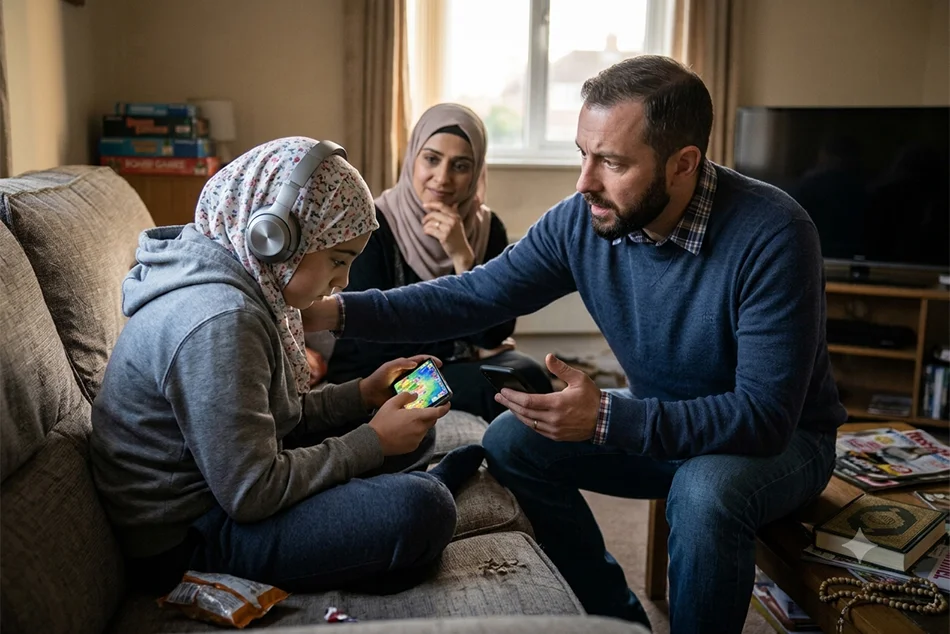
- Second, parents go first. This one stings, but it's true. A child copies what he sees. If you check your phone at dinner while banning his tablet, he hears the rule and sees the exception. Put your own phone down first. It works faster than any speech.
- Third, one screen-free hour every evening. Not a punishment hour. A family hour. Homework, Quran, play, talk. The point is that the home can function without a screen, every single day.
- Fourth, pick the games together. Don't just ban. Sit with your child, look at what he's playing, and choose what's fine and what's not. A child who helped make the rule breaks it less.
- Fifth, agree with your spouse first. Two parents with two rules give a child a gap to walk through. Settle the two or three non-negotiables together, then present one front.
Screen time limits work when they are clear, shared, and steady. They fail when they change with the parent's mood.
When Screens Help
Let's be fair. Screens aren't evil. Your child reads the Quran with an online tutor on a screen. He watches a Seerat cartoon on a screen. He calls his grandparents on a screen.
The device isn't the problem. The purpose is.
So ask a better question than "how do I get rid of screens?" Ask "what is this screen time for?" Learning, family connection, and real rest have a place. Endless scrolling doesn't. Teach your child to ask that question too. A teenager who can tell the difference between watching a lesson and killing two hours has learned something no ban can teach.
Questions Parents Ask
How much screen time is OK for my child?
There's no single number that fits every home. A small child needs very little. An older child can handle more if school, sleep, prayer, and Quran time are already done. Meals and bedtime stay screen-free at every age. That's the line that matters most.
Should I ban games completely?
A full ban usually backfires. The game becomes more attractive, and the child plays it elsewhere. Choose the games, set the hours, and play together sometimes. Limits work. Total bans mostly create secrecy.
My child only wants YouTube. What do I do?
Curate it. Watch with him. Set a time box, and offer something better first, not after. A child who just finished a good Quran lesson and a game with his father doesn't crave YouTube the same way.
Can Quran learning happen on a screen?
Yes, and it already does. Live online classes run on screens, with a real teacher, a fixed time, and a real relationship. That's the difference between screen time that builds and screen time that drains.
Is it OK to watch a game or match as a family?
Wholesome play is fine to watch. The Prophet (peace be upon him) himself invited Aisha to watch the Abyssinians' display. The conditions are simple: nothing haram in it, like gambling or indecency, no missed prayers, and a time limit. A halal game watched together as a family is no harm.
What if my spouse and I disagree on the rules?
Agree on two or three non-negotiables in private, then present them together. Children test every split they find. One front, even an imperfect one, beats two perfect rules that contradict each other.
What to Remember
- Screens win on instant reward, novelty, and control. Lectures can't beat that. Routines can.
- Heavy screen time hits attention, eyesight, sleep, and speech. Real play repairs what screens wear down.
- The Quran guards time and warns against idle pursuits, without banning play itself.
- The Prophet (peace be upon him) allowed wholesome play and invited Aisha to watch it. Balance, not joylessness, is the goal.
- Sunnah sports like archery, horse riding, and swimming build body and focus, and they are not forbidden. They are the best replacement.
- Replace before you remove. A fixed Quran habit crowds out screen hours on its own.
- Parents go first. Your phone habits teach louder than your rules.
The Goal: Screens That Serve Your Family
You don't need a screen-free home. You need a home where screens serve the family instead of running it. A home where Quran time has a slot nobody negotiates, where meals belong to conversation, and where play, learning, and rest each get their share.
Muslim parenting challenges like this one are not solved by one big rule. They are solved by small wins, held daily. Pick one rule from this article and hold it for a week. One screen-free hour. One fixed Quran slot. One phone-down dinner. Small wins build the home you actually want, and your child will feel the difference before you do. For guidance and qualified tutors to build that Quran habit, QuranlyHub is there to help.
Follow ummid.com WhatsApp Channel for all the latest updates.
Select Language to Translate in Urdu, Hindi, Marathi or Arabic