The American Promise at 250: When Power Overshadows Principle
For 250 years, the United States has carried one of the most influential political promises in modern history, but the distance between the ideals proclaimed at the nation’s founding and the realities of its global conduct remains a subject of enduring debate
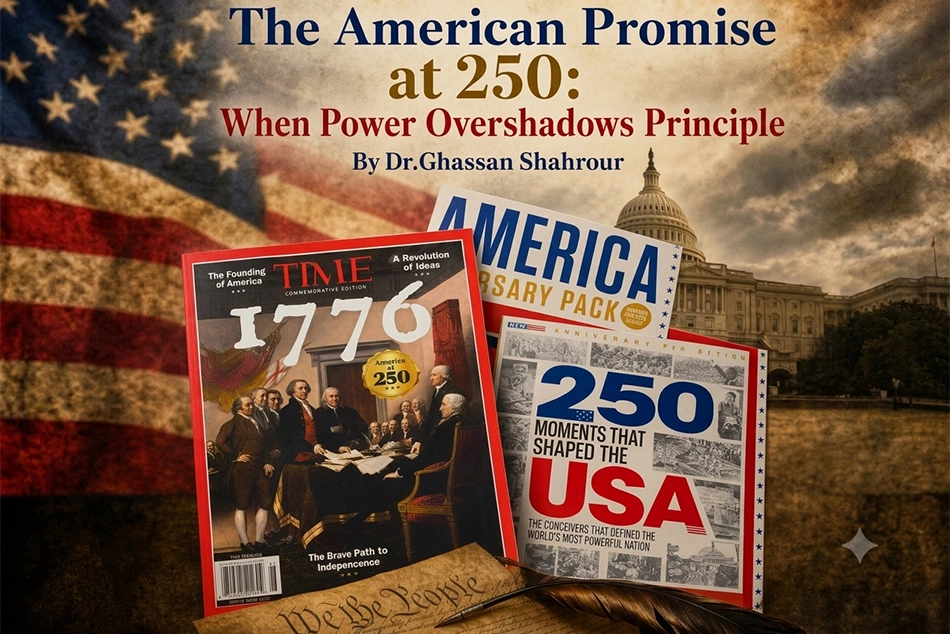
For 250 years, the United States has carried one of the most influential political promises in modern history: the belief that human beings can govern themselves, that rights are inherent rather than granted, and that power must be accountable to the people. This promise emerged in a world ruled by empires, monarchies, and coercive authority, making it at the time a radical declaration of human dignity and political possibility. Yet the distance between the ideals proclaimed at the nation’s founding and the realities of its global conduct remains a subject of enduring debate.
From the outset, America announced liberty while denying it to millions, spoke of equality while sustaining slavery, and built a constitutional order that protected rights while leaving each generation with the unfinished task of making those rights universal. As observers often note:
“The strength of a promise lies not in its beauty, but in its fulfillment.”
Today, admiration for the American idea coexists with concern about its application.
Over decades, the world has witnessed wars, occupations, and sanctions that have destabilized entire regions. Political and military decisions have weakened prospects for peace and strained the principles of international humanitarian law. Fear and mistrust have reshaped societies, often imposing costs on civilians who bear no responsibility for geopolitical calculations. As one humanitarian scholar wrote, “When power speaks too loudly, humanity becomes difficult to hear.”
At the same time, global challenges demand unprecedented cooperation: climate change, pandemics, food insecurity, artificial intelligence, outer space governance, and cyber stability. In these arenas, gaps persist between American rhetoric and practice. The United States withdrew from the Paris Climate Agreement before rejoining it, resisted binding frameworks for cyber governance, and opposed international rules for the peaceful use of outer space.
It is also important to recognize that the United States has played constructive roles in building peace and supporting global recovery. After World War II, it contributed to rebuilding Europe and Japan, supported the creation of the United Nations, helped establish international financial institutions, and backed development programs that shaped global stability for decades. These achievements form part of the American promise. Yet this article examines whether that promise, after 250 years, still aligns with the principles of international legitimacy and human dignity.
Today, the performance of major powers is increasingly measured against the Sustainable Development Goals, especially good health and well-being, climate action, reduced inequalities, and strong institutions. Principles such as Health for All and Universal Health Coverage are no longer technical aspirations; they are pillars of human security. Access to healthcare, food, water, and a safe environment now shapes the security of nations more profoundly than military strength. Climate change has become a direct threat to millions and a test of global responsibility, including that of the United States.
In the field of disarmament, a cornerstone of human security, the United States remains outside several key treaties designed to protect civilians and reduce the brutality of war:
- The Mine Ban Treaty
- The Convention on Cluster Munitions
- The Treaty on the Prohibition of Nuclear Weapons
- The Comprehensive Nuclear Test Ban Treaty
It has also not ratified major human rights instruments, including:
- The Convention on the Rights of the Child
- The Convention on the Elimination of Discrimination Against Women
- The Convention on Enforced Disappearances
These omissions are not procedural details; they reflect structural hesitation toward emerging global consensus on human dignity and civilian protection.
In practice, the consequences have been profound. From the Vietnam War to the 2003 invasion of Iraq without UN authorization, from the prolonged conflict in Afghanistan to covert operations in Iran, Libya, and Syria, interventions have occurred outside the boundaries of international legitimacy. These actions have left deep societal scars and weakened global confidence in the norms the United States claims to defend.
Unilateral decisions have further strained the international order, including:
- Recognizing Israel’s annexation of the occupied Syrian Golan
- Declaring Israeli settlements in the West Bank “legal”
- Recognizing Jerusalem, including its occupied eastern part, as Israel’s capital
These decisions were rejected by the overwhelming majority of UN member states of the principle that territory cannot be acquired by force.
Additionally, unilateral sanctions outside the UN framework, withdrawals from key international institutions, and repeated use of the veto to block resolutions aimed at protecting civilians, especially in Palestine, have widened the gap between moral discourse and political behavior. As one diplomat observed:
“Legitimacy is not a possession; it is a practice.”
This article does not seek to condemn but to analyze. It aims to understand how global security is shaped by the tension between declared principles and actual policies. The world stands at a critical juncture requiring a redefinition of the legitimacy of power, one rooted in adherence to international humanitarian law and in recognizing disarmament, especially nuclear disarmament, as essential to sustainable peace.
The future of the international system will not be built on military superiority but on the collective ability of nations to uphold law, protect civilians, and expand justice. In this context, the renewal of the American promise depends on the willingness of the United States to close the gap between its ideals and its actions, and to engage in a global order that places human dignity above all other considerations.
CONCLUSION
The 250th anniversary of the United States is not merely a moment to celebrate history but an opportunity to reassess it. The global future requires major powers, foremost among them the United States, to redefine their role in advancing peace, commit to international humanitarian law, join key disarmament treaties, and abandon unilateral policies that weaken the international system.
Humanity today needs leadership measured not by the weapons it possesses but by the lives it protects. If the United States seeks to redefine its global leadership for the next quarter century, its strongest advantage will not be unmatched military power but unmatched credibility in defending international law, humanitarian disarmament treaties, and the protection of civilian life. Acknowledging past errors and correcting course in line with international legality and human justice is essential for any responsible global role, and for any promise seeking to regain its credibility.
[Dr. Ghassan Shahrour, Coordinator of the Arab Human Security Network, is a medical doctor, prolific author, and human rights advocate specializing in health, disability, humanitarian disarmament, and human security. He has contributed to global campaigns for peace, disarmament, and the rights of persons with disabilities.]
Follow ummid.com WhatsApp Channel for all the latest updates.
Select Language to Translate in Urdu, Hindi, Marathi or Arabic