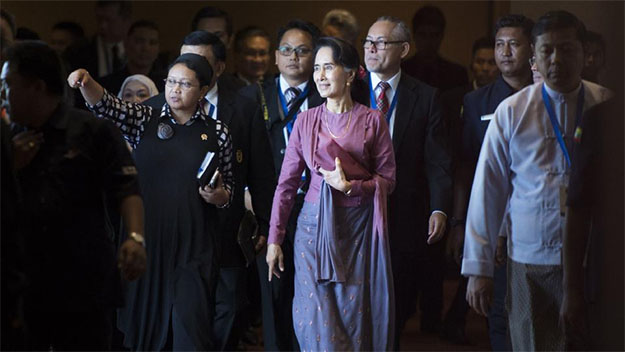
[Indonesia’s foreign minister Retno Marsudi (L) and Myanmar state counsellor and foreign minister Aung San Suu Kyi (C) attend the ASEAN meeting in Yangon on Monday. (AFP photo)]
Yangon: The fate of Myanmar's Rohingya Muslim minority took center stage on Monday as ministers from the Association of Southeast Asian Nations (ASEAN) held crisis talks over a security crackdown that has drawn rare criticism from neighboring nations.
More than 27,000 Rohingya Muslims have fled northwestern Myanmar for Bangladesh since the start of November to escape a heavy-handed counterinsurgency campaign.
The army said it was hunting militants behind deadly raids on police posts in October. But Rohingya survivors have described rape, murder and arson at the hands of security forces – accounts that have raised global alarm and galvanized protests in capitals around Southeast Asia.
On Monday foreign ministers from ASEAN, the regional 10-member bloc, met in Yangon for emergency talks, a gathering Malaysia said was the result of pressure building on Myanmar to resolve the crisis.
"Constant pressure from both the international community as well as Malaysia has led us to this point and to the retreat to be held," Malaysia's Foreign Minister Anifah Aman said ahead of the talks.
The vast majority of Myanmar's Rohingya population are denied citizenship and have lived for years under movement restrictions that many have likened to apartheid. Thousands have fled over the years on rickety boats, seeking sanctuary in Muslim majority countries like Malaysia and Indonesia.
Earlier this month Malaysian Prime Minister Najib Razak accused Myanmar's de facto leader Aung San Suu Kyi of allowing "genocide" on her watch – an unusually strong rebuke by one ASEAN state of another.
Former Secretary General of ASEAN Ong Keng Yong said neighboring nations feared the Rohingya crisis could spiral.
"This kind of issue, if it's not well managed, will impact on the general picture of our peace and security in ASEAN," he told AFP.
Myanmar has also seen a cascade of criticism from outside the region over its handling of the Rohingya crisis, including from the United States, the European Union and the United Nations.
Last week UN High Commissioner for Human Rights Zeid Ra'ad Al Hussein criticized the government's "callous" handling of the crisis, describing it as "a lesson in how to make a bad situation worse".
In 2015 thousands of the stateless group were stranded at sea after authorities closed off a well-worn trafficking route through Thailand.
 Post Comments


 | Quick links