The Deeper Crisis 2026 Israel National Election has Revealed
The question is no longer simply whether Netanyahu can survive another political battle, it is whether Israel can emerge from this deadlock without reproducing the exclusions, inequalities and entrenched political assumptions that helped create it
The Israeli election has dealt Benjamin Netanyahu a serious setback, but the struggle to remove him exposes a deeper crisis: A political system unwilling to accept Palestinian citizens as equal partners in power.
The shock of Israel’s October 27 election is not that Benjamin Netanyahu has been decisively defeated. It is that, despite his political dominance, his far-right alliances and his relentless projection of strength, he has failed to secure the parliamentary majority needed to govern. The results available on October 29 show a weakened prime minister, an opposition unable to establish a government on its own, and an unprecedented parliamentary breakthrough for Israel’s Palestinian citizens. The final outcome remains uncertain, but the political message is unmistakable: Netanyahu’s grip on Israel is slipping.
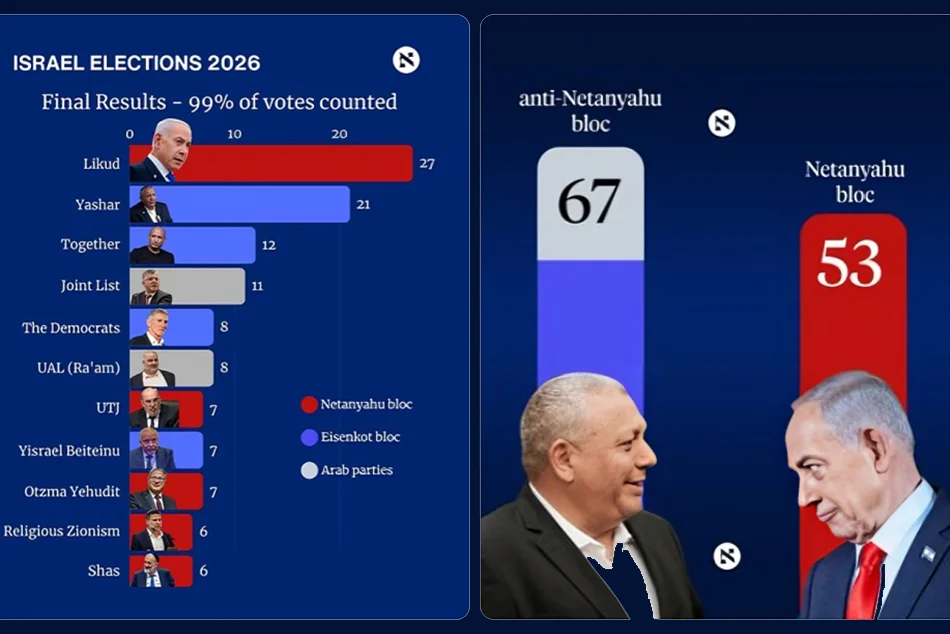
With all of the votes counted and the final results officially announced, Netanyahu’s right-wing, far-right and ultra-Orthodox bloc has won 53 seats in the 120-member Knesset. The opposition led by Gadi Eisenkot has secured 48 seat, while the Arab-led Joint List and Ra’am have jointly won a total of 19 seats. A minimum of 61 is required for a parliamentary majority. Netanyahu’s bloc has therefore lost the majority it previously commanded, while Eisenkot’s grouping remains short of the numbers needed to govern independently. Neither side has emerged with a clear mandate to form the next government.
This is a significant reversal for a leader who has spent years presenting himself as indispensable to Israel’s security and political survival. Netanyahu has survived corruption charges, mass protests, bitter internal divisions, the catastrophic security failure surrounding October 7, 2023, and mounting criticism of his government’s conduct in Gaza. He has repeatedly demonstrated an extraordinary capacity to turn crises into opportunities for political survival. Yet survival is not the same as victory, and remaining the largest political force is not the same as possessing the authority to govern.
The election has exposed the limits of Netanyahu’s political strategy. His coalition has lost substantial ground, and the far-right and ultra-Orthodox partners on whom his government depends may now find themselves with fewer options and less bargaining power. His personal future remains uncertain. It would be premature to declare that he will never become prime minister again, but equally mistaken to interpret his continuing lead as evidence that the electorate has endorsed his leadership.
The Arithmetic is Clear, Political Consequences are Not
The final results reveal the central problem: Netanyahu’s bloc lacks a majority, but his opponents have not assembled a politically viable alternative. It is therefore too early to announce Netanyahu’s political demise, just as it is wrong to describe him as the election’s unambiguous winner.
The distinction matters. With 27 seats, Netanyahu’s Likud remains the largest individual party, and his bloc is ahead of Eisenkot’s Jewish-led opposition grouping. This gives him a potential advantage in the struggle to form a government, but not an automatic right to return to office. Israel’s president, Isaac Herzog, must consult political parties before deciding whom to task with forming a government. The ensuing negotiations could produce an unlikely coalition, a government dependent on outside support, or another election if the political impasse cannot be resolved.
A national unity arrangement involving Netanyahu and Eisenkot cannot be entirely ruled out. Yet Eisenkot has campaigned on removing Netanyahu from power, condemning what he describes as the prime minister’s culture of lies, division and incitement. Joining Netanyahu would undermine the central promise of his campaign and could alienate voters who supported him precisely because they wanted a change in leadership. Such a partnership might offer a temporary escape from the deadlock, but it would carry a considerable political cost.
The Arab vote changed the equation
Perhaps the most consequential development is the revival of electoral participation among Israel’s Palestinian citizens, who constitute approximately one-fifth of the country’s population. The two Arab-led political groupings have won 19 seats, nearly doubling their current parliamentary representation. This is a historic breakthrough and a direct challenge to the assumption that Palestinian citizens can be marginalised without consequences for the country’s political arithmetic.
The significance extends beyond the number of seats. Arab voters have mobilised in the face of policies they regard as discriminatory, a political climate increasingly hostile to Palestinian identity, and the devastation inflicted on Palestinians in Gaza. Their participation demonstrates that they have not surrendered the possibility of political resistance within Israel’s electoral system. At a moment when Palestinian life and political aspirations are routinely denied legitimacy, the result asserts their presence in the very institutions that determine their future.
Former Israeli ambassador Daniel Shek has described the revival of the Arab vote as one of the most important phenomena of the election, arguing that such a large section of the electorate can no longer be disregarded in political calculations. That observation captures the central contradiction of the result. Palestinian citizens have acquired greater parliamentary representation, yet their ability to translate that representation into executive power remains severely constrained.
In purely numerical terms, the Arab-led parties could provide the votes necessary for an anti-Netanyahu government. If Eisenkot’s 48-seat grouping secured their support, the combined total would reach 67, comfortably above the 61-seat threshold. But politics is not mathematics alone. Several Jewish-led opposition parties have rejected cooperation with the Arab-led lists, while Eisenkot himself faces the contradiction between his stated ambition to remove Netanyahu and his reluctance to depend on Palestinian representatives.
Joint List leader Yousef Jabareen has indicated that his party would seek to use its parliamentary strength to facilitate the removal of Netanyahu’s government and change Israel’s political direction. Yet he has also made clear that the Joint List could not simply join an Eisenkot-led government while it supports Israel’s military campaign in Gaza and its occupation of southern Lebanon.
This is where the election’s most uncomfortable question emerges. If the Arab parties possess enough seats to influence the formation of a government, why should their participation be treated as politically unacceptable? If they are legitimate representatives when their votes are counted, on what grounds are they considered illegitimate partners when power is negotiated?
The answer exposes a fundamental contradiction within Israeli parliamentary democracy. Palestinian citizens may vote, elect representatives and occupy seats in the Knesset, but their inclusion in the governing process remains subject to a political veto exercised by parties that regard cooperation with them as unacceptable. Honaida Ghanam, director general of the Palestinian Forum for Israeli Studies in Ramallah, has described this exclusion as rooted in a racist political structure that treats Arab citizens as illegitimate partners.
The election has therefore produced a paradox. The Arab vote may have helped prevent Netanyahu and his allies from securing a majority, but it may not be permitted to play a decisive role in creating the alternative. Their votes count towards the parliamentary arithmetic, yet their political legitimacy is questioned when that arithmetic threatens the established order.
This is not merely a tactical difficulty for Eisenkot. It is a test of what Israel means when it describes itself as a democracy. A democracy cannot credibly celebrate electoral participation while denying an entire section of its citizenry an equal claim to political partnership. Nor can an opposition convincingly promise change while preserving the exclusions that have helped sustain the existing system.
A government may change without the system changing
Netanyahu’s difficulties should not be confused with a decisive rejection of the policies he represents. The opposition itself is ideologically diverse, encompassing political forces that disagree sharply on settlements, military service, security, religion and the future relationship with the Palestinians. Eisenkot’s challenge is to turn opposition to Netanyahu into a coherent governing programme. That is a far more difficult task than winning seats.
Nor should a Netanyahu-led coalition be assumed to be impossible. He could attempt to draw political rivals into a unity government, negotiate with smaller parties, or exploit divisions within the opposition. If those efforts fail, Israel could face another election. For now, Netanyahu remains caretaker prime minister while the process of forming a government unfolds.
Even his departure, should it eventually occur, would not automatically signal a fundamental change in Israel’s relationship with the Palestinians. The occupation, settlement expansion, the denial of Palestinian self-determination and the devastation of Gaza are not simply the products of one man’s political personality. They are sustained by political institutions, ideological commitments and a wider consensus that extends beyond Netanyahu and his immediate allies. A change of prime minister could alter the tone and direction of government without dismantling these structures.
That is why the election must be read on two levels. At the immediate level, Netanyahu has lost the parliamentary majority that made his return to power appear relatively straightforward. He faces a difficult struggle to assemble a coalition, and his opponents have an opportunity to challenge his prolonged dominance. At the deeper level, the result reveals a political system in which the exclusion of Palestinian citizens remains a powerful organising principle, even when their votes could determine who governs.
The record Arab representation offers a measure of political hope, but it is not yet a guarantee of influence. Their electoral strength will matter only if it can be translated into concrete political leverage, greater equality and resistance to discriminatory policies. The refusal of Jewish-led parties to work with Arab representatives may ultimately prove more consequential than the numerical balance of seats itself.
For Netanyahu, the election is a warning that political survival has limits. He may yet return to office, but he can no longer claim an uncomplicated mandate or assume that his coalition will command the Knesset. For Eisenkot, the challenge is equally stark. He cannot convincingly promise to remove Netanyahu while ruling out the very parliamentary partnership that could make that outcome possible.
Netanyahu has not won a clear victory. His opponents have not secured a clear alternative. And Palestinian citizens, despite their historic electoral gains, are still being told that their votes may count without their voices being accepted.
That is the deeper crisis revealed by this election. The question is no longer simply whether Netanyahu can survive another political battle. It is whether Israel can emerge from this deadlock without reproducing the exclusions, inequalities and entrenched political assumptions that helped create it.
[The writer, Dr Ranjan Solomon, is an author, researcher, and freelance writer focused on global and national justice. Over a 58-year career beginning at age 19, he has worked closely with oppressed and marginalized groups. A central pillar of his human rights advocacy has been his steadfast solidarity with the Palestinian struggle against occupation and apartheid. He can be contacted via ranjan.solomon@gmail.com.]
Follow ummid.com WhatsApp Channel for all the latest updates.
Select Language to Translate in Urdu, Hindi, Marathi or Arabic