Remembering Dushyant Kumar who imparted a new meaning to Hindi Ghazal
Fifty years have passed since the death of Dushyant Kumar (September 1, 1933 – December 30, 1975), his 50th death anniversary can be an opportunity to examine his creativity afresh
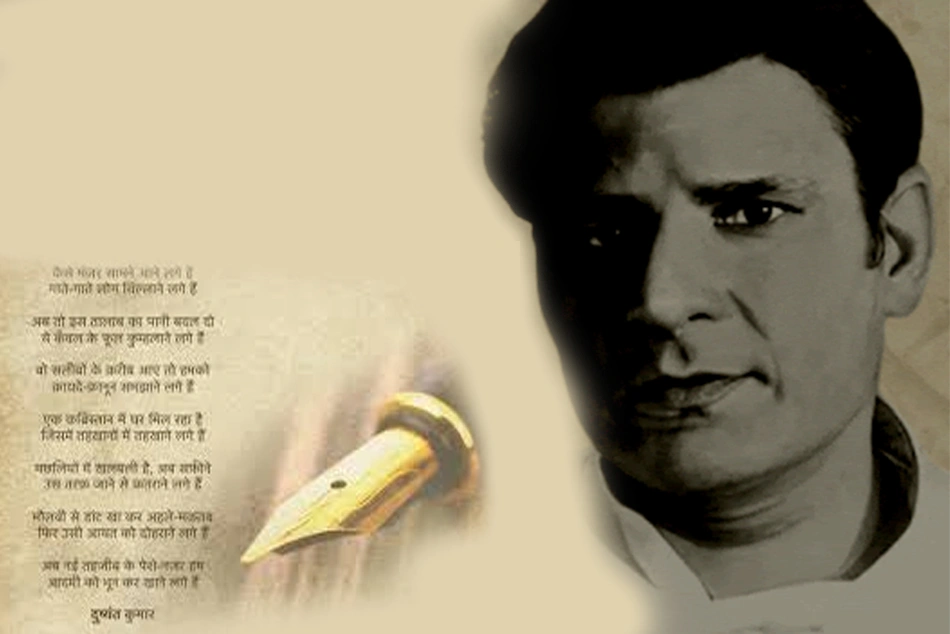
Kahan to tay tha chiragan har ghar ke liye/Kahan chrag mayassar nahin shahar ke liye/Yahan darakhton ke saaye mein dhoop lagti hai/Chalo yahan se chalen aur umr bhar ke liye. (Once it was decided: light for every home/Now not a lamp for the entire city./Here in the very shade of trees, the sun still scorches/Let us walk away from this place, once and for all, for a lifetime.)
Fifty years have passed since the death of Dushyant Kumar (September 1, 1933 – December 30, 1975). His 50th death anniversary can be an opportunity to examine his creativity afresh. This important task calls for seminars on various aspects of his works and for serious critical engagement with the same. No such concerted effort was visible in 2024-2025 in the literary circles; it is to be hoped that something of the kind will materialise in 2025-2026. This is necessary so that Dushyant's works do not become mere fodder for the ongoing ‘tamasha fest’ that grips public discourse in the country.
I had the opportunity to attend 'Dushyantnama' a program organized in Delhi under the joint auspices of Dr. Rajendra Prasad Academy and Sahitya Varta on 29 January. The program had three sessions. In the first session, critical articles on Dushyant Kumar’s poems and ghazals were presented and discussed; in the second, six students (four girls two boys) from Jamia and Delhi Universities performed ‘Rangpath’ (dramatic recitation) of some of his ghazals; and in the third session was a Mushaira/Kavi-sammelan.
I was pleasantly surprised by the young talents who participated in the second session. They gave a wonderful dramatic reading of Dushyant Kumar's ghazals, as if they had internalized the nuances and rhythm of Dushyant Kumar's ghazals while juxtaposing them with the stark realities of the present. The impact of recitation of ghazals on the audience was profound. Noteworthy too was the fact that none of the students belonged to Hindi or Urdu departments. Dushyant Kumar's intention behind his transition from New Poetry (Nayi Kavita) to the world of ghazals - to share the pain of millions of people of his time directly, in their own language and verse – continues to bear fruit among young readers.
Dushyant Kumar lived only for 44 years and a few months. (His actual date of birth is 27 September 1931.) Had he lived a few more years, he could have expanded the modern, progressive sensibility inherent in New Poetry to a far wider audience of ordinary readers principally through his ghazals. Dushyant Kumar's quarrel was with the abstruseness and monotony of New Poetry, not with New Poetry itself. In the preface to his ghazal collection 'Saaye Mein Dhoop' (Sunlight in the Shade), he suggested that he would not mind treating the Hindi ghazal as a genre of New Poetry.
It's not that the new sensibility at the heart of New Poetry was indifferent to the plight of the helpless ordinary person. Dushyant Kumar didn't want to confine that concern to literary and artistic debates alone. He advocated for its direct and shared expression, which was only possible in the language spoken and understood by the people - a blend of Hindi and Urdu. While he may have developed a fondness for ghazals through the verse of Shamsher Bahadur Singh, he had long admired the poetic language and style of Bhawani Prasad Mishra.
As Dushyant Kumar himself acknowledged, ghazal didn't simply descend upon him; he had been quietly experimenting with the form for some 25 years. Even without a formal grounding in Urdu, he had sought to understand the rich tradition of the Urdu ghazal. He had certainly absorbed the lesser-known tradition of the Hindi ghazal, even as he enriched it. In Kamleshwar’s words:
“It's not that we have no tradition of the ghazal genre; it is found in works from Amir Khusro to Bharatendu, Nirala, Shamsher Bahadur Singh and Balbir Singh 'Rang'. Yet, despite those poets, the ghazal never became the primary genre of the Hindi poetic tradition. Dushyant, for the first time - after the tragedy of Partition and the stigma of being a traitor to Urdu, presented the shared heritage of Hindi and Urdu in his ghazals with honesty and courage. This is a historic, literary, and heroic feat.”
By building a bridge between Urdu and Hindi ghazal, Dushyant gave Hindi ghazal a new meaning and identity. In his ghazals, the experience of life resonates through the poet with a tremor, like a bridge shaking as a train passes over it – Tu kisi rail si gujarti hai/Mein kisi pul sa thartharata hun. (You glide by like a roaring train - I tremble like a bridge under that rush.) Perhaps that is why a large readership was so deeply moved by his ghazals; and why those ghazals became slogans and refrains at protest sit-ins and processions. Shamsher Bahadur Singh warmly welcomed the new voice and expression that Dushyant Kumar brought to the Hindi ghazal. Dushyant, in fact, enriched both the traditions - Urdu and Hindi - while imparting a new meaning to Hindi ghazal.
Dushyant acknowledges his commitment to human beings, not to any party. Yet he is by no means an apolitical writer; he is a politically engaged writer in his capacity as a concerned citizen of independent India – one eager to become the voice of millions: Mujh mein rahate hain karodon log chup kaise rahun/Har ghazal ab saltant ke naam ek bayan hai. (Within me dwell millions whose silence I cannot restrain - every poem now is a manifesto addressed to the empire.)
A true political writer is never a pessimist, and neither is Dushyant Kumar. He intensely desires change in the status quo and recognizes even feeble signs of change – Aaj yah deevar parde ki tarah hilne lagi, /Shart lekin thi ki ye buniyad hilni chahiye. (Today this wall began to shake like a curtain/But the condition was that this very foundation should shake.) In the tattered bag of an impoverished Indian, there is a constitution –Samaan kuchh nahin hai phatehaal hai magar/Jhole mein usake paas koi samvidhan hai. (Worn, ragged, he owns nothing - yet in his tattered bag he clutches a constitution.) Through that very Constitution, Dushyant urges: Ab to talab ka pani badal do/ye kamal ke phool murjhane lage hain. (This pond’s stale water now/The lotus blooms are wilting and spent.)
Instead of changing the water of the pond, the country's political and intellectual elite chose in 1991 to alter the Constitution itself. Since then, they have been engaged in the acrobatics of making the pond’s stagnant water appear fragrant and golden with the incense and lamps of new imperialism and communal fascism. As a result - Ab kisi ko bhi najar aati nahin koi darar/Ghar ki har deewar par chipke hue hain ishtahar. (No one notices any peeling crack - advertisements have plastered the wall of every home.) To cover the cracks, there is now a dazzling array of glossy printed and digital advertisements, far more than before. In the current deceptive debates surrounding the Constitution, such ghazals of Dushyant Kumar are even more relevant to the contemporary reader than ever.
Dushyant Kumar had a premonition of the Emergency. As early as 1972, he wrote: Pahle bhi is phizan mein koi kam ghutan na thi/Mausam bahut kharab hua chahta hai ab. (Not that this air offered no measure of suffocation before/ But now the season itself resolves to turn truly foul.) Dushyant regarded the Emergency an attack on the freedom of the country and its citizens.
Several of Dushyant Kumar's colleagues, including Kamleshwar, have noted that Dushyant Kumar was deeply disturbed throughout that period. It is no coincidence that most of his ghazals were written in 1974-75. Today, when talk of an undeclared emergency is commonplace in political and social circles, Dushyant Kumar's ghazals and other works deserve to be read and analysed afresh.
Consider this couplet: Ek budha adami hai mulk mein ya yon kahen/Is andheri kothri mein ek roshandan hai. (There is an old man in this land - or perhaps, within this shadowed cell, a small window still lets light in.) When the administration demanded an explanation from him about the ‘old man’ in his ghazal - whom he described as a shaft of light in a dark room, the astute Dushyant Kumar saved himself from official wrath by naming Vinoba Bhave than Jayaprakash Narayan.
A few years ago when Dushyant Kumar had written the poem ‘Sooli Par Ishwar’ (God on the Cross) to condemn a police firing in Jagdalpur, he explained to the state's Chief Minister, Dwarika Prasad Mishra – himself a poet - that such a poem writes itself. The explanation worked, and Dushyant Kumar escaped administrative action. He was, however, warned against writing anti-government poetry while in government service. Had he attempted a similar gambit over the Emergency poem, he would very likely have been arrested. And then, perhaps, the story of the heart attack that claimed him on the night of 29-30 December might have been different!
(The author, Prem Singh, is a former teacher of Delhi University and a fellow of Indian Institute of Advanced Study, Shimla)
Follow ummid.com WhatsApp Channel for all the latest updates.
Select Language to Translate in Urdu, Hindi, Marathi or Arabic