I Knew Them: Tim Carstairs and The Unfinished Work
Remembering Tim Carstairs, who passed away on 6 January 2015, is not an exercise in nostalgia, it is a way of measuring the distance between the standards he helped shape and the realities we still face
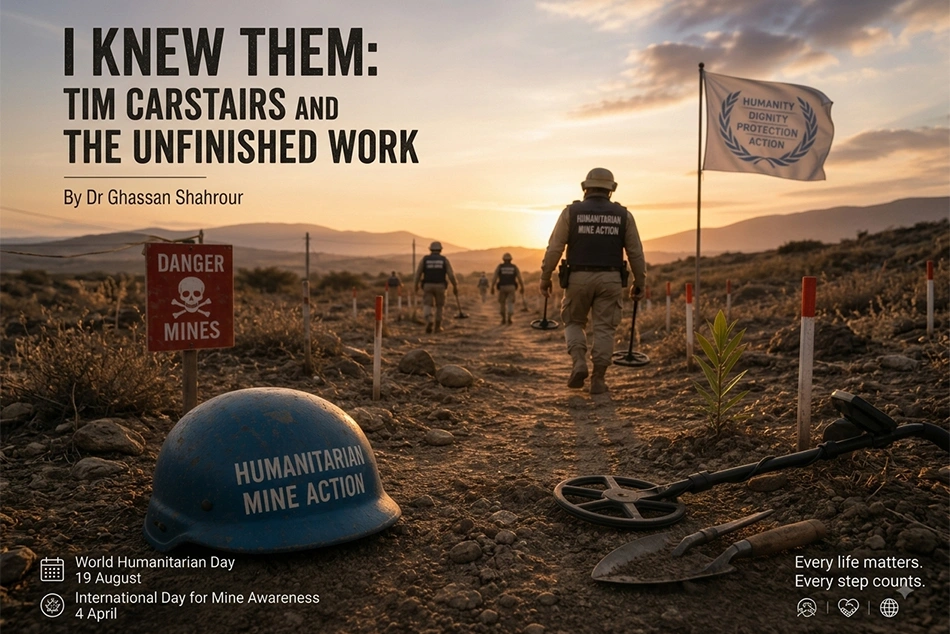
World Humanitarian Day 2026 on 19 August and the International Day for Mine Awareness on 4 April form a single moral arc. Together they remind us that humanitarian action is not defined by dates on a calendar, but by the responsibilities that continue long after each commemoration ends. These two days call for one message: protection is not symbolic, and remembrance must lead to results.
On 19 August, the world honors humanitarian workers and the communities they serve. On 4 April, it confronts the deadly legacy of landmines and explosive remnants of war. Both days point to the same truth. Humanitarian duty begins with respect for life, but it is measured by the urgency with which we act to prevent harm. Remembering Tim Carstairs within this combined frame is not an act of ceremony. It is a reminder that the standards he helped define apply every day of the year, and that unfinished work remains a shared responsibility.
Every year, 4 April, the International Day for Mine Awareness and Assistance in Mine Action, asks the world to pause and reflect. But in the field of humanitarian mine action, remembrance alone is never enough. It must become an obligation: a commitment to confront what remains unfinished.
I think of Tim Carstairs, who passed away on 6 January 2015, on this day and on 19 August. Remembering him is not an exercise in nostalgia. It is a way of measuring the distance between the standards he helped shape and the realities we still face.
Tim was part of the founding generation of the International Campaign to Ban Landmines, contributing to its creation in October 1992. He worked with Humanity and Inclusion, the Mines Advisory Group, the UK Working Group on Landmines, and Geneva Call during a formative period for humanitarian mine action. At a time when the field was still defining its purpose, he helped articulate a simple but demanding principle: civilians should not be left to live and die with the remnants of war beneath their feet. For him, mine action was never merely technical. It was a moral responsibility rooted in human dignity.
His work across Syria, Lebanon, Palestine, Iraq, and other affected countries reflected this conviction. He carried himself with quiet authority, grounded in respect for the communities he served. I remember him in Khan Arnaba, Quneitra, Syria, in 2005, opening his remarks in Arabic. It was not a performance. It was a statement of principle: if we do not meet people where they are, we cannot claim to protect them.
Our paths crossed often, in the Meetings of States Parties to the Ottawa Treaty, at the Sharjah International Conference on Landmines and Remnants of War on 8 and 9 December 2003, which I organized, and through the work of the Landmine Monitor. These gatherings were never ceremonial for us. They were meant to turn commitments into measurable protection, to ensure that treaties translated into safety for real people in real places.
Yet the gap between commitment and delivery remains stark.
More than 60 countries and territories are still contaminated by landmines and explosive remnants of war. Thousands of civilians are killed or injured each year, many of them children. Clearance progresses unevenly. Funding fluctuates in ways that do not match the scale or duration of contamination. Survivor assistance is too often treated as an afterthought. In several conflicts, new contamination is being created faster than old contamination is being cleared.
This is not a failure of knowledge. It is a failure of urgency.
The norm established by the Ottawa Treaty still stands, but norms alone do not clear a field, restore a livelihood, or protect a child taking a single wrong step. Norms without action become comfort, and comfort becomes complacency.
If we are serious about honoring those who built this field, then certain responsibilities can no longer be optional. Clearance must accelerate where contamination is known. Compliance must be enforced as obligation, not treated as preference. Engagement with non state actors, through mechanisms such as Geneva Call, must expand. And survivors must be recognized as a central measure of success, not a residual concern.
Tim’s passing on 6 January 2015 was quiet, like the departures of many humanitarian workers whose contributions continue to shape the protection of civilians long after they are gone. His legacy is not in the past. It is in the standards he helped define and in the work that remains unfinished.
That is why 19 August and 4 April should not reassure us. They should unsettle us. Because remembrance, without correction, risks becoming complicity.
I knew Tim.
He did not work for remembrance.
He worked for results.
And if we are honest, the results are not yet enough.
[Dr. Ghassan Shahrour, Coordinator of Arab Human Security Network, is a medical doctor, prolific author, and human rights advocate specializing in health, disability, disarmament, and human security. He has contributed to global campaigns for peace, disarmament, and the rights of persons with disabilities. I Knew Them is a recurring cultural editorial written by him.]
Follow ummid.com WhatsApp Channel for all the latest updates.
Select Language to Translate in Urdu, Hindi, Marathi or Arabic