Nehru Centre develops smart tech to detect Alzheimer's disease
Scientists at the Jawaharlal Nehru Centre for Advanced Scientific Research (JNCASR), an autonomous institute of the Department of Science and Technology in Bengaluru, have developed a smart fluorescence lifetime-responsive probe which enables highly selective, sensitive, and differential detection of Aβ fibrils (Aβf) through turn-on fluorescence and distinct lifetime signatures
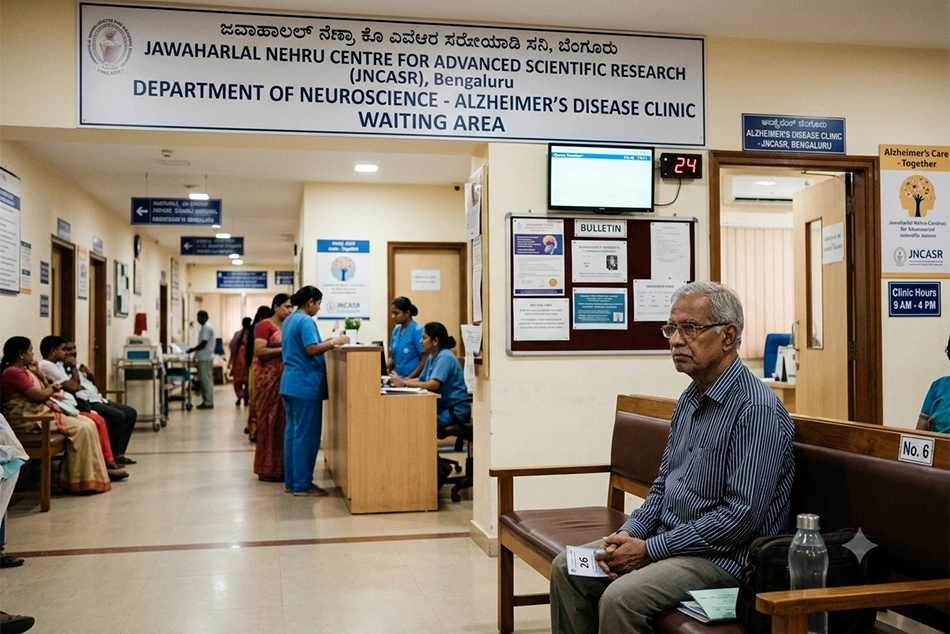
Scientists at the Jawaharlal Nehru Centre for Advanced Scientific Research (JNCASR), an autonomous institute of the Department of Science and Technology in Bengaluru, have developed a smart fluorescence lifetime-responsive probe which enables highly selective, sensitive, and differential detection of Aβ fibrils (Aβf) through turn-on fluorescence and distinct lifetime signatures.
The probe called TZ-48 published in the journal ACS Chemical Neuroscience exhibits excellent BBB permeability, robust labelling of Aβ plaques in transgenic AD mouse brains, and compatibility with confocal laser scanning microscopy (CLSM) and FLIM for quantitative mapping of Aβ burden across disease stages. Beyond tissue imaging, TZ-48 enables sensitive detection of Aβ in CSF and blood serum, accurately distinguishing AD from healthy mice, Union Ministry of Science & Technology, New Delhi said.
About Alzheimer's Disease
Alzheimer's Disease or AD is a progressive neurodegenerative disorder characterized by memory loss, cognitive decline, and behavioural impairment. Central to its pathology is the misfolding and aggregation of amyloid-β (Aβ), which self-assembles into fibrils and deposits as extracellular plaques that trigger neurotoxic cascades leading to synaptic dysfunction and neurodegeneration.
The National Institute on Aging-Alzheimer’s Association (NIA-AA) framework identifies Aβ, tau, and neurodegeneration as core biomarkers for definitive AD diagnosis across brain, cerebrospinal fluid (CSF), and blood. Importantly, Aβ pathology is an early and AD-specific biomarker, making Aβ a more reliable diagnostic indicator.
Although positron emission tomography (PET) and magnetic resonance imaging (MRI) provide valuable diagnostic information, their high cost, need for specialized infrastructure, technical expertise, and limited accessibility restrict widespread use.
Blood-based assays targeting Aβ and tau, have emerged as promising alternatives, but are expensive and complex. These limitations highlight the need for simple, sensitive, scalable diagnostic platforms capable of early and accurate detection of Aβ for AD diagnosis.
Fluorescence lifetime imaging microscopy
Fluorescence lifetime imaging microscopy (FLIM) has emerged as a powerful sensing modality because fluorescence lifetime is largely independent of probe concentration and photobleaching, enabling robust detection of biomarkers and enhancing diagnostic precision.
To facilitate clinical translation, the JNCASR scientists consisting of Krithi K. Bhagavath, Madhu Ramesh, Yogendra Kumar, Sabyasachi Mandal, Hiriyakkanavar Ila and Thimmaiah Govindaraju developed ADxFluor, a smartphone-integrated platform leverages the fluorescence response of TZ-48 for rapid, unbiased quantification of serum Aβ load.
The system combines dual-mode brain imaging, biofluid detection, and smartphone-based quantification of Aβ in biofluids, establishing it along with ADxFluor, a smartphone-integrated platform as a foundation for next-generation smart diagnostics for AD and other neurodegenerative diseases.
The integration of TZ-48 with the smartphone-based ADxFluor platform further establishes a portable, low-cost, and user-friendly point-of-care diagnostic system, representing a significant technological and translational innovation in AD diagnostics.
Follow ummid.com WhatsApp Channel for all the latest updates.
Select Language to Translate in Urdu, Hindi, Marathi or Arabic