Why The FCRA Debate Should Concern Every Indian?
India could lose something more fundamental if it gets the FCRA question wrong: the autonomy of the institutions through which minorities and citizens organise themselves outside the state
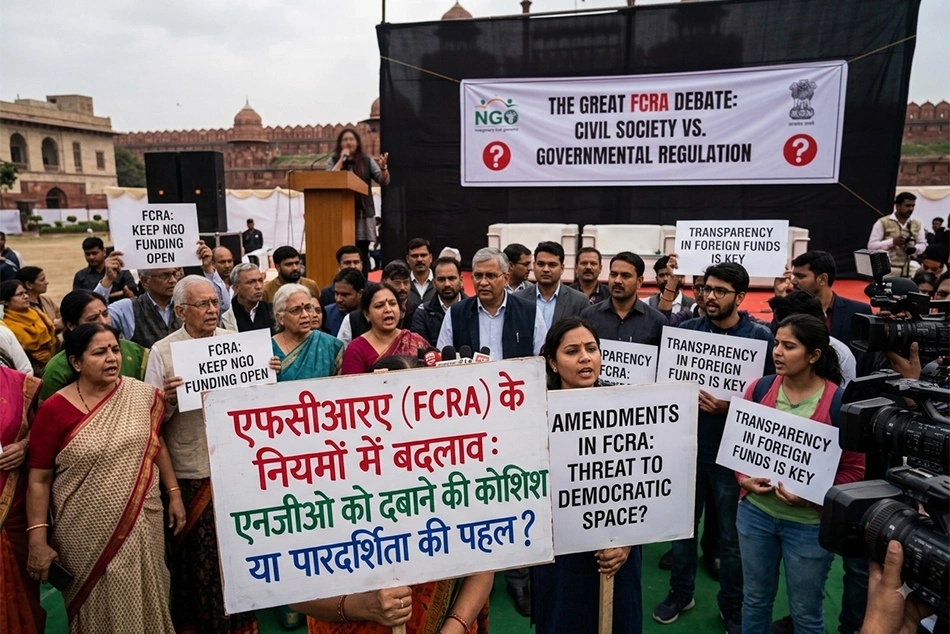
There are moments when a piece of legislation appears technical but is, in fact, deeply political. The Foreign Contribution (Regulation) Act, or FCRA, is one such law. On the surface, it concerns foreign money entering India. Every sovereign country has a legitimate interest in knowing who sends money into the country, who receives it, how it is used and whether it is being diverted for unlawful purposes. No serious defence of civil society requires the state to abandon financial accountability.
But the FCRA has increasingly ceased to be merely a law about financial transparency. It has become part of a much larger struggle over the autonomy of civil society, the freedom of association, the constitutional rights of minorities and, ultimately, the limits of executive power.
The controversy has acquired a new urgency with the Foreign Contribution (Regulation) Amendment Bill, 2026. The Bill was introduced in March and, after mounting opposition, was referred by the Lok Sabha on August 12 to a 31-member Joint Parliamentary Committee. The committee is expected to report before the first week of the Winter Session. Opposition parties have described the Bill as an attack on minorities and NGOs, while the government maintains that its purpose is national security, transparency and prevention of misuse of foreign funds.
The referral to a parliamentary committee is welcome. But it should not be mistaken for the end of the controversy. It is precisely the moment when the country should ask a more fundamental question: What kind of civil society does the Indian state want?
From Regulation to Control
The FCRA regime has already produced a remarkable contraction in the number of organisations able to receive foreign contributions. The government’s own FCRA portal currently lists 13,297 active registrations, 20,871 cancelled registrations and 14,004 expired registrations. The figures are not themselves proof that every cancellation was arbitrary; organisations can lose registration for legitimate reasons. But the scale tells us that the FCRA is no longer a marginal regulatory instrument. It is a powerful mechanism for determining which institutions can continue to participate in a significant part of India’s associational life.
The distinction between regulation and control is therefore essential.
Regulation asks an organisation to disclose its accounts, identify donors, maintain records, submit returns and demonstrate that money has been used for lawful purposes. Control begins when the state acquires broad discretionary powers to determine whether an organisation may continue receiving resources at all, whether its registration will be renewed, where it may operate, what activities it may undertake and what happens to assets accumulated during its lawful existence.
The 2026 Bill takes this question into particularly sensitive territory. It proposes a framework for the supervision, management and disposal of foreign contributions and certain assets of organisations whose FCRA registration ceases. The proposed architecture has generated concern precisely because cancellation or non-renewal can have consequences extending beyond the foreign money itself to the institutional assets associated with the organisation.
This is where the constitutional question begins.
An NGO is not merely a recipient of foreign currency. A charitable organisation may own a building, run a school, operate a hospital, maintain a training centre, employ hundreds of people and provide services to thousands of citizens. A religious organisation may have developed institutions over generations. If the financial regulatory status of such an institution becomes the gateway through which the state can determine its institutional future, regulation begins to acquire a different character.
The state is no longer merely asking, “Where did the money come from?”
It begins to ask, in effect, “Should this institution continue to exist in its present form?”
That is a much more serious constitutional question.
The Christian question cannot be dismissed
The most immediate anxiety has been expressed by Christian organisations. Catholic bodies, Christian NGOs and church representatives have urged the Centre to reconsider or withdraw the proposed legislation, arguing that it could severely restrict religious and charitable organisations dependent upon foreign contributions. Church organisations have nevertheless welcomed the referral to the JPC as an opportunity for clause-by-clause examination and consultation. Christian groups in the Northeast have similarly welcomed the parliamentary scrutiny.
Their concern should not be caricatured as a demand for immunity from financial regulation.
Christian institutions occupy a distinctive place in India’s social history. Missionary and church organisations have established schools, colleges, hospitals, nursing institutions, social-service centres, programmes for vulnerable communities and humanitarian initiatives across some of the country’s poorest and most remote regions. Much of this work is not confined to Christians. It serves people irrespective of religion.
This is precisely why the FCRA question cannot be reduced to a question about foreign funding of religious bodies.
If a hospital serves the poor, does its social contribution become less legitimate because part of its institutional financing comes from abroad? If a school educates children from communities with little access to quality education, does its educational character disappear because it receives international charitable support? If a humanitarian organisation assists people during disasters, does the origin of its philanthropic resources automatically transform its work into a threat to national sovereignty?
Obviously not.
The proper question is whether the money is lawful, whether it is properly accounted for and whether the organisation complies with the law.
The danger begins when the regulatory mechanism becomes so intrusive that legitimate institutions are forced to organise their existence around the fear of losing governmental permission.
India is not simply regulating money. It is regulating institutional autonomy. This distinction becomes particularly important when we consider the Constitution.
Constitutional Guarentees
The Article 25 of the Indian Constitution protects freedom of conscience and the right freely to profess, practise and propagate religion, subject to constitutionally permitted restrictions. Article 26 protects the right of religious denominations, subject again to public order, morality and health, to establish and maintain institutions for religious and charitable purposes and to manage their own affairs in matters of religion.
Articles 29 and 30 take the question further into the cultural and educational sphere. Article 29 protects the right of sections of citizens to conserve their distinct language, script and culture, while Article 30 expressly guarantees religious and linguistic minorities the right to establish and administer educational institutions of their choice.
These rights do not create a constitutional sanctuary in which minority institutions are beyond regulation. They do, however, establish a constitutional presumption against the state becoming the ultimate arbiter of whether minority institutions can exercise their legitimate autonomy.
That is the distinction we must preserve.
A school may be inspected. Its accounts may be audited. Its employees may be protected by labour law. A hospital may be subject to health regulations. A charitable organisation receiving foreign contributions can and should be required to account for every rupee.
But regulation must remain regulation.
If the cumulative effect of financial rules is to make an institution’s survival dependent upon the executive’s continuing satisfaction, the state has entered a different constitutional territory.
The Supreme Court’s 2022 FCRA judgment makes one point very clear: There is no fundamental right to receive foreign contributions. That proposition is important and should be acknowledged honestly. The FCRA recipients cannot claim an absolute constitutional entitlement to foreign donations.
But that does not settle the entire constitutional question.
The absence of a fundamental right to receive foreign money does not mean that every consequence attached to the denial of that money is constitutionally irrelevant. The institutions receiving such money may simultaneously exercise other protected rights—freedom of association, religious freedom, educational rights, charitable activity and minority institutional rights.
The state may regulate the financial channel without acquiring an unlimited power over the institution itself.
The danger is institutional attrition
The greatest danger may not be that thousands of Christian schools and hospitals suddenly close their doors.
That is not the most plausible scenario.
The danger is slower, and therefore, more difficult to see.
An organisation loses its registration. Another cannot secure renewal. A third decides that accepting foreign funds is no longer worth the administrative risk. A fourth abandons a politically sensitive programme. A fifth restructures itself simply to survive regulatory scrutiny. An organisation that once advocated for the rights of vulnerable communities begins to avoid advocacy because it fears being labelled political.
None of these developments necessarily produces a dramatic headline.
But together they change civil society.
The result can be a country in which civil-society organisations remain technically legal but become increasingly cautious, financially fragile and politically dependent.
That is institutional attrition.
And institutional attrition can be more consequential for democracy than outright prohibition because it is less visible. There is no dramatic banning of civil society. There are merely fewer organisations capable of challenging power, documenting abuses, defending unpopular communities, undertaking independent research or providing services where the state itself is unable or unwilling to do so.
This is why the FCRA debate should concern everyone, including people who have never received a foreign contribution.
Why should the BJP be uncomfortable with its own legislation?
The government has a legitimate argument that foreign funding can be abused and that India cannot permit foreign money to undermine national security or democratic institutions. No responsible government can simply ignore that possibility.
But there is a fundamental difference between preventing foreign interference and treating independent civil society as a potential instrument of foreign interference.
A democracy requires citizens to associate independently of the state. Universities, churches, mosques, temples, trade unions, professional associations, charities, human-rights groups, environmental organisations, women’s organisations and community institutions form part of the social architecture through which citizens participate in public life.
They are not foreign governments merely because some of their resources originate outside India.
Indeed, the government’s own decision to send the Bill to a JPC suggests that it understands that the issue has become politically and institutionally sensitive. The government had already sought to reassure Christian representatives that the proposed changes would not operate retrospectively. The subsequent referral followed strong opposition in Parliament and objections from Christian and civil-society organisations.
This is not necessarily “dragging its feet”.
It may be something more strategic.
The BJP government can retain the central principle of tighter control while allowing parliamentary consultation to absorb the political pressure. It can amend provisions that have generated the greatest alarm without abandoning the larger direction of the legislation.
That would be politically understandable.
But it would not answer the constitutional question.
Why are minorities especially vulnerable?
The answer lies partly in the structure of Indian civil society.
Minorities do not possess only individual rights. The Constitution recognises the importance of institutions through which communities sustain their religious, cultural and educational identities.
When an institution loses financial autonomy, its community may lose more than money. It can lose the ability to determine priorities, sustain programmes and preserve institutional traditions.
This is particularly important for Christians because many Christian institutions have historically combined religious identity with a broad public-service mission.
The same constitutional principle, however, must apply to Muslims, Sikhs, Buddhists, Jains, Parsis and linguistic minorities.
The issue should therefore never be framed as a special privilege for Christians.
It is about whether minority institutions have meaningful constitutional autonomy.
If one minority’s institutions can be weakened through financial regulation today, another minority may face similar pressures tomorrow.
And beyond minorities lies the larger population of civil-society organisations whose work does not fit comfortably into the preferences of the government of the day.
The state must not become the proprietor of civil society
There is a deeper political theory behind this controversy.
A democracy consists of more than the state and the individual. Between the individual citizen and the government exists an entire intermediate world of institutions. These institutions enable people to organise, educate, worship, care for the vulnerable, defend their rights and articulate dissent.
When those institutions become financially dependent upon the state, the balance of democratic power changes.
The citizen may remain formally free, but the organised capacity of citizens to act independently begins to diminish.
This is why the FCRA should not be viewed merely through the language of “NGO regulation”.
The real question is whether the state is becoming the gatekeeper of organised citizenship.
There is an important difference between a government saying, “You must account for your money,” and saying, “Your continued ability to receive resources, operate programmes and retain institutional assets depends upon a regulatory system over which the executive possesses extensive discretion.”
The first is accountability.
The second risks becoming dependency.
And democracy cannot remain healthy if civil society must constantly negotiate its survival with the executive.
What the JPC must examine
The Joint Parliamentary Committee (JPC) now has an opportunity to do something more substantial than simply modify the most controversial clauses.
It should examine whether every new power is necessary, proportionate and subject to meaningful judicial and parliamentary oversight. It should ask what happens to legitimately acquired institutional property when an FCRA certificate is cancelled or not renewed. It should establish clear safeguards against arbitrary or politically motivated action. It should insist upon transparent reasons for adverse decisions and effective opportunities for appeal.
Most importantly, the Committee should examine the cumulative effect of FCRA regulation on constitutional freedoms.
A provision that appears innocuous when read by itself can become oppressive when combined with renewal requirements, restrictions on activities, scrutiny of office-bearers, banking controls, asset provisions and the possibility of cancellation.
Constitutional rights cannot be assessed clause by clause alone. They must also be assessed by their cumulative effect upon institutional freedom.
That is the test the JPC should apply.
The real issue is not foreign money
There is an easy political temptation here.
The government can portray its critics as defenders of foreign influence. Its opponents can portray every FCRA restriction as proof of an anti-minority conspiracy.
Both approaches are inadequate.
India does need financial transparency. It needs protection from foreign interference. It needs strong mechanisms against money laundering, fraud and political manipulation.
But it also needs an independent civil society.
These are not contradictory objectives.
The state can demand accounts without demanding obedience. It can investigate wrongdoing without assuming that dissent is wrongdoing. It can regulate foreign contributions without treating every foreign-funded institution as a potential enemy. It can protect national security without converting minority institutions into objects of administrative suspicion.
That balance is the essence of constitutional democracy.
Will India lose its minority services?
Not necessarily. But India could lose something more fundamental if it gets the FCRA question wrong: the autonomy of the institutions through which minorities and citizens organise themselves outside the state.
The Christian community’s anxiety should therefore not be dismissed as a narrow community grievance. It should be heard as an early warning about the relationship between government and civil society.
If Christian hospitals, schools and charities become financially weakened, the immediate victims may be poor patients, children, students, women and vulnerable communities who depend upon their services. But the longer-term victim would be the plural institutional character of India itself.
A democracy does not prove its commitment to minorities merely by allowing them to vote.
It proves it by allowing them to build institutions, sustain communities, educate their children, practise their faith, serve society and disagree with the government without fearing that their institutional existence can be placed at risk.
That is why the FCRA matters.
The question before India is not whether foreign money should be regulated. It should.
The question is whether regulation will remain a means of accountability or become an instrument of political control.
The difference is the difference between a constitutional state and an administrative state that increasingly demands obedience from the society it governs.
The FCRA debate therefore deserves to escape the narrow vocabulary of “NGOs”, “foreign funding” and “national security”. At its heart lies a much more consequential question:
Who owns civil society—the citizens who constitute it, or the state that licenses it?
If the answer gradually becomes the latter, India may retain elections, Parliament and constitutional language while losing one of democracy’s most important foundations: a society capable of organising itself independently of power.
And that is a danger far greater than the loss of foreign contributions.
It is the possible loss of institutional freedom itself.
[The writer, Ranjan Solomon, has worked in social justice movements for close to 58 years. After this period of working with oppressed and landless and small farmers, workers, urban poor locally, nationally, and internationally, he has now turned author-researcher and freelance writer focussed on questions of global and local justice struggles. Ranjan Solomon is particularly tied in close solidarity with the Palestinian struggle for freedom from Israeli occupation, and the cruel apartheid system since 1987. Ranjan Solomon can be contacted at ranjan.solomon@gmail.com.]
Follow ummid.com WhatsApp Channel for all the latest updates.
Select Language to Translate in Urdu, Hindi, Marathi or Arabic