Madhya Pradesh govt urged to withdraw UCC Bill or exclude Muslims from it
'Withdraw the Madhya Pradesh Uniform Civil Code (UCC), Bill 2026, or exclude Muslims from it', the Bhopal Shahar Qazi Maulana Syed Mushtaq Ali Nadvi declared, adding that interference in personal laws is unacceptable as it affects religious freedom
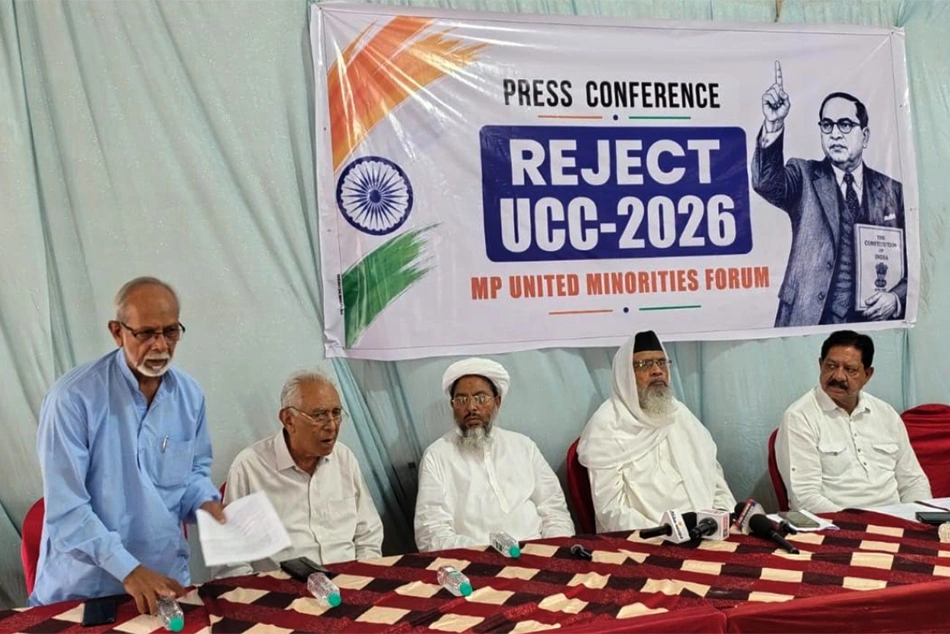
[At joint Press Conference Bhopal Shahar Mufti Maulana Abul Kalam Qasmi (3rd from left), Bhopal Shahar Qazi Maulana Syed Mushtaq Ali Nadvi (4th from left) along with Christian religious leader Anil Martin ( 5th from left) seated on the dais.]
Bhopal: "Withdraw the Madhya Pradesh Uniform Civil Code (UCC), Bill 2026, or exclude Muslims from it," the Bhopal Shahar Qazi Maulana Syed Mushtaq Ali Nadvi declared, adding that interference in personal laws is unacceptable as it affects religious freedom.
The above announcement was made by Bhopal Shahar Qazi Maulana Mushtaq Nadvi at a joint Press conference attended by Bhopal Shahar Mufti Abdul Kalaam Qasmi, Fr. Anil Martin along with Bhopal’s legal luminaries Adv. Syed Sajid Ali and Adv. Mohammad Mahir.
The Bhopal Shahar Qazi said:
"He has been speaking out against this draconian law since day one. He is not acting under pressure from anyone. Those making accusations should understand that we can respond to what we are doing. Our legal panel is also preparing to go to court."
He stated:
"The UCC affects Muslim personal law and will impact the religious and legal freedom of Muslims."
He added:
"The Muslim community has always followed its personal laws regarding marriage, inheritance, wills and other personal matters. If the 21 per cent tribal community can be excluded from the UCC, then the 6 per cent Muslim community should also be excluded, he asserted."
Shahar Qazi pointed out that he along with Bhopal Shahar Mufti Abdul Kalaam Qasmi had submitted a memorandum to the Madhya Pradesh Assembly Speaker Narendra Singh Tomar in this regard after the Bill was passed by the House.
Meanwhile, Bhopal Shahar Mufti Maulana Abul Kalam Qasmi said that the Muslim community considers Islamic Sharia as divine laws. According to him, as long as any law does not conflict with the Qur’an and Hadith, Muslims abide by it, but when interference in private life and religious principles is made then it is absolutely inappropriate.
The MP United Minorities Forum has also opposed the current UCC Bill 2026 and demanded exemption for Muslims and other minority communities. The forum is of the view that the Constitution guarantees religious freedom and cultural identity, therefore, the religious sentiments of all communities should be respected in the UCC.
Christian leader Anil Martin raises concerns
Meanwhile, the Christian religious leader Anil Martin raised concerns over religious freedom during the press conference saying that even prayer and worship conducted inside homes are increasingly being questioned on allegations of religious conversion.
Martin said the Indian Constitution guarantees citizens the right to practice their religion. He claimed that Christian families often invite relatives and acquaintances to their homes for prayer on occasions such as birthdays and wedding anniversaries, but alleged that complaints and accusations of conversion are sometimes made when prayers or religious songs can be heard outside.
Concerns Over Home Prayer
Martin said such incidents were affecting religious activities, including what he described as “house church” gatherings. He argued that individuals should not face restrictions for carrying out religious activities within their homes.
He also questioned what he described as differing attitudes towards religious practices in public and private spaces, and said religious freedom should be protected equally for members of all communities.
Call for wider consultation
On the proposed UCC, Martin said legislation covering sensitive issues such as marriage, divorce, inheritance and live-in relationships should be preceded by wider public consultation.
He called for the views of women's organizations, tribal communities, religious groups, legal experts and civil society organizations to be considered before provisions affecting personal and family matters are finalized.
Martin also expressed concerns about government intervention in matters involving personal life and privacy. He raised questions about provisions concerning registration of live-in relationships and criminal consequences in certain family-related matters.
‘Community Fears Legal Action’
Responding to questions about why the Christian community has reportedly been less vocal than some other groups in opposing the UCC, Martin said many members of the community prefer to avoid police stations, courts and prolonged legal disputes.
He claimed there was apprehension that raising objections could lead to cases or administrative action. At the same time, he said representatives of the community were continuing to communicate their concerns to the government through constitutional means.
Constitution Cited
Martin referred to Articles 14, 19, 21 and 25 of the Constitution while seeking protection of equality, personal liberty, life and religious freedom.
“We are concerned that our religious freedom is being taken away,” he said.
The comments came amid wider debate over the proposed Madhya Pradesh UCC Bill 2026, with religious representatives and legal experts from different minority communities raising questions about its potential impact on personal laws, privacy and religious practices.
Confusion
Meanwhile, after the passage of the UCC Bill 2026 in the Madhya Pradesh Assembly confusion circulated among the Muslims in Bhopal that the UCC Bill debars marriages of some relatives including cousins among themselves. This led to a mad beeline rush in Bhopal Qaziat to get the Nikah performed between cousins before the Bill becomes an Act and comes into force. The Nikah applications in Bhopal Qaziat which was about 30-40 on a daily basis swelled and crossed the 200-250 mark per day.
However, later Dr. Sanawar Patel, Chairman of M.P. Waqf Board, stepped in and got a clarification issued by the ruling BJP Government that the UCC Bill does not intent to debar some relatives including cousins marriages among themselves. The confusion occurred due to lacuna in Hindi translation of Section 4(4) of the UCC Bill. Thereafter, the situation has returned to normal practice which prevailed before the “ghost” of the Bill 2026 arrived on the scene.
Meanwhile, Governor of Madhya Pradesh Mangubhai C. Patel after keeping the MP UCC Bill pending with him for a month has forwarded it to the President of India for assent. Thus, the Bill is presently awaiting Presidential approval.
While according to media reports reaching here said that Muslims men and women both holding allegiance to various community welfare organizations, in about 50 districts headquarters of the state submitted memorandums to the District Collectors addressed to the President of India urging to withhold assent to the UCC Bill 2026 and return it back to the State Government.
Follow ummid.com WhatsApp Channel for all the latest updates.
Select Language to Translate in Urdu, Hindi, Marathi or Arabic