MP: UCC Final Draft submitted amid protests, opposition
The High-Level Committee constituted to examine the feasibility of implementing the Uniform Civil Code (UCC) in Madhya Pradesh has submitted the final draft to the state government amid protests and opposition.
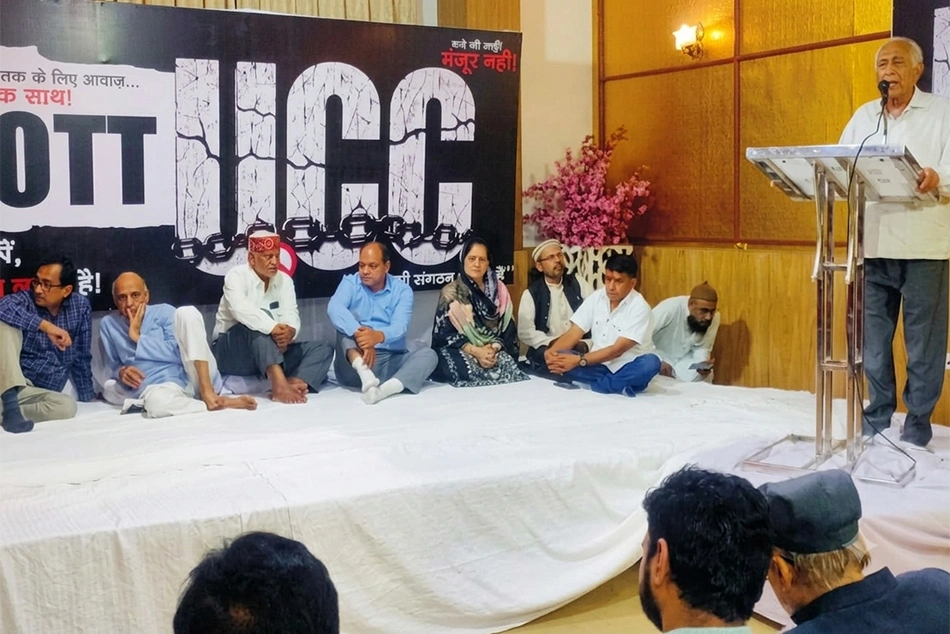
[Muslim social organizations holding protest meeting on Madhya Pradesh Uniform Civil Code (UCC) in Bhopal.]
Bhopal (Madhya Pradesh): The High-Level Committee constituted to examine the feasibility of implementing the Uniform Civil Code (UCC) in Madhya Pradesh has submitted the final draft to the state government amid protests and opposition.
Mandatory registration of live-in relationships and a share in children's property for both parents are among the key recommendations in the UCC draft, submitted to the state government on Monday July 13, 2026 evening.
Meanwhile, various social organizations of Muslims in Bhopal and the state have formed a Joint Action Committee (JAC), to oppose the implementation of UCC on them including Christians, tribals and other communities.
Madhya Pradesh UCC At a Glance
The Madhya Pradesh Uniform Civil Code draft is based on the Gujarat model. It includes provisions relating to marriage, maintenance, divorce and the property rights of adopted children.
Besides other things, the proposed UCC also makes registration of live-in relationships mandatory. If a live-in relationship is not registered, it will be considered a crime. Under the proposed registration of live-in relationships, one copy of the registration will go to the concerned police station and another to the parents.
Children born out of a live-in relationship will be entitled to a share in their parents' property even if the partners separate. If a partner deserts the woman in a live-in relationship, she may seek maintenance from the partner.
Another major recommendation in the Madhya Pradesh UCC relates to succession law, under which, along with the mother, the father will also be entitled to a share in the property of a son if the latter dies.
Currently, only the mother is considered eligible for a share in a deceased son's property, which is also divided equally among the deceased's wife and children. In other words, the mother and father have been made a single unit for claiming a share in the property of their children.
This, according to the proposal, will help address situations in which fathers received nothing in old age following the death of a son. In effect, parents have been entitled to a share in the property of their children.
Three Parts of the UCC
The UCC final draft has been prepared in three parts.
- The first part includes the UCC committee's recommendations
- The second contains the UCC Bill
- The third embodies public opinion collected at three stages, including district-level and state-level consultations, along with suggestions received through the website.
The state cabinet will meet at Jagdishpur, formerly known as Islam Nagar, on July 19, 2026 when it is likely to approve the final draft of the UCC.
The UCC Bill is then expected to be tabled during the Assembly Session beginning on July 20, 2026. After its passage in the Assembly, it will be sent to the President for assent. The state government will then frame the rules under the new law. Madhya Pradesh will become the fourth state to implement the UCC after Uttarakhand, Gujarat and Assam.
Muslims form Joint Action Committee to oppose UCC
Meanwhile, various social organizations of Bhopal and the state have formed a Joint Action Committee, under the auspices of which a large program was organized in the state capital, Bhopal, on Sunday July 12, 2026. Representatives and speakers of various organizations participated in the program, calling the proposed law against the prevailing system and diversity of the country.
During the program, the speakers raised strong objections and said that an attempt is being made to implement the new law by talking about equality, but in it, tribals, SCs, STs and minorities are being completely sidelined.
They said that a deliberate attempt is being made to separate the Muslim society, in particular from Sharia, and this attitude of arbitrariness and stubbornness will never be tolerated.
The speakers said that the Muslims of India have stayed in this country by choice (of their own free will) and their elders have also shed their blood for the country's independence. "When he did not go to a country where he had complete religious freedom at the time of partition, why would he accept to live under such restrictions in his own country today?" the speakers asked.
"Politcally Motivated"
Addressing the important convention, former Director General of Police (DGP) M. W. Ansari said that the subject of the UCC is definitely included in the guiding principles of the Constitution. "But before implementing it, it is necessary to have extensive discussions and consensus building with all communities and stakeholders", he said.
M. W. Ansari clarified that the impact of the proposed UCC will not be limited to the Muslim society, but it can also have a profound impact on the traditions and personal laws of Christians, tribals and other communities.
He advised the government that if it really wants to promote equality, then basic issues like social justice, economic inequality, employment and education should be given equal priority. During his address, the former DGP also accused the Rashtriya Swayamsevak Sangh (RSS) and the Bharatiya Janata Party (BJP) of pushing forward the UCC for political purposes.
Addressing the meeting, Qazi Syed Anas Ali Nadvi said that the subject of the UCC is not limited to marriage, divorce or inheritance, but should be considered a broader issue related to religious freedom and personal laws. "India’s diversity and pluralistic traditions are its true identity; therefore, it is important to take all parties into confidence before deciding on any law", he said.
He appealed to the people to express their views peacefully and democratically and said that all opposition will be done within the ambit of the Constitution and the law. He said that various programs will be organized in the future to increase public awareness on this subject.
Other speakers in the program also registered their objections to the proposed UCC outline and discussed the strategy of holding district level meetings, drafting memorandums and conducting public awareness campaigns. Senior advocate Syed Sajid Ali, former mayor Deepchand Yadav, popular poet Vijay Tiwari, AIMIM Madhya Pradesh provincial president Mohsin Ali Khan, Touqeer Nizami, Hafiz Mujahid Ali Khan, Muhammad Mahir and Sarwat Zaidi along with a large number of office bearers and leaders of various organizations were present on the occasion.
Follow ummid.com WhatsApp Channel for all the latest updates.
Select Language to Translate in Urdu, Hindi, Marathi or Arabic