Alzheimer’s Disease: The Earlier We Know, The More We Can Do
Alzheimer disease is one of the most common, but vascular dementia, dementia with Lewy bodies, frontotemporal dementia, and mixed conditions are part of the picture
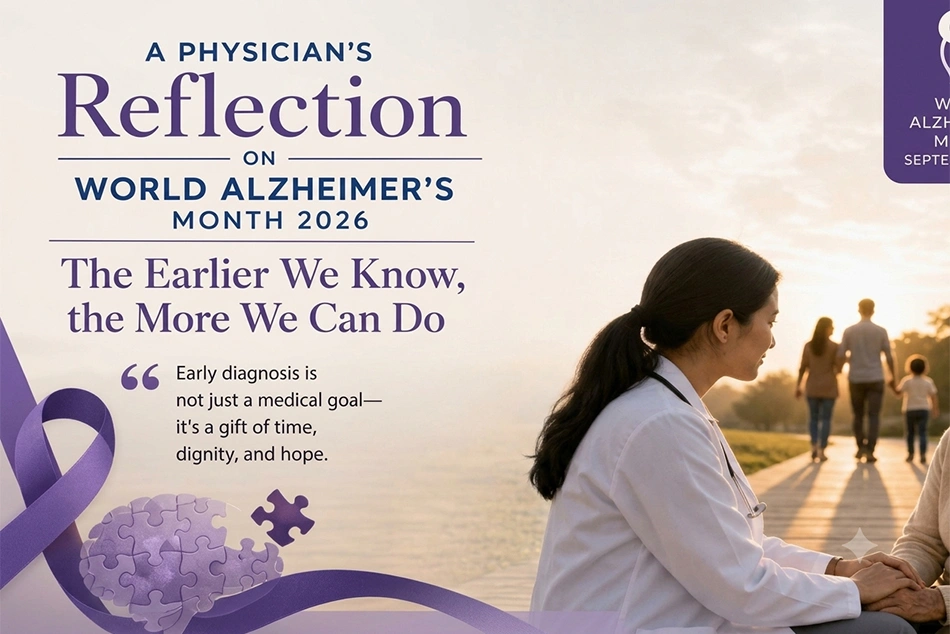
There is a truth people sense long before they dare to name it: dementia does not begin the day a person forgets a name or loses their way home. The biological changes that lead to some forms of dementia may start years before clinical symptoms appear. They may emerge quietly: a repeated question, a word that suddenly feels out of reach, difficulty managing tasks once handled with ease, or withdrawal from conversations once filled with confidence.
Dementia is not a single disease. It is a syndrome with multiple possible causes. Alzheimer disease is one of the most common, but vascular dementia, dementia with Lewy bodies, frontotemporal dementia, and mixed conditions are part of the picture. Early detection is not about searching for Alzheimer disease in every instance of forgetfulness. It is about noticing meaningful change, understanding its cause, and giving the person a chance to receive appropriate evaluation and care.
Between normal cognitive aging and dementia lies a stage called Mild Cognitive Impairment (MCI). For some people, MCI is a transitional phase. For others, it remains stable. Recognizing this stage helps families and clinicians respond to change without unnecessary fear and without harmful delay.
Yet many health systems still treat dementia as a condition that deserves attention only when symptoms become severe. Families often hesitate to name what they see, as if acknowledging the truth means surrendering hope. But science tells a different story.
Science that helps us see what we fear to notice
Diagnostic tools have advanced significantly. Several methods are now used depending on the clinical situation:
- Blood based biomarkers, including p-tau217 and the A beta 42/40 ratio, can support the evaluation of Alzheimer disease but do not diagnose dementia on their own.
- Magnetic Resonance Imaging (MRI), including multiparametric techniques, can reveal structural changes and help rule out other causes.
- Cognitive assessments such as the Montreal Cognitive Assessment (MoCA) and Mini Mental State Examination (MMSE) can identify cognitive impairment and help estimate its severity.
- Digital cognitive assessments can help detect or track changes at home or in the clinic.
- Cerebrospinal fluid biomarkers can be used selectively when greater diagnostic certainty is needed.
None of these tools is a final verdict. A good diagnostic process begins with the person: their story, their changes, their family’s observations, and clinical examination. Science is not a substitute for humanity. It is a way to understand it more clearly.
Fear: When silence becomes part of the problem
One of the hardest moments is when a daughter says to her father, “We have noticed you are forgetting things more than before.”
Equally difficult is the moment a clinician tells someone that what they are experiencing needs evaluation, knowing that the word dementia can weigh heavier than the condition itself.
Fear is everywhere: fear of diagnosis, fear of losing independence, fear of long term follow up, and fear of its cost.
But delaying the truth does not erase it.
And what we see may not be dementia at all. Changes can come from depression, sleep disorders, medication effects, or other treatable conditions. Early detection is not a judgment but an opportunity to understand what is happening. If a disease is present, early detection allows planning, support, and intervention at a time when the person can still participate in decisions about their life.
Where early detection begins
Within the family
Early detection often begins with someone who knows the person well: a spouse noticing difficulty managing finances, a son hearing the same question repeated, or a granddaughter noticing withdrawal.
Sometimes the person themselves feels something has changed but hides it out of fear of losing independence.
These observations do not automatically mean dementia. But persistent or impactful change deserves evaluation.
Home based tools such as the Self Administered Gerocognitive Examination (SAGE) or digital cognitive tests can be a starting point. They are not a diagnosis. They are a signal to pay attention.
Within the health system
A primary care clinic should be a place where questions begin, not a waiting room for advanced symptoms.
A humane early detection pathway includes:
- A suitable cognitive assessment.
- A medical evaluation to rule out treatable causes.
- Biomarker testing or imaging when appropriate.
- Referral to a specialist when needed.
The goal is not to test everyone. The goal is to build a humane pathway:
Observation -> Assessment -> Understanding -> Care.
Early detection without a care pathway can turn knowledge into fear. Early detection with support turns knowledge into agency.
The person before the diagnosis
Behind every laboratory result is a human being. Not a dementia case. A father, mother, spouse, friend, or teacher. A person with memories, roles, and dreams.
When change is recognized early, the person can participate in decisions about their care, plan for the future, express their wishes, organize legal and financial matters, benefit from treatment, and, if eligible, participate in research and clinical trials.
Early detection is not about naming a disease sooner. It is about giving the person more time to understand, choose, plan, and receive support.
Dementia is not the end of the person
Dementia may alter memory, ability, and dependence, but it does not erase human value.
Our responsibility is clear: to see the person before the disease, to listen before we judge, to explain before we frighten, and to use science to protect dignity, not reduce a human being to a label.
Early detection is not simply faster diagnosis. It is a chance for life, choice, and preserving what can be preserved of independence and dignity.
[Dr. Ghassan Shahrour is a prolific author, physician, and civil society advocate whose work spans medicine, public health, and humanitarian action. He founded the Syrian Alzheimer’s and Memory Association and advocates for dementia awareness, compassionate care, and quality of life, with research and international engagement focused on hearing and memory in older adults.]
Follow ummid.com WhatsApp Channel for all the latest updates.
Select Language to Translate in Urdu, Hindi, Marathi or Arabic