A Simple Nikah is Blessed Nikah: Bringing Down The Cost of Muslim Weddings
Imams and community elders can help by praising simple weddings openly, conducting Nikahs, as the Sunnah of the Prophet ﷺ, in the masjid without fuss, and speaking about the Sunnah of the Walima in Friday sermons
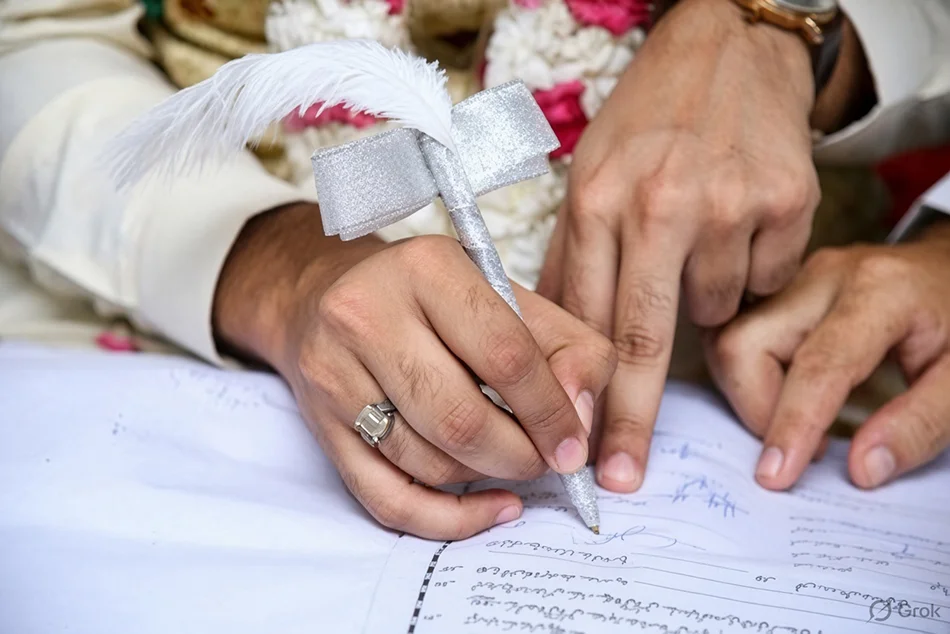
In many Indian Muslim families, saving for a daughter's wedding begins years before anyone has proposed. Parents set money aside for jewellery, furniture, gifts for the groom's family, a large hall and a meal for hundreds of guests. When the time comes, many still borrow. Others quietly delay the marriage until the money is there.
None of this is required by Islam.
The Nikah the Prophet ﷺ taught is one of the simplest contracts in the Shariah, and the celebration around it was meant to be within a family's means. Returning to that simplicity would make it easier for young people to marry, and it would lift a heavy burden from parents.
What the Nikah actually requires
At its core, a Nikah needs the consent of the bride and groom, the Mahr given by the groom to the bride, witnesses, and, according to most scholars, the bride's Wali. It can be done in a home or a masjid in a matter of minutes. Nothing in it requires a hall, a set menu, a dowry or new furniture.
The Prophet ﷺ made this clear in practice. When a poor Companion wanted to marry and could not find even an iron ring to give as Mahr, the Prophet ﷺ married him on the basis of the Quran he had memorised, which he was to teach his wife (Sahih al-Bukhari 5135). The marriage was valid, and it was blessed. Poverty was not treated as a reason to delay it.
How the Prophet ﷺ celebrated
Islam does encourage celebrating a marriage. The Walima, the meal given by the groom after the Nikah, is a Sunnah. But look at how it was done.
When Abdur-Rahman ibn Awf (RA), who later became one of the wealthiest Companions, told the Prophet ﷺ that he had married, the Prophet ﷺ said to him:
"Give a banquet, even if with one sheep" (Sahih al-Bukhari 5167).
For a man of means, one sheep was enough.
The Prophet's own Walima for Safiyyah had neither meat nor bread. Leather mats were spread out, and dates, dried yoghurt and butter were placed on them. That was the whole wedding meal (Sahih al-Bukhari 5085). Anas ibn Malik (RA), who served the Prophet ﷺ for years, said that the best Walima the Prophet ﷺ ever gave, for his marriage to Zaynab (RA), consisted of one sheep (Sahih al-Bukhari 5168).
The Prophet ﷺ also warned against the kind of wedding meal that shows off:
"The worst food is that of a wedding banquet to which only the rich are invited while the poor are not invited" (Sahih al-Bukhari 5177).
The value of a Walima is in who is fed, not how much is spent.
The burden falls in the wrong place
In the Sunnah, the costs of marriage fall on the groom: the Mahr is his duty, and the Walima is his to host. In practice, many Indian Muslim families have reversed this. The bride's family is expected to provide furniture, appliances, clothes and cash, and to host a large dinner on top.
Even what the Prophet ﷺ gave his own daughter was modest. When Fatimah (RA) married Ali (RA) , the Prophet ﷺ fitted her out with a velvet garment, a water-skin and a pillow stuffed with a fragrant grass called idhkhir (Sunan an-Nasa'i 3384, graded sahih by Darussalam). That is a world away from a list of household goods demanded by the groom's side.
The Quran is direct about waste:
"And give the relative his right, and [also] the poor and the traveler, and do not spend wastefully. Indeed, the wasteful are brothers of the devils" (Surah al-Isra 17:26-27).
Debt taken on to impress guests at a wedding sits uneasily with this verse.
The real cost of expensive weddings
The money is only part of the cost. When weddings become expensive, young people marry later. Families with daughters feel pressure years in advance. Proposals stall over expectations rather than over character and Deen. And a couple who start married life in debt carry that strain into their first years together.
The Prophet ﷺ gave a principle that applies here as much as anywhere:
"Facilitate things to people, and do not make it hard for them" (Sahih al-Bukhari 69).
A wedding that a family cannot afford makes marriage hard.
Practical steps for families
Change rarely comes from one family alone, but every family that chooses simplicity makes it easier for the next. Some steps that help:
- Talk about the wedding early. Whether a couple meet through relatives, the local masjid or a marriage platform such as Pure Matrimony, both families can agree on a simple Nikah and Walima before the proposal goes any further, so that expectations never become a reason to delay.
- Agree the guest list first, and set the budget from it, rather than the other way round. A small Nikah with close family, followed by a modest Walima, fulfils the Sunnah completely.
- Hold the Nikah in the masjid. It is simple, it keeps the focus on the contract itself, and it lets the wider community share in the blessing.
- Let the groom's family host the Walima as the Sunnah intends, and keep it within their means. Invite people who would value the meal, not only those you wish to impress.
- Say clearly, and early, that no dowry is expected. A groom's family that does this openly sets an example others can follow.
- Spend on what lasts. Money saved on a single evening can help the couple set up their home or begin married life without debt.
Imams and community elders can help by praising simple weddings openly, conducting Nikahs in the masjid without fuss, and speaking about the Sunnah of the Walima in Friday sermons.
A blessing, not a burden
Marriage is meant to bring tranquillity, not anxiety. When a family keeps the Nikah simple, it is not cutting corners. It is following the Prophet ﷺ, protecting itself from debt, and making the path to marriage easier for everyone who comes after. The most memorable weddings are rarely the most expensive ones. They are the ones where the couple begin their life together with gratitude, and without a burden.
[The writer, Subhan Ullah, works in digital PR at Pure Matrimony, a marriage platform for practising Muslims, and writes on Muslim marriage and family life.]
Follow ummid.com WhatsApp Channel for all the latest updates.
Select Language to Translate in Urdu, Hindi, Marathi or Arabic