How to Read India’s Latest Unemployment Rate?
The Periodic Labour Force Survey (PLFS) Annual Report for 2025, released in March, puts India’s unemployment rate at 3.1%, next to most large economies, that looks remarkable.
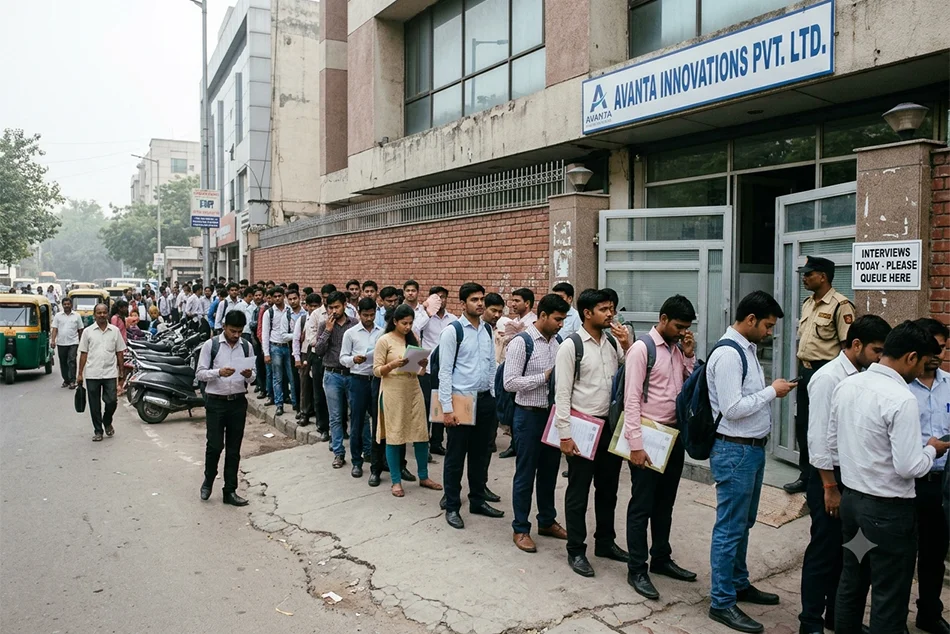
Every new labour survey brings a headline that reads like a victory lap. The Periodic Labour Force Survey (PLFS) Annual Report for 2025, released in March, puts India’s unemployment rate at 3.1%. Next to most large economies, that looks remarkable. Yet for students approaching graduation, the number can seem to describe a different country.
In a sense, it does. The headline figure is an average across very different groups of people, and it conceals the part that matters most for those under 30.
Look beneath the average
The same survey puts unemployment among people aged 15 to 29 at 9.9%, and among urban youth at 13.6%, more than four times the national figure. Among people aged 15 and above with at least secondary education, it is 6.5%, more than double the overall rate. Unemployment, in other words, is concentrated among the young and the educated, the very people on whom India’s growth ambitions rest.
Part of the explanation is that unemployment is something of a luxury. A person with little schooling and no savings cannot afford to go without work, so they take whatever is available, however poorly it pays. A graduate with family support can afford to wait for a better job, and so shows up in the unemployment count. Low measured unemployment among the poor does not mean they are doing well. It means they cannot afford to stop working.
The unemployment rate also has a blind spot. It counts only people in the labour force, that is, those working or looking for work. The PLFS estimates that 25% of Indians aged 15 to 29 are not in employment, education or training (NEET): one in every four young people. This group includes some of the unemployed, but also many who are neither studying nor seeking work, often young women occupied with responsibilities at home, and most do not appear in the unemployment rate at all. A country can report low unemployment while a quarter of its young people are neither earning nor learning.
Then there is the quality of work. Only 23.6% of workers hold regular salaried jobs. Some 56.2% are self-employed, about a fifth are casual labourers, and 43% still work in agriculture. Much of this work is low-paid and low-productivity. On many farms and in many family enterprises, there are more hands than the work requires, which is what economists call disguised unemployment: output would barely fall if some of those workers left. The unemployment rate shows whether people found work. It does not show whether that work is productive or pays enough to live on.
More schooling, not enough skills
India has done well at getting people into classrooms. Among those aged 15 and above who have attended school, the average is about 10 years of formal education. But human capital theory holds that education raises productivity only when it builds skills that employers will pay for. Here the numbers are weak: only 5% of people aged 15 to 29 have received, or are receiving, formal vocational or technical training.
That makes this a structural problem, not a passing slump. Employers say they cannot find job-ready candidates; graduates say there are no jobs. Both can be true at once when degrees and jobs do not match.
To be fair, the 2025 survey does show some improvement over 2024: youth unemployment fell from 10.3% to 9.9%, unemployment among the educated from 7.0% to 6.5%, regular salaried work rose from 22.4% to 23.6%, manufacturing’s share edged up to 12.1%, and agriculture’s fell to 43.0%. But these are small shifts from a low base, and with manufacturing employing barely one worker in eight, growth alone will not create enough good jobs unless it becomes far more labour-intensive.
Women are the largest untapped pool. Female labour force participation stands at 40.0%, against 79.1% for men. Among women outside the labour force, 44.4% cite childcare or home-making as the main reason. A young population is a demographic dividend only if it is productively employed. Otherwise, it becomes a burden on families and on the state.
What should be done
There is no single magic scheme, but a few steps would help.
- Build apprenticeships into degrees: Colleges should include a paid internship or apprenticeship semester, with the stipend shared between government and employers. The National Education Policy 2020 already calls for vocational exposure and internships; the gap is in implementation, not ideas. Germany’s dual vocational system offers a useful model.
- Map skills district by district: Local industry and colleges need to talk to each other. A district built around a textile cluster needs different courses from one built around logistics. Industry representatives should sit on curriculum boards, so that colleges stop teaching skills nobody hires for.
- Back labour-intensive sectors: Textiles, footwear, food processing and small enterprises can absorb large numbers of young workers. Easier credit and simpler compliance for micro, small and medium enterprises would do more for jobs than another headline announcement.
- Make it easier for women to work: Affordable childcare, safe public transport and flexible working hours matter more than is often admitted. When nearly half the women outside the labour force point to care and household duties, the barrier is not a lack of willingness.
- Change what is celebrated: Governments and the media should report the NEET share, underemployment and youth unemployment alongside the headline rate, so that a single low number cannot hide a real problem.
The bottom line
The 3.1% figure is not wrong. It answers a narrow question, whether people who want work are finding some, and answers it accurately. What it cannot reveal is whether that work uses people’s education or pays them fairly.
If India wants its young population to be a dividend rather than a liability, the goal must shift from getting people into any job to getting them into decent ones. For millions of young Indians, that difference will decide whether their degrees become careers or remain certificates.
[The article has been jointly written by Devangi Dugar and S Susanthika. Devangi Dugar is a third-year B.Sc. Economics (Honours) student at the School of Social Sciences, CHRIST (Deemed to be University), Delhi-NCR. S Susanthika is an Assistant Professor, School of Social Sciences, CHRIST (Deemed to be University), Delhi-NCR. All figures are from the Periodic Labour Force Survey Annual Report, 2025 (January–December 2025), Ministry of Statistics and Programme Implementation.]
Follow ummid.com WhatsApp Channel for all the latest updates.
Select Language to Translate in Urdu, Hindi, Marathi or Arabic