India AI Impact Summit: A Reality Check
The India AI Impact Summit may not qualify as an outright failure, but it has certainly emerged as a cautionary tale
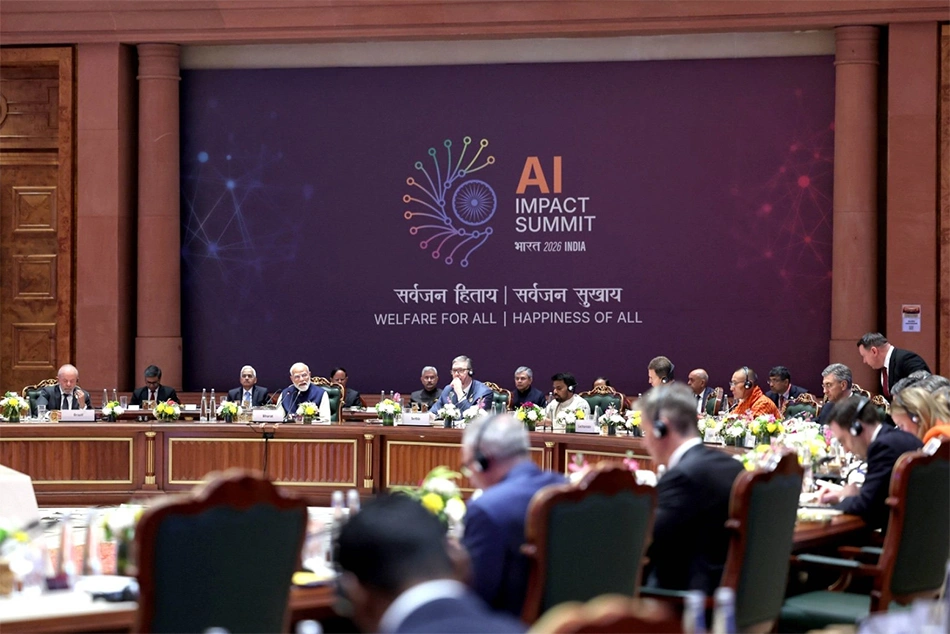
The India AI Impact Summit, currently underway in New Delhi (February 19, 2026), was envisioned as a defining moment for India’s Artificial Intelligence ambitions. Marketed as a landmark platform to showcase indigenous innovation, attract global stakeholders, and position India as a serious AI contender, the summit instead finds itself grappling with controversy, embarrassment, and criticism.
From chaotic crowd management to allegations of imported technology being passed off as domestic innovation, the event has triggered a larger debate:
Is India’s AI push being driven by substance—or by spectacle?
The Prime Minister’s visit, accompanied by heavy security protocols and what many perceived as a public relations exercise, reportedly led to genuine visitors being moved aside by officials raising further questions about priorities and optics.
Let us examine where the country stands in its global AI ambitions and where it continues to lag in ground reality.
A Chaotic Start: Optics Over Order
The summit’s troubles began on Day One, coinciding with the visit of Prime Minister Narendra Modi. What should have been a celebration of technological progress turned into confusion under heavy security protocols?
According to multiple attendees, AI enthusiasts, researchers, and genuine tech participants were asked to vacate sections of the venue during the Prime Minister’s walkthrough. The disruption reportedly to facilitate controlled visuals and VVIP movement left many questioning whether the event was designed for innovation or optics.
Ironically, while exhibitors and technologists were sidelined, only select corporate figures such as Akash Ambani were seen accompanying the Prime Minister, explaining AI installations and demonstrations. For many observers, the episode symbolized a troubling shift: public relations overshadowing public participation, disrupting even the internet connection out there.
The Robotic Dog Controversy: Innovation or Import?
The most viral controversy erupted around an exhibit by Galgotias University. A professor from the institution presented a robotic dog named “Orion,” claiming it was a university-developed innovation backed by a ₹350 crore investment.
However, social media users quickly identified the device as a commercially available Chinese-made Unitree Go2 robot. The revelation went viral, drawing mockery online including from Chinese social media accounts and raising serious questions about misrepresentation.
The backlash was swift. The university was reportedly asked to vacate its stall, and opposition leaders, including Rahul Gandhi, criticized the summit as a “disorganised PR spectacle,” alleging that imported Chinese products were being showcased as indigenous breakthroughs.
The episode struck at the heart of India’s AI narrative. If domestic innovation is to be celebrated, transparency must be non-negotiable.
Bill Gates’ Withdrawal: Optics Take Another Hit
Adding to the summit’s turbulence was the unexpected withdrawal of Bill Gates from his scheduled keynote address. The cancellation reportedly came amid renewed scrutiny surrounding his past association with Jeffrey Epstein.
While the withdrawal may have been unrelated to the summit’s organization, the timing amplified perceptions of instability and poor coordination. High-profile events rely heavily on marquee speakers to set tone and credibility. Losing one hours before a keynote session inevitably fuels speculation and damages optics.
Operational Failures: Crowd Control and Coordination Gaps
Beyond headline controversies, attendees pointed to broader operational lapses:
- Massive overcrowding on Day One
- Confusion around access and security briefings
- Disruptions during VVIP movements
- Lack of structured interaction spaces for startups and researchers
Many participants felt the event prioritized camera angles over collaborative dialogue. In an industry where precision, clarity, and systems thinking are foundational, visible disorder at a flagship AI summit sent mixed signals.
The PR vs. Progress Debate
The central criticism emerging from social media, policy commentators, and technology professionals is this:
Was the summit a genuine platform for advancing artificial intelligence, or was it primarily a branding exercise?
Critics argue that several imported demonstrations were presented as technological breakthroughs, raising concerns about authenticity and transparency.
They also contend that political optics overshadowed grassroots innovators who should have been the real focus of such a platform.
According to them, substantive discussions on crucial issues such as AI governance, indigenous chip development, data localisation, and long-term research funding were diluted by spectacle and public relations-driven moments.
Defenders, however, offer a different perspective.
They point out that large-scale, government-backed events are inherently complex to execute and often face logistical challenges. Bringing together policymakers, startups, academia, and investors under one roof, they argue, still creates long-term networking and collaboration opportunities. In their view, imperfections in execution do not necessarily negate the summit’s broader strategic intent.
Both arguments carry weight. Yet in the global technology ecosystem, perception is as significant as policy. How an event is received internationally can influence credibility, investor confidence, and the broader narrative around a country’s innovation ambitions.
The Larger Question: Can India Balance Ambition with Authenticity?
India undeniably possesses the talent pool, vast data scale, and startup energy required to emerge as a global leader in artificial intelligence. However, global credibility does not rest on potential alone. It depends on transparent showcasing of innovation, institutional integrity, policy clarity, and operational excellence especially in high-visibility public forums.
An AI summit is more than just a stage for announcements; it serves as a signal to the world about a nation’s seriousness and preparedness. If that signal appears disorganised, exaggerated, or overly theatrical, it risks weakening investor confidence and diluting the strength of the country’s broader technological ambitions.
India continues to lag behind China and the United States in research and development (R&D) investment due to a combination of lower spending relative to GDP, limited private-sector participation, and structural challenges in converting research investment into patents, commercialization, and scalable innovation.
Despite steady economic growth, India’s gross expenditure on R&D (GERD) has remained stagnant at around 0.6–0.7% of GDP for more than two decades. In comparison, China invests approximately 2.4–2.7% of its GDP in R&D, while the United States allocates nearly 3.5%. This persistent gap has impacted India’s global innovation standing—ranked 39th in the 2024 Global Innovation Index and constrained its ability to generate major technological breakthroughs across strategic sectors.
In absolute terms, the disparity is even more striking. India’s total R&D expenditure in 2024 stood at about $75.7 billion roughly one-tenth of China’s $785.9 billion and the United States’ $781.8 billion. China now accounts for 27.4% of global R&D spending, closely matched by the US at 27.2%, while India’s share remains at just 2.6%.
Although India’s R&D spending has tripled since 2000, it has not kept pace with China’s rapid surge where Beijing overtook Washington as the world’s top R&D spender in 2024—or with America’s consistently high investment levels. With global R&D growth projected to slow to 2.3% in 2025, India’s relatively low base further amplifies the challenge of closing this innovation gap.
Conclusion: A Wake-Up Call, Not a Failure
The India AI Impact Summit may not qualify as an outright failure, but it has certainly emerged as a cautionary tale. Grand ambition must be matched with grounded execution. In technology, authenticity matters. In governance, accountability matters. And in global positioning, consistency matters most. When optics begin to overshadow outcomes, even well-intentioned initiatives can risk losing credibility.
If anything, this episode offers an opportunity to recalibrate from hype to homework, from spectacle to substance, and from branding to building. In artificial intelligence, as in public life, credibility cannot be coded; it must be earned.
Turning such a platform into a public relations exercise ultimately proves counterproductive, especially when genuine innovators and technology enthusiasts feel sidelined by VIP-centric optics. An AI summit should amplify innovation, ideas, research, and collaboration—not reinforce a culture of symbolism over substance.
[The writer, Mohd Ziyauallah Khan, is a freelance content writer & editor based in Nagpur. He is also an activist and social entrepreneur, co-founder of the group TruthScape, a team of digital activists fighting disinformation on social media.]
Follow ummid.com WhatsApp Channel for all the latest updates.
Select Language to Translate in Urdu, Hindi, Marathi or Arabic