Manufacturing Consent: When Media Starts Interpreting Events
Manufacturing Consent is a crucial theoretical framework for understanding this very process, one in which consent does not emerge spontaneously, but is instead systematically engineered, and the media, those in power, and investigative agencies lie at the very center of this process
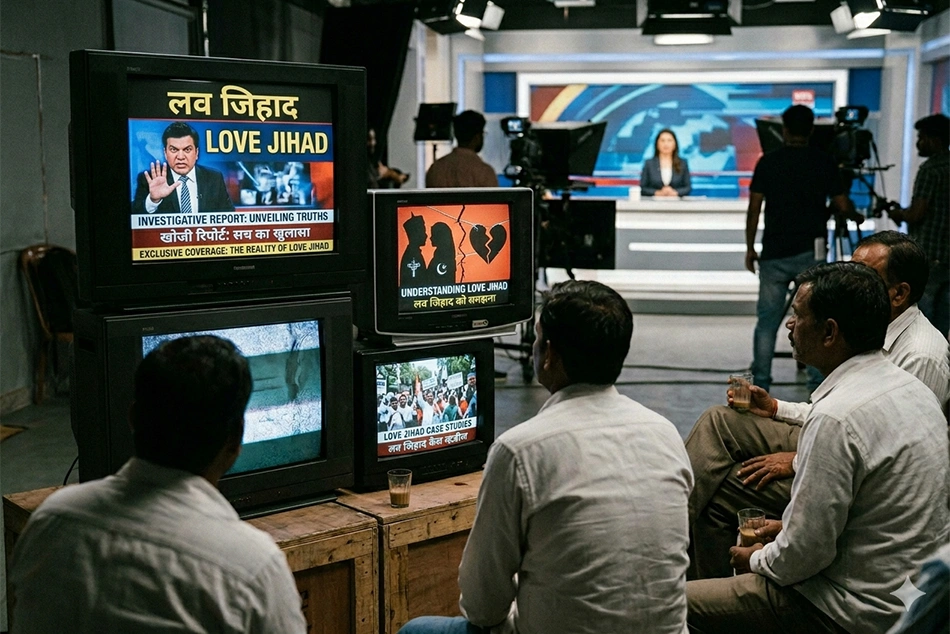
In today's world, the most pressing question is no longer simply "What is the truth?" but rather, "What are we being shown and told in the name of truth?"
"Is what we think the result of our own independent understanding, or is a specific narrative gradually constructed before us a narrative that, through repeated exposure, we eventually come to accept as reality?"
"Manufacturing Consent" is a crucial theoretical framework for understanding this very process, one in which consent does not emerge spontaneously, but is instead systematically engineered. The media, those in power, and investigative agencies lie at the very center of this process.
Media does not simply present events, it also interprets them
The above thoughts are that of Razia Masood, Bhopal-based Social activist, who in an analytical thought provoking write-up has expressed. She says emphatically that news stories are not merely collections of facts, rather, they are presented within a specific framework, as the role of framing is equally significant. The media does not simply present events, it also interprets them. The choice of words, images, and contexts can fundamentally alter how a story is perceived.
For instance, a group of people gathered on the streets might be characterized as "peaceful protesters" or an "unruly mob," depending on the narrative being advanced. This distinction is by no means trivial; it shapes emotional responses and influences public judgment. Framing operates in highly subtle ways, and audiences often remain unaware that their thinking is being steered in a particular direction.
Some issues are highlighted in such a way that they become the focal point of every discussion, while many significant questions are gradually relegated to the margins. This very selection of what to reveal and what to conceal shapes public perception. Consequently, the public begins to view matters through the very lens that has been consistently presented to them.
Razia Masood says in recent years, a recurring pattern has been observed: a continuous cycle of press conferences, arrests and TV debates surrounding an alleged scam or accusation. A single subject is reiterated day and night in such a manner that it begins to appear as the absolute truth. However, when with the passage of time, those very allegations lose their force or are dismissed, the question regarding the fate of the previously constructed narrative is not raised with the same vigor. Is the truth brought to light with the same intensity with which the allegations were disseminated?
In this context, a serious question concerning civil rights also arises. Former Chief Election Commissioner S.Y. Quraishi issued a warning regarding this, describing it as a "blow to the soul of Article 326." Article 326 of the Indian Constitution explicitly grants every eligible citizen the
How can a right be revoked when a final verdict has not yet been delivered?
right to vote, unless they have been duly disqualified. Despite this, instances have come to light where the names of a large number of people were removed from the electoral rolls while their appeals were still pending. This constitutes not merely an administrative oversight, but a violation of the fundamental principle of justice: "hear first, decide later."
The question is straightforward: How can a right be revoked when a final verdict has not yet been delivered?
This trend is not limited merely to the local or national level; examples of this nature also emerge on a global scale, where the expected transparency and accountability regarding serious issues are conspicuously absent. The case involving Jeffrey Epstein serves as a complex illustration of this phenomenon. Comprising over three million pages, these documents contain allegations regarding the exploitation of individuals purported to be victims of Epstein and Ghislaine Maxwell.
Within these documents, prominent figures including politicians are clearly implicated in instances involving the sexual abuse of children, torture and human trafficking. Since the public release of these files in 2025 and 2026, there have been no arrests in the United States in connection with this case save for a few resignations and the tarnishing of the reputations of certain high-ranking American officials, meanwhile, the widespread and sustained global discourse that might have been expected regarding this matter has failed to materialize with any significant clarity. This situation compels one to ponder whether every issue is accorded equal significance, or if, in certain instances, silence itself constitutes a deliberate strategy.
This is precisely where the concept of “Manufacturing Consent” becomes even more relevant. When it is determined which issues will dominate the headlines and which will not, what is actually being decided is the direction in which society will think. This is not merely a flow of information, but the construction of thought itself.
Selective construction of narratives
There is another serious aspect to this, the selective construction of narratives. For decades, certain communities or religions have been portrayed within a specific framework. Through the repeated reinforcement of a singular image, it has been rendered "normal" and "acceptable."
The consequence is that the perceptions formed in people's minds have come to be perceived as the absolute truth, regardless of how complex the actual reality may be. The impact of this is evident today on a global scale, where deep chasms of mistrust and hatred have emerged. In numerous instances, it has been observed that the identities of individuals implicated in crimes such as their names, religions, or backgrounds are selectively highlighted, whereas in other cases, this very information is not brought to the forefront with equal prominence.
This inconsistency raises the question of whether media representation is truly impartial, or if, in certain instances, it serves to reinforce a specific narrative. These points out not to genuine journalism, but rather to selective reporting whereas crime, by its very nature, should never be viewed through the lens of any specific community or identity.
Social media has further accelerated this process. Now, it is not just news, but trends as well that influence our thinking. Through algorithms, it is determined what we see, what we read, and which issues we react to. Often, this process is so subtle that we do not even realize the direction in which our thinking is being steered.
Furthermore, giving a religious or emotional spin to every issue in order to divide society is becoming an increasingly common strategy. As a result, real and substantive issues such as Education, Healthcare, Employment and Civil rights—take a back seat, while emotional debates take center stage. This not only undermines democratic discourse but also creates lasting divisions within society.
Who bears the responsibility for it?
In such a scenario, the most critical question is that of accountability. If public opinion is being influenced through the construction of a narrative, who bears the responsibility for it? Can the media, those in power, and institutions remain immune to this influence, or should they, too, be held accountable for it?
Democracy does not run on elections alone, it rests upon an informed citizens who do not merely act as consumers of information, but also possess the capacity to comprehend and question it.
Therefore, the greatest imperative today is that we do not blindly accept whatever is presented to us, but rather question everything that is served up without scrutiny. For ultimately, the path to truth is not an easy one, it often winds through questioning, dissent, and a ceaseless quest. And perhaps, this is the true hallmark of any healthy democracy, concludes Razia Masood.
Follow ummid.com WhatsApp Channel for all the latest updates.
Select Language to Translate in Urdu, Hindi, Marathi or Arabic