Jamiat Releases Critical Analysis of Babri Masjid Judgement
Jamiat Ulama-i-Hind, one of the largest representative bodies of the Indian Muslims, Saturday May 16, 2026 a detailed report titled 'A Critical Anlysis of Babri Masjid Judgement and The Places of Worship Act 1991'.
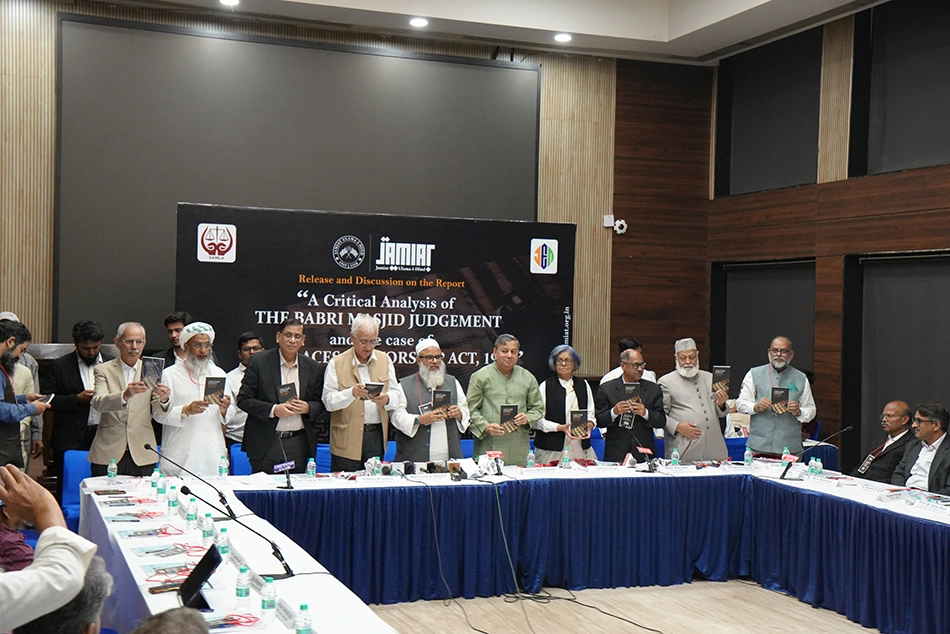
New Delhi: Jamiat Ulama-i-Hind, one of the largest representative bodies of the Indian Muslims, Saturday May 16, 2026 a detailed report titled 'A Critical Anlysis of Babri Masjid Judgement and The Places of Worship Act 1991'.
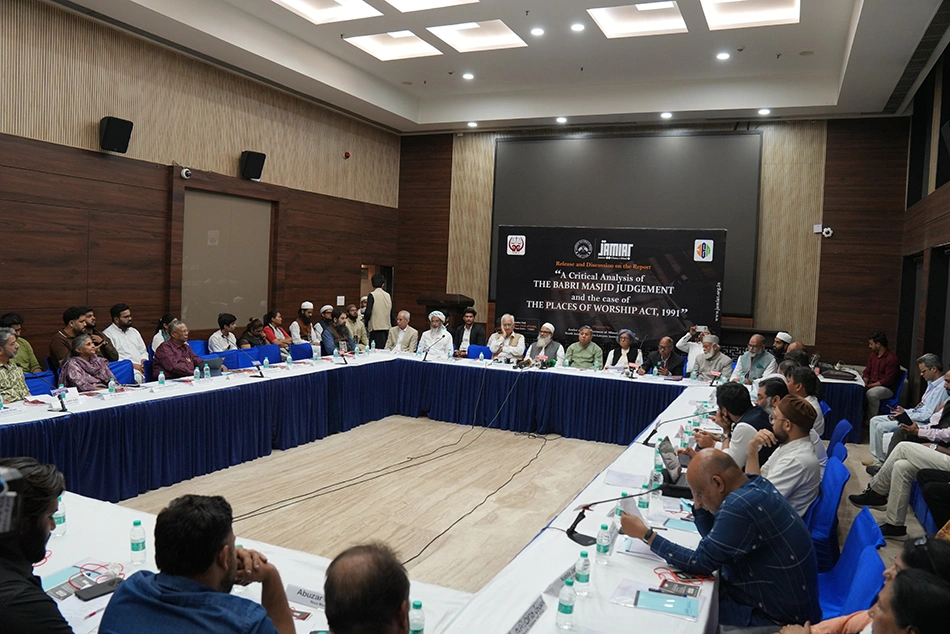
The detailed analysis of the Supreme Court's judgement on the babri Masjid demolition case and the places of worship act was released at an event organised by the Justice and Empowerment of Minorities Forum of Jamiat Ulama-i-Hind, in collaboration with the South Asian Minorities Lawyers Association (SAMLA)at the Deputy Speaker Hall, Constitution Club of India, New Delhi,
The programme was presided over by the President of Jamiat Ulama-i-Hind, Maulana Mahmood Madani, and attended by senior advocates, legal experts, former judges, and scholars from across the country.
What is in the report?
The Jamiat's report titled "A Critical Anlysis of Babri Masjid Judgement and The Places of Worship Act 1991" argues that the Places of Worship Act, 1991 holds central importance in protecting India’s secular structure, communal harmony, and constitutional stability by preventing the reopening of historical religious disputes.
The report presents a detailed analysis of the Supreme Court judgments, particularly the Ismail Faruqui case (1994) and the M. Siddiq (Ayodhya Verdict 2019), arguing that the interpretation in the Ismail Faruqui judgment, which stated that a mosque is not an essential part of Islam, had deep implications for subsequent cases.
The report recommends strict implementation of the Places of Worship Act, 1991, and strengthening the principles of secularism and religious equality.
Why the report?
Jamiat president Maulana Mahmood Asad Madani, in his keynote address after the release of the report, said that a serious and critical study of the Babri Masjid verdict was necessary so that future generations could understand how one section of society presented its perspective in an academic and constitutional manner. He described the report as a sincere effort to protect India’s secular identity, constitutional values, and communal harmony.
Referring to the Babri Masjid case, he stated that there was no conclusive evidence proving that the mosque had been built after demolishing a temple, a fact acknowledged by the Supreme Court itself in paragraph 788 and related portions of the judgment.
He further said that despite Muslims responding to the verdict with patience and constitutional commitment, fresh disputes concerning Gyanvapi, Mathura Eidgah, Kamal Maula Mosque, and other religious places were raised, turning the issue into a matter concerning India’s constitutional identity, judicial credibility, and the principles of justice.
Earlier, SAMLA Secretary General Advocate Firoz Ghazi in the welcome address remarked that history always honors those who stand for justice, integrity, and human dignity. He expressed hope that constitutional morality and the principle of Satyameva Jayate would ultimately prevail.
"Not a true judgment"
Former Patna High Court Judge Justice Iqbal Ahmad Ansari stated that the real strength of a judge lies in conscience, fearlessness, and commitment to justice, because justice suffers when judges succumb to fear.
Referring to the SC verdict on Babri Masjid case, he remarked that the court delivered merely a “decision,” not a true “judgment,” since a judgment requires sound reasoning, whereas a decision may simply reflect prevailing circumstances.
Senior Advocate Indira Jaising emphasized in her speech that the Babri Masjid verdict and the Places of Worship Act cases are not merely about one religious site or dispute, but concern the constitutional future of the country, equally affecting both Hindus and Muslims. She stressed that in a secular and democratic nation, the primary duty of judges is to decide cases according to the Constitution, law, and equality—not on the basis of religious belief.
Why Places of Worship Act 1991 is important?
Vice Chancellor of Chanakya National Law University Faizan Mustafa said that the Places of Worship Act, 1991, represents a constitutional effort to preserve the historical status of religious places in the country. However, he observed that the mere existence of a law is not in itself a complete guarantee.
"What is truly needed is the proper preservation of documents, historical records, and legal status relating to religious sites", he said.
He noted that while the court accepted several historical and legal aspects in the Babri Masjid case, there remains room for academic disagreement on certain observations. Therefore, he stressed the need for dialogue in resolving sensitive religious disputes rather than relying solely on judicial confrontation.
Senior Advocate M. R. Shamshad warned that attempts to weaken the Places of Worship Act or create new disputes through ASI-related legal mechanisms could prove dangerous for the country’s secular and constitutional framework. He stressed that constitutional rights should not remain confined to books but must be effectively implemented in practice.
"No proof of temple demolition"
Senior lawyer and former Union Minister of Law Salman Khurshid stated that a significant portion of the Babri Masjid verdict actually supports the Muslim legal position.
He pointed out that the ASI reports nowhere conclusively established that a temple had been demolished to construct the mosque. He further emphasized that sustainable solutions in the future can emerge not merely through legal or political means, but through dialogue, constructive engagement, and restoration of mutual trust.
Advocate Nizam Pasha said that mosques are symbols of the religious and historical identity of the Muslim community. He argued that the court accorded legal significance to the Hindu side’s belief, while the Muslim position was reduced merely to a place of worship, leading to debates over the essentiality of mosques in Islam. He added that although Muslims had fully presented arguments based on waqf and historical ownership, these important arguments were not discussed in detail in the judgment.
Also Read: 'Indian Judiciary has become a joke': Reactions on Babri Masjid Demolition Verdict
Advocate Ejaz Maqbool remarked that if any historical wrong has occurred, it must be remembered and acknowledged honestly. Appreciating the efforts of Jamiat Ulama-i-Hind, he said that the foremost challenge facing Muslims today is the protection of their constitutional rights, particularly religious and educational freedoms guaranteed under Article 30 of the Constitution.
Research scholar Dr. Nizamuddin Ahmad Siddiqui elaborated on the background and context of the report. Advocate Rauf Rahim emphasized that the ongoing struggle for the protection of waqf properties has become extremely necessary in the current circumstances, while Advocate Tahir M. Hakim stressed the importance of justice and fairness at every level.
Among others present at the programme were Jamiat Ulama-i-Hind General Secretary Maulana Mohammad Hakimuddin Qasmi, Secretary Maulana Niaz Ahmad Farooqui, Advocate Rubina Javed, former SAMLA President Advocate J. H. Jafri, Advocate Rukhsana Chaudhary, Advocate Tayaab Khan, Advocate Mohammad Nurullah, Advocate A. Sirajuddin, and Professor Hasina Hashia of Jamia Millia Islamia University, Prof Mujibur Rahman Jamia Millia Islamia, Ovais Sultan Khan, Dr Shabbir Mushtaq along with several distinguished lawyers and scholars. The vote of thanks was delivered by Advocate Mansoor Ali Khan, while the proceedings were conducted by SAMLA President Advocate Nasir Aziz.
Follow ummid.com WhatsApp Channel for all the latest updates.
Select Language to Translate in Urdu, Hindi, Marathi or Arabic