India, Nigeria Geo-Political, Economic and Cultural Similarities
The geo-political, economic and cultural similarities that exist between India and Nigeria present a great opportunity for each of them to benefit from the other’s strengths
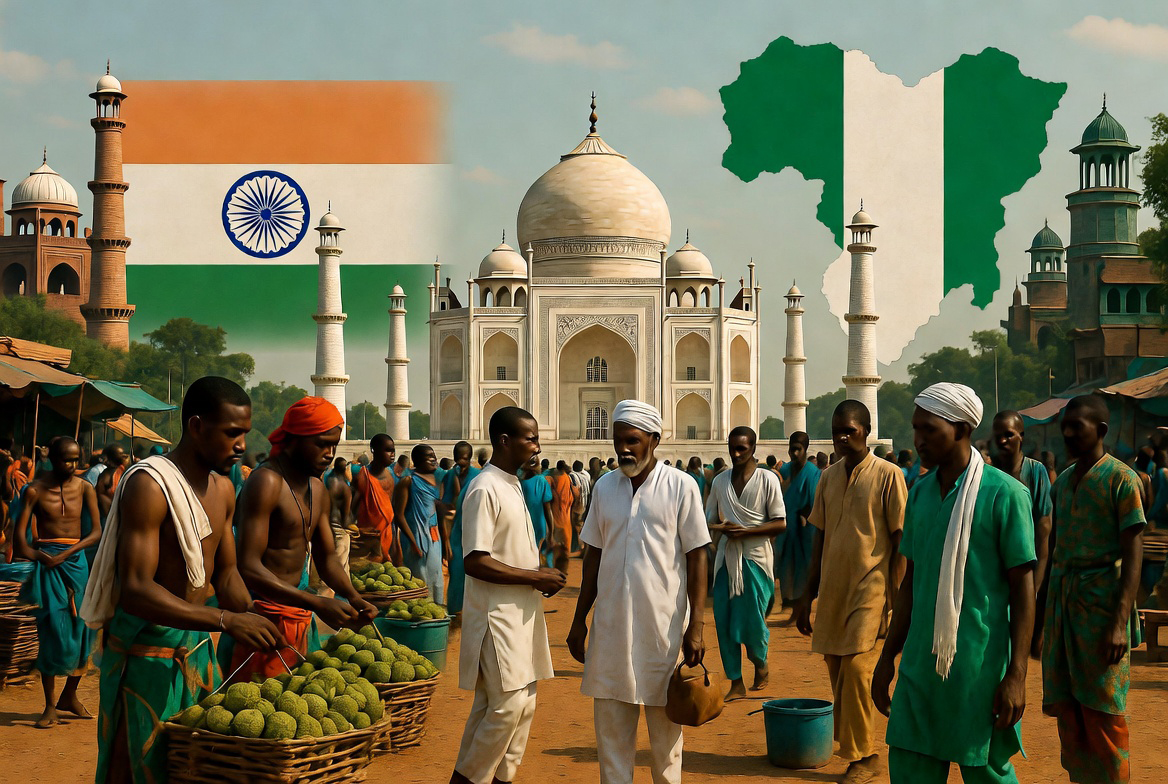
[Grok AI image for representation.]
India is the world’s largest democracy by population, while Nigeria is set to become the world’s second largest democracy in 2050, as the country’s population overtakes that of the USA. By 2050 and 2100, India’s population is projected to stand at 1.67 billion and 1.09 billion, while Nigeria’s population is projected to hit 400 million and 791 million respectively.
Similarly, both countries share a goal to succeed economically. The geo-political, economic and cultural similarities that exist between both countries present a great opportunity for each of them to benefit from the other’s strengths. India and Nigeria are running the same majoritarian political project. India is not an exception or a success story; it is the same experiment conducted with greater state capacity – identical steroids, higher dosage, more efficient repression.
Comparisons between India and African societies are often avoided in Indian public discourse, not because they lack analytical value, but because they unsettle deeply held assumptions. India has long imagined itself as distinct from the postcolonial failures it associates – often crudely and unfairly – with Africa. This imagination is itself shaped by racial hierarchies inherited from colonialism and reproduced through nationalism. For that reason alone, any comparison must be made with care, humility, and clarity of purpose.
The argument here is not civilisational. It is not cultural. It is not racial. It is structural.
To compare India with Nigeria is not to diminish either society or to homogenise vastly different histories. It is to examine how postcolonial states manage inequality, legitimacy, and dissent under conditions of mass poverty and elite capture. When viewed through this lens, the comparison becomes not only defensible, but necessary.
Describing India as “Nigeria on steroids” is deliberately provocative, but it is not flippant. It does not imply similarity of competence or failure in any political sense. It points instead to a more disturbing possibility: that India is reproducing many of the political and economic pathologies commonly associated with postcolonial breakdown – religious mobilisation, informalisation, elite predation, scapegoating of minorities—while possessing far greater state capacity to stabilise and institutionalise those pathologies. That difference changes everything.
This is not an argument against India. It is an argument against illusion.
Nigeria’s political economy is shaped by well-documented structural constraints. Dependence on oil rents, extreme inequality, a weak welfare state, and fragmented public services have produced a situation in which the state struggles to deliver basic material security to large sections of the population. In this context, religion has emerged as a powerful source of social organisation and political legitimacy. Christianity and Islam do not merely express belief; they function as moral economies. They offer belonging, explanation, and dignity in a context where the state often offers little else.
Political elites in Nigeria have repeatedly instrumentalised religious identity. Faith becomes a language through which economic failure is reframed, responsibility deflected, and social anger redirected. Poverty is moralised rather than politicised. Endurance is celebrated. Structural injustice recedes from view. This is not unique to Nigeria, nor is it a reflection of Nigerian society’s values. It is a common outcome where material deprivation meets weak redistribution.
India, however, has taken this logic much further. Hindu majoritarianism is not simply a mobilisation strategy operating in a vacuum of governance. It is embedded in the machinery of the state. It functions as a binding agent in a deeply unequal society, producing a moral hierarchy that naturalises domination and delegitimises resistance.
Economic grievances that might otherwise generate class-based politics are systematically converted into civilisational anxieties. Unemployment, hunger, agrarian distress, and precarity are displaced by narratives of cultural threat. Muslims, dissenters, migrants, students, and activists are positioned as obstacles to national renewal. Citizenship itself is subtly redefined: no longer an equal constitutional status, but a conditional belonging premised on cultural loyalty.
For millions facing stalled mobility and declining security, symbolic supremacy substitutes for material advancement. National pride compensates for economic exclusion. Sacrifice is glorified. Suffering is reframed as contribution to a larger civilisational project. This is not an accidental by-product of populism. It is a governing strategy.
At a structural level, India and Nigeria now share several features that should trouble anyone committed to social justice. In both societies, poverty is increasingly moralised. It is no longer treated as a failure of policy or distribution, but as a consequence of individual deficiency—of discipline, culture, nationalism, or faith. Welfare is reframed as dependency. Redistribution is attacked as appeasement. Inequality becomes not a political problem to be solved, but a moral sorting mechanism that distinguishes the “deserving” from the expendable.
Dissent follows a similar trajectory. In Nigeria, protest is often dismissed as elite conspiracy or foreign manipulation. In India, dissent is criminalised with greater efficiency and legal sophistication. Journalists, students, activists, and opposition voices are not merely discredited; they are surveilled, detained, and exhausted through process. The language may differ, but the outcome is shared: resistance is rendered suspect, risky, and isolating.
Both systems also redirect popular anger away from capital, corruption, and structural failure toward internal enemies. In Nigeria, this may take ethnic or religious form. In India, it is more systematically codified. Muslims, Adivasis, Kashmiris, Leftists, and critical intellectuals become repositories of social anxiety. The identities differ, but the political function remains the same.
Where the comparison becomes most unsettling is in state capacity.
Nigeria’s failures are often visible and disorganised. Institutions break down in ways that are difficult to conceal. India, by contrast, possesses a powerful bureaucracy, a national taxation system, advanced digital infrastructure, and a disciplined security apparatus. This allows repression to be procedural rather than chaotic, legalised rather than openly arbitrary.
India has constructed one of the world’s most expansive digital governance and surveillance ecosystems. Aadhaar-linked databases, financial monitoring, telecom interception, and facial recognition systems are routinely justified in the language of efficiency and inclusion. But their political effect extends far beyond service delivery. They produce anticipatory compliance. Citizens internalise surveillance. Self-censorship precedes coercion.
Legal frameworks have evolved accordingly. Preventive detention laws, expansive national security statutes, and prolonged incarceration without trial have normalised punishment without conviction. Emergency powers are no longer exceptional; they are embedded in ordinary governance. Even violence has been partially outsourced. Lynching, vigilante attacks, and punitive demolitions function as informal extensions of state authority, tolerated precisely because they discipline without bureaucratic friction.
Nigeria’s violence is often unstable and contested. India’s is increasingly calibrated.
The crucial distinction, then, is not competence but direction. Nigeria struggles to govern inequality. India governs it efficiently.
This reality demands an honest reckoning. India is not a developed economy. It is not a manufacturing powerhouse. It is not a broadly shared middle-income success. It is a low-income, high-inequality society characterised by extreme concentrations of wealth alongside mass informal labour, nutritional deprivation, and social insecurity. Institutional autonomy is eroding. Political power and corporate capital are increasingly fused. Spectacular infrastructure coexists with employment collapse. Stock markets rise while hunger indicators stagnate.
This is not inclusive growth. It is extraction wrapped in nationalist symbolism.
The phrase “Nigeria on steroids” is not meant literally. It is diagnostic. It describes a political economy that combines deep inequality and elite capture with population scale, ideological nationalism, and high administrative capacity. This combination is volatile. Where Nigeria’s dysfunction limits its reach, India’s functionality amplifies its consequences. A state that can surveil, discipline, incarcerate, and narrate at scale is capable of producing authoritarian stability amid mass deprivation.
History suggests such arrangements are inherently fragile.
A crucial clarification counts. This trajectory did not begin with the current regime alone. Earlier governments tolerated inequality, deregulated labour, courted capital, and avoided meaningful redistribution. Institutions were weakened through neglect and compromise. But there is a decisive difference. Those governments drifted. The present one governs with ideological clarity. Inequality is no longer an embarrassment to be managed; it is legitimised. Identity is weaponised to protect it. Law and technology are mobilised to enforce it. Cruelty is normalised as administrative necessity.
This is not incompetence. It is coherence.
India does not need lectures from the West, nor does it need racialised comparisons that demean other societies. What it needs is honesty—about power, about inequality, and about the costs of governing through exclusion. No society can indefinitely combine mass poverty, concentrated wealth, permanent surveillance, and moralised nationalism without rupture. Consent can be manufactured. Dissent can be suppressed. But material reality has a way of returning.
“Nigeria on steroids” is not an insult to Africa, nor a dismissal of India’s complexity. It is a warning about what happens when inequality is stabilised rather than resolved, when identity replaces justice, and when state capacity is used not to uplift, but to discipline.
History is unforgiving to regimes that confuse coercion with strength.
[The writer, Dr. Ranjan Solomon, has worked in social justice movements since he was 19 years of age. After an accumulated period of 58 years working with oppressed and marginalized groups locally, nationally, and internationally, he has now turned a researcher-freelance writer focused on questions of global and local/national justice. Since the First Intifada in 1987, Ranjan Solomon has stayed in close solidarity with the Palestinian struggle for freedom from Israeli occupation, and the cruel apartheid system. He has initiated solidarity groups in India, Afro-Asia-Pacific alliance, and at the global level. Ranjan Solomon can be contact ranjan.solomon@gmail.com.]
Follow ummid.com WhatsApp Channel for all the latest updates.
Select Language to Translate in Urdu, Hindi, Marathi or Arabic