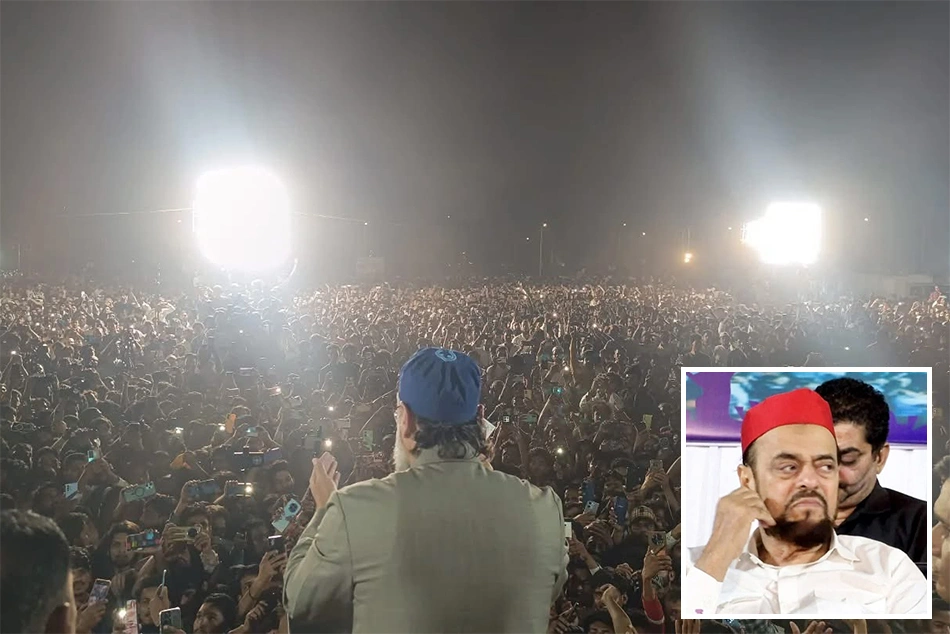
AIMIM Rise Meaningless If Doesn't Lead to Muslim Empowerment
The uncritical celebration of the AIMIM’s expansion risks mistaking movement for progress as the challenge before Muslims is not merely to assert, but to survive and endure politically
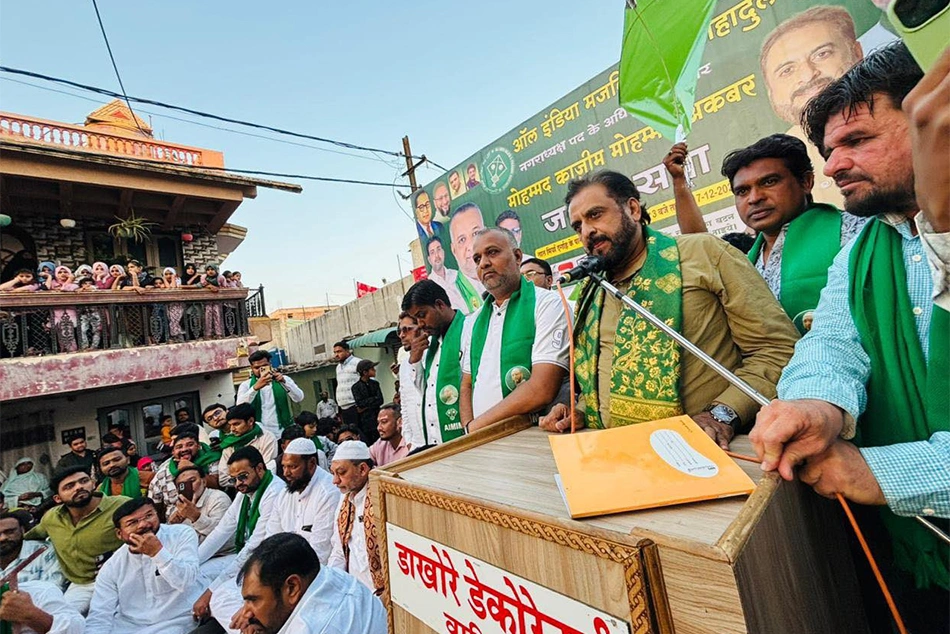
Amaan Asim’s essay (The Wire, January 21, 2026) offers a careful and largely sympathetic reading of the recent churn in Muslim electoral behaviour, particularly in regions such as Aurangabad and Seemanchal.
Its central claim that the rise of the AIMIM reflects a crisis of representation produced by the abdication of mainstream “secular” parties, deserves serious engagement.
Yet, the analysis risks overstating both the novelty and the political utility of this turn, while underplaying the structural constraints within which Muslim politics in India has historically operated and continues to do so.
At the outset, it is important to correct a foundational assumption that animates much contemporary commentary, that Muslims in India have merely been treated as a ‘vote bank’ by the Congress-led secular establishment, without any deeper moral or political commitment.
This reading flattens history. The decision of large numbers of Muslims to remain in India at the time of Partition was not politically incidental; it was anchored in explicit assurances by leaders of the national movement, most notably Jawaharlal Nehru and Mahatma Gandhi, that India would not follow the trajectory of post-Reconquista Spain, where Muslims were gradually erased from public and political life.
The trauma of Partition, the massacres at the borders, and the long shadow of that violence created not a transactional relationship, but a constitutional compact rooted in trust, vulnerability, and citizenship. That compact has undoubtedly frayed, but its erosion cannot be explained solely as cynical vote-bank politics.
Rather, it must be located in the transformation of India’s electoral and ideological landscape, particularly after the consolidation of majoritarian politics.
The Bharatiya Janata Party’s persistent charge that the Congress “appeased” Muslims has proven politically effective not because of its empirical accuracy, but because it resonates with a post-Partition Hindu majoritarian anxiety that views Muslim presence itself as excessive or illegitimate.
The Congress’s difficulty in countering this narrative is less a sign of Muslim over-privileging than of a structural imbalance in a polity governed by first-past-the-post (FPTP) electoral logic, where even modest minority assertion can be portrayed as ‘disproportionate influence’. Within this context, the emergence of explicitly Muslim-centred parties such as the AIMIM must be evaluated with considerable caution.
The Assam experience with the AIUDF is instructive. Its attempt, in 2010, to politically consolidate what was perceived as a 35% Muslim population did not merely fail to produce durable Muslim empowerment; it also fragmented anti-BJP votes, facilitating the BJP’s eventual rise to power.
The subsequent redrawing of constituencies, the systematic reduction of Muslim legislative presence, and the intensification of state hostility towards Muslims illustrate a paradox of assertion. Numerical visibility without coalition power can provoke backlash without securing protection.
A similar risk inheres in the expansion of the AIMIM beyond the pockets of extreme ‘ghettoisation’. Under the FPTP system, the entry of a new party appealing primarily to Muslim voters does not occur in a political vacuum.
In constituencies where Muslims are not an overwhelming majority, the AIMIM’s presence often functions, willingly or otherwise as a vote-splitter, reducing the probability of victory for Muslim candidates fielded by broader secular formations.
The result is not increased Muslim representation, but its numerical decline, even as the symbolic language of assertion grows louder.
This structural reality distinguishes Muslim politics from that of other marginalised groups. Scheduled Castes, Scheduled Tribes, and Other Backward Classes possess constitutionally guaranteed reservations that ensure a baseline of representation irrespective of party affiliation.
Dominant OBC groups such as Yadavs in Uttar Pradesh and Bihar enjoy both demographic concentration and entrenched party vehicles (the SP and RJD respectively), enabling them to negotiate power across parties without risking erasure.
Muslims, by contrast, lack both reservations and a territorially concentrated electoral geography across most of India. Their political survival has therefore historically depended on strategic alliances rather than standalone mobilisation.
The frustration of Muslim youth with this logic is understandable, particularly in an era marked by lynchings, demolitions, and routine stigmatisation. Yet frustration does not negate political arithmetic. Assertion that ignores structural constraints can become self-defeating.
The language of dignity and self-respect, when detached from an analysis of electoral systems, risks substituting moral satisfaction for material outcomes.
That some critics of this position resort to labelling such caution as “impotence” or “slavery to secular parties” reflects not political clarity, but despair.
This is not an argument for passivity, nor an unconditional defence of the Congress or other secular parties. They must be held accountable for shrinking Muslim representation, excessive risk-aversion, and moral silence in the face of discrimination.
The remedy lies not in further fragmenting an already vulnerable electorate, but in forcing internal reform within coalition-based politics: demanding winnable tickets, organisational leadership, and principled articulation of minority rights within broad constitutional platforms.
Muslim political thought, if it is to be effective, must balance assertion with restraint, and anger with strategy.
Colonial Britain did not leave Indian Muslims with the institutional advantages enjoyed by some other groups. It left them with structural limitations that require cool-headed political realism rather than expressive maximalism.
In this light, the uncritical celebration of the AIMIM’s expansion risks mistaking movement for progress. The challenge before Muslims is not merely to assert, but to survive and endure politically.
Any strategy that inadvertently strengthens majoritarian dominance, even while speaking the language of resistance, must be scrutinised rigorously.
The task is not to mirror identity politics, but to minimise suffering and preserve space within a hostile democratic terrain.
[The writer, Amir Hussain, is an Academic Counsellor (Social Work & Political Science) IGNOU]
Follow ummid.com WhatsApp Channel for all the latest updates.
Select Language to Translate in Urdu, Hindi, Marathi or Arabic