Redrawing Muslim Politics: AIMIM’s Rise and SP’s Fall in Maharashtra
Beneath the BJP victory in Maharashtra civic polls lies a more consequential story: The decline of the Samajwadi Party (SP) and the steady rise of Asaduddin Owaisi-led AIMIM as the principal Muslim political force in Maharashtra’s urban politics
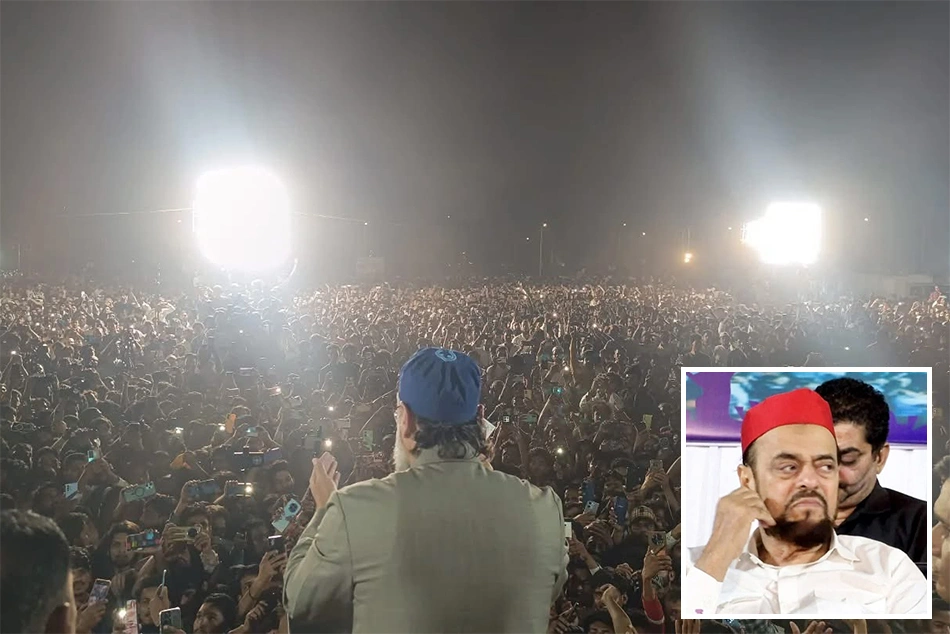
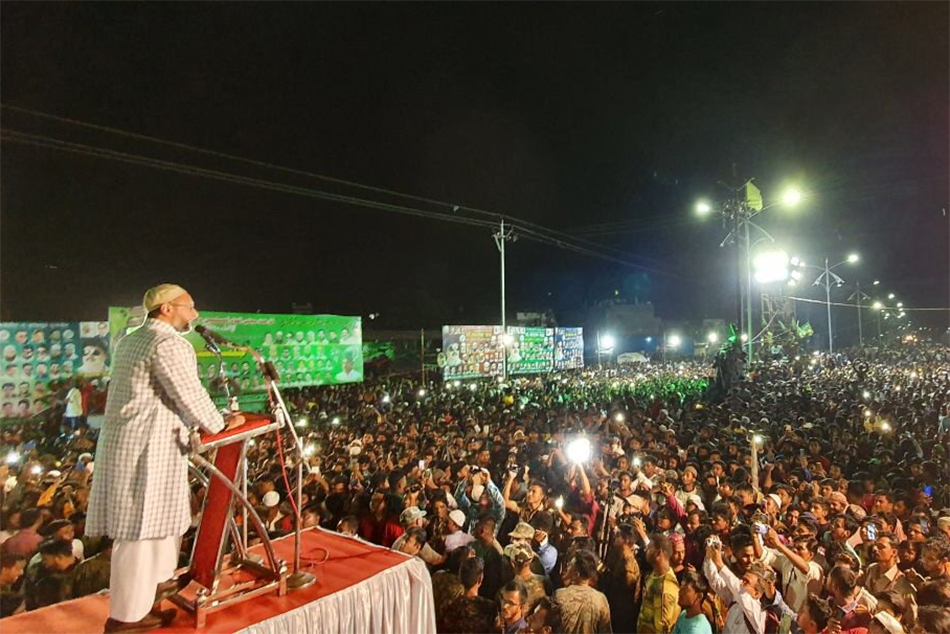
[AIMIM Chief Asaduddin Owaisi addressing a rally in Mumbai. (Inset) Maharashtra SP Chief Abu Asim Azmi)]
Beyond the BJP’s headline victory, aided by the Shiv Sena (Shinde faction) in the Brihanmumbai Municipal Corporation (BMC), another politically significant shift quietly unfolded across Maharashtra. Muslim political representation in urban local bodies is undergoing a visible realignment, reflecting both electoral dissatisfaction and evolving political strategies.
The BJP emerged as Mumbai’s single-largest party with 89 seats, while Shiv Sena (Shinde) secured 29. Together, the alliance claimed 118 of the BMC’s 227 seats, consolidating control over India’s richest civic body. Yet beneath this dominance lies a more consequential story: The decline of the Samajwadi Party (SP) and the steady rise of Asaduddin Owaisi-led AIMIM as the principal Muslim political force in Maharashtra’s urban politics.
Mumbai Verdict: SP Falters, AIMIM Consolidates
Despite the resignation of its Mumbai Chief Farooq Shabdi, the AIMIM won 8 seats, its strongest performance yet in the BMC, mainly from Govandi, Mankhurd, Shivaji Nagar, and adjoining wards. By contrast, SP managed only 2 seats, losing areas it once considered strongholds. The BMC seat distribution 2026 is:
- BJP: 89 seats
- Shiv Sena (Shinde): 29 seats
- Shiv Sena (UBT): 65 seats
- Congress: 24 seats
- MNS: 06 seats
- All India Majlis e Ittehadul Muslimeen (AIMIM): 08 seats
- NCP (Ajit Pawar): 03 seats
- NCP (Sharad Pawar): 01 seat
- Samajwadi Party: 02 seats
Internal Rift and Electoral Impact
SP’s decline is closely tied to internal divisions. Reports suggest a dispute between Abu Asim Azmi, Maharashtra SP president, and Rais Shaikh over ticket distribution, particularly in Bhiwandi and Madanpura area of Mumbai.
Madanpura (Ward 211), historically an SP bastion, was won by Congress candidate Waqar Khan, a close associate and former PA of Rais Shaikh, who allegedly facilitated his nomination from Congress. Residents noted that this shift occurred largely because Abu Asim Azmi denied tickets to candidates loyal to Rais Shaikh.
In another SP stronghold, Bhiwandi, Shaikh reportedly facilitated tickets for his loyalists from Congress and NCP, contributing to SP’s defeats there. This internal split fractured SP’s organisational base at a critical moment, highlighting the vulnerability of factionalised party structures.
Govandi: Voters Seek Alternatives
Govandi, traditionally an SP stronghold, illustrates this shift vividly. The AIMIM has won 7 seats in the area, capturing voter attention with grassroots mobilisation and an emphasis on local civic concerns.
Residents pointed to persistent underdevelopment, youth drug abuse, and perceived disengagement by local SP leadership as reasons for changing allegiance.
Political observers note that the AIMIM’s approach, focusing on everyday grievances rather than symbolic politics, and the visits of the Owaisi brothers, whose speeches and rallies drew especially young voters, contributed significantly to the party’s gains.
AIMIM’s Statewide Expansion
Mumbai was not an isolated success. Aggregating official ward-wise results, media reports indicate the AIMIM won a total of 125 seats across 29 municipal corporations in Maharashtra.
This makes the AIMIM the most electorally successful Muslim-led party in urban local governance in the state, far ahead of SP and other smaller formations.
Representation Beyond Civic Bodies
Since 2014, Muslim representation has declined not only in civic bodies but also in Maharashtra’s legislatures. The state currently has no Muslim Member of Parliament in the Lok Sabha, despite Muslims comprising nearly 12% of the population.
Several major parties have increasingly preferred symbolic outreach rather than nominating Muslim candidates in winnable seats. This structural exclusion has narrowed institutional avenues for meaningful political representation, pushing voters toward alternatives outside traditional party frameworks.
Electoral Process Concerns
The municipal elections also raised procedural concerns. According to media reports, these included:
- Absence of VVPAT verification
- One-hour reduction in polling
- Use of markers instead of indelible ink
- Voter lists exceeding adult population in select wards
Additionally, the Mahayuti alliance secured 68 seats unopposed (BJP 44, Shiv Sena 22) in regions such as Thane and Kalyan.
While these issues do not alter the official results, they underscore a growing trust deficit that requires institutional review to maintain confidence in the electoral process.
Call for Collective Introspection
The verdicts in civic elections send a strong signal not only to political parties but also to the community’s leadership. Muslim political and social leaders in Maharashtra must move beyond factional divisions and collaborate to strengthen representation in legislatures, civic bodies, and Parliament.
This effort should include dialogue and coordination with political parties, NGOs, and government authorities to enhance electoral transparency and authenticity. Without credible leadership pipelines and sustained engagement with broader democratic coalitions, electoral gains will remain fragmented and localized.
Muslim leadership must recognize that their role goes beyond community politics; they are crucial stakeholders in shaping Maharashtra’s and India’s democratic future, with the ability to influence governance, policy, and the political process itself.
Divided Mandate, Clear Signal
Concerns have emerged over the impartiality of the Election Commission in these polls, underscoring the need for greater transparency and stronger institutional accountability.
But, the 2026 municipal elections also highlight two key realities: BJP’s organisational strength continues to dominate Maharashtra’s civic politics, while voters in Muslim-majority urban areas are re-evaluating traditional party loyalties. The era of uncontested SP dominance has come to an end.
The broader challenge now extends beyond simply identifying which party or individual represents Muslims. It involves rebuilding meaningful political representation that translates community concerns into tangible policy outcomes, ensuring that Muslim voices are not just present but influential in legislative assemblies, civic bodies, and national policymaking.
This requires developing credible leadership pipelines, fostering coordination across political and social organizations, and engaging proactively with broader democratic coalitions.
Only through such strategic and sustained engagement can the community move from symbolic representation to actual political leverage, shaping governance, resource allocation, and policy decisions at both the state and national levels.
Follow ummid.com WhatsApp Channel for all the latest updates.
Select Language to Translate in Urdu, Hindi, Marathi or Arabic