Saudi Arabia-UAE Conflict and Options for India
The challenge for New Delhi is not choosing between Riyadh and Abu Dhabi — but navigating a Gulf that is no longer strategically monolithic.
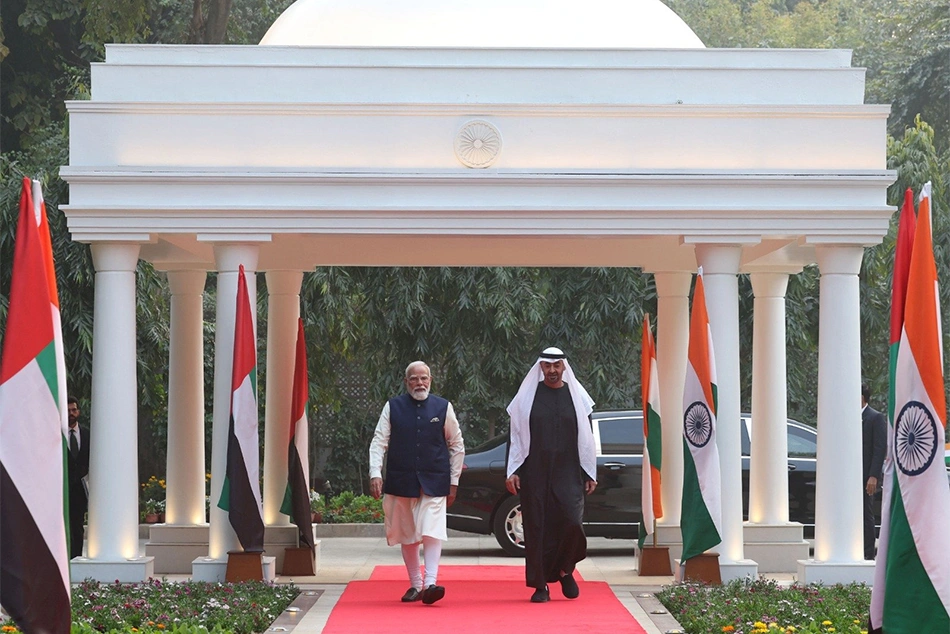
[Prime Minister Modi with UAE President Sheikh Mohamed bin Zayed Al Nahyan in New Delhi]
When United Arab Emirates President Sheikh Mohamed bin Zayed Al Nahyan flew to New Delhi on January 19 for a visit that lasted barely three hours, the optics were as striking as the substance. In that compressed window, India and the UAE announced their intention to conclude a framework agreement for a strategic defence partnership, alongside cooperation spanning LNG supply, space, nuclear technology, infrastructure, and finance.
Yet, the timing of the visit should be seen against the shifting Gulf landscape in which the UAE’s relationship with Saudi Arabia is increasingly defined by strategic competition rather than seamless alignment. For India — one of the few major powers with deep, functional ties to both Riyadh and Abu Dhabi, the moment carried implications well beyond bilateral optics.
The current phase of Saudi-UAE tensions is best understood not as a collapse of relations between two traditional allies but as a strategic recalibration driven by divergent approaches to economics, security, and regional intervention. Understanding this divergence is essential not only for Gulf stability but also for close partners like India, which maintains close ties with both states.
Saudi Arabia and UAE: Competing Models and Structural Differences
The growing rift between Saudi Arabia and the United Arab Emirates should not be seen as an episodic disagreement or a personality-driven clash. It reflects a deeper divergence between two distinct models of regional power — how influence is exercised, how security is produced, and how the Middle East should be politically organized.
For decades, Saudi Arabia and the United Arab Emirates stood at the heart of Gulf cooperation — partners in the broad project of stabilizing a turbulent neighborhood. They shared core objectives: protecting the Gulf from spillover wars, sustaining strong ties with Western powers, containing jihadist threats, and curbing Iranian influence. But even at the height of apparent unity, the relationship carried a quiet structural tension.
Geography, scale, and ambition pushed the two states toward different ways of exercising power. Saudi Arabia — larger, oil-rich, and demographically weighty, has long treated itself as the Arab world’s central pillar, favouring state-to-state diplomacy and outcomes managed through recognized governments and formal institutions.
The UAE - smaller in territory and population, built influence differently: through nimble diplomacy, high-velocity investment, and a forward-leaning regional posture that often works through local partners and proxy actors, and is more open to unconventional alignments, including with non-Arab players.
The decades-long cooperation between the two Arab states didn’t mean that differences were entirely absent. Old disputes — such as the Buraimi tensions of the 1950s and later border frictions addressed through agreements like the 1974 Treaty of Jeddah, hinted at competing strategic instincts. Yet for years, these issues were contained, subordinated to a wider sense of Gulf cohesion.
The real stress test arrived after the Arab Spring, when Yemen became the arena in which the two models collided. In 2015, Saudi Arabia assembled a coalition to restore Yemen’s internationally recognized government and roll back the Iranian-backed Houthis’ advance. The UAE joined as a major partner, and Riyadh, in turn, elevated Abu Dhabi — politically and economically, folding it into high-level coordination and projecting a narrative of strategic unity that aligned neatly with Saudi Arabia’s wider Vision 2030-era confidence.
However, beneath the alliance branding, the two capitals were fighting for different end states. While Saudi Arabia prioritized Yemen’s territorial unity and the reconstitution of a central government, the UAE cultivated the Southern Transitional Council (STC), a separatist force oriented toward autonomy—or outright independence—for the south. Control of strategic ports, especially Aden and areas near the Bab al-Mandab Strait, became central to the Emirati calculus.
The result was not merely policy divergence; it was operational friction. Coordination on the ground frayed as competing local partners hardened into rival power centers. By late 2025, Saudi strikes — symbolic but politically loud, around Mukalla against positions or shipments linked to the UAE-backed STC signaled that the disagreement had moved into the open. The UAE’s eventual drawdown from Yemen underscored how far the coalition had drifted from its original premise, even as Yemen itself risked becoming a proxy arena for competing Gulf ambitions.
And the fault lines do not stop at Yemen. Across the Red Sea and the Horn of Africa, Riyadh and Abu Dhabi appear to be pursuing different maps of influence. Saudi Arabia has grown increasingly wary of what it sees as the UAE’s expanding external partnerships —especially perceived alignment with Israel and support for non-state actors in places like Sudan, Somalia, and Somaliland, moves Riyadh can interpret as destabilizing, reputationally costly, or strategically encircling. Emirati investments and security ties around key ports such as Berbera in Somaliland amplify these anxieties, not simply because they expand UAE reach, but because they reflect a form of power that can bypass traditional state channels.
In essence, what looks like a bilateral dispute is better understood as a contest between two political models. Riyadh leans toward a state-centric approach: stabilizing through recognized governments, formal diplomacy, and institutional control. Abu Dhabi, by contrast, often favors a networked model: building leverage through markets, ports, finance, and local partners—sometimes operating alongside, rather than through, established power structures. As these models collide, the Saudi-UAE relationship is less a “rift” than an ongoing argument over what Gulf power should look like in the changing world order.
India’s Stakes: Avoiding Entanglement, Diplomatic Balancing
India has so far refrained from taking sides in the Saudi-UAE conflict, recognizing that alignment with one could damage relations with the other. This approach aligns with India’s strategic autonomy — engaging all partners without binding commitments that limit its freedom of action in the Middle East.
Yet Abu Dhabi’s outreach to India takes place in an environment where it may subtly encourage hedging against Saudi Arabia’s growing regional dominance. Abu Dhabi may also seek to shape Indian perceptions by foregrounding recent shifts in Saudi Arabia’s strategic partnerships — particularly the deepening Saudi–Pakistan defence relationship and the prospect of a more formalized Saudi–Turkey–Pakistan security understanding.
UAE may seek to lock in Indian economic and technology partnerships as geopolitical ballast. It has both the ability and capability to present itself as the Gulf’s most efficient gateway for Indian capital and connectivity. India should welcome the visit and deepen cooperation, but it should also stay alert to the regional signalling embedded in Gulf diplomacy.
Besides, India has several diplomatic levers at its hand that can act as a bridge between the two Gulf states without compromising its balanced engagement and diplomatic autonomy; beginning with an offer to facilitate Track II dialogues or informal consultations, emphasizing points of shared interest like Gulf security, economic connectivity, and regional cooperation.
Moreover, leveraging India’s position in initiatives like the India-Middle East-Europe Economic Corridor (IMEC), New Delhi can advocate for economic projects that incentivize cooperation rather than competition—focusing on trade corridors, port connectivity, and technology partnerships that benefit multiple Gulf states without zero-sum logic.
Finally, as the Middle East enters a phase of recalibration, external partners like India must read this divergence carefully. India’s interest lies not in amplifying competition, but in engaging both powers while quietly privileging stability, institutional authority, and regional cohesion. The challenge for New Delhi is not choosing between Riyadh and Abu Dhabi — but navigating a Gulf that is no longer strategically monolithic.
[Sajid Farid Shapoo holds a PhD in Security Studies from Princeton University and is a senior IPS officer. The views expressed are personal.]
Follow ummid.com WhatsApp Channel for all the latest updates.
Select Language to Translate in Urdu, Hindi, Marathi or Arabic