Mark Tully's death marks more than the passing of a man
The death of Mark Tully signifies more than the passing of a man, and the end of a particular form of British writing about India
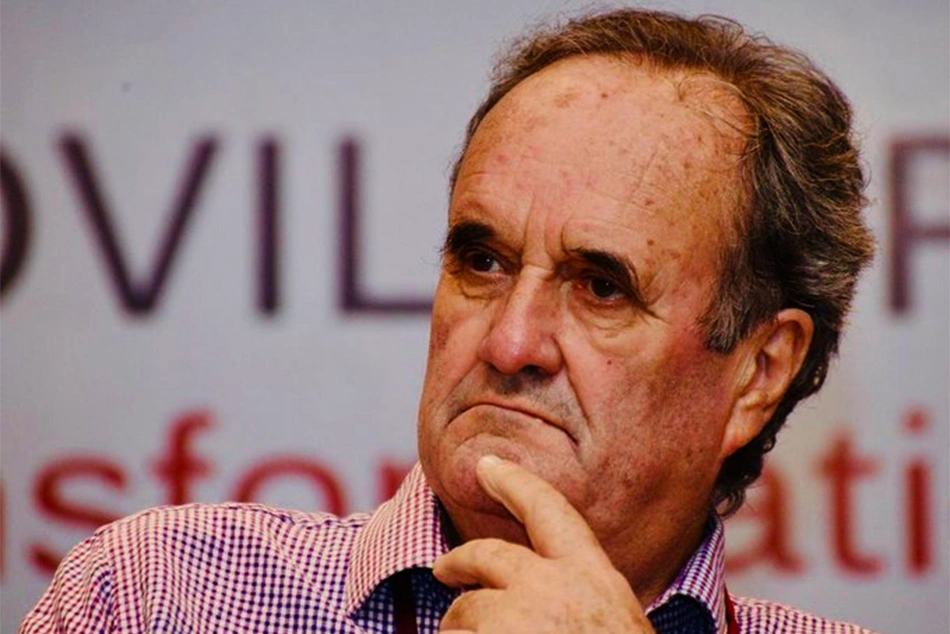
[Mark Tully (File Image/Press Club of India)]
On 25 January 2026, Mark Tully died aged 90. Tully, the BBC’s legendary India correspondent, represented a particular breed of British writer: Educated at Marlborough and Cambridge, publicly modest but quietly assured in his right to interpret ‘India’ for Western audiences.
Mark Tully inherited and eventually outlived the ‘grand interpreter’ archetype, a lineage stretching from Kipling to Forster, then to the postcolonial correspondents of the BBC and The Times. The route was familiar: Oxbridge education, internalised Empire and a moral sense of vocation. It produced voices that claimed to ‘explain’ a continent to readers who had long ceased to rule it.
Tully’s authority was institutional. The BBC microphone bestowed legitimacy, and his slow, deliberate reporting came to stand for slow journalism. This was an era in which a single correspondent’s voice could be taken, in London at least, to stand for a nation’s complexity. The same process that enabled depth could also mean gatekeeping: what did not fit a preconceived framing might not reach the airwaves.
By the mid-1990s, however, a different kind of British writing about India had emerged. We had books like William Sutcliffe’s Are You Experienced? (1997), followed by Sarah Macdonald’s (Australian writer) Holy Cow (2002). In these texts, ‘What is India?’ became ‘What is India doing to me?’ We moved from the postcolonial interpreter to the self-conscious tourist and their diary of discomfort.
Academic critiques of Holy Cow describe this mode as ‘consumerist orientalism’: yoga classes, ashram stays and temple visits feed the Western hunger for revelation. However, the memoir’s humour does not mask a critical transition. The outsider ceases to translate India and begins to perform their reactions to it. The author becomes the story, setting the stage for the influencer era in which the gaze of the protagonist is the real subject.
And then, with the development of the internet, the vlogger emerged. We have gone from institutions like the BBC to the self-branded content creator.
The vlogger’s handheld camera replaces the BBC bureau with viewers seeking immediacy. While some vloggers can be informative, their India tends to be a feed of endlessly scrollable fragments stitched together by personality and performance. Even the most reflective videos are disciplined by metrics they do not control.
The algorithm-driven narrative rewards spectacle over reflection. A Delhi scam or ‘my 24 hours of hell in India’ (numerous similar clickbait titles exist on YouTube by those who have spent limited time in the country) outperforms any explanation of agrarian policy or caste relations.
The truth becomes whatever the camera can capture in 4K. We see the vibrancy of street life while losing the capacity to connect the scenes to land markets, the plight of street vendors or community erosion. Spectacle and immediacy are what count.
Renowned journalist P Sainath warns against a cocoon of wilful ignorance created by both elite correspondents and digital creators. Whether in Oxbridge polish or vlogger enthusiasm, the foreign gaze is shaped by marketability. For Sainath, the greatest casualty is a shared understanding of how India’s majority, particularly its rural population, live and labour.
India does, of course, narrate itself: in vernacular newspapers, regional TV, local YouTube channels and grassroots reportage that follow farmers’ movements or migrant journeys in exhausting detail (Sainath’s site ruralindiaonline being a fine example). These voices exist, but they rarely circulate globally because they do not fit the viral feed.
The foreign vlogger’s dependence on platform metrics is simply a new form of an old logic whereby the West is still selling India to itself. If Tully’s microphone was institutional, the influencer’s lens is personal. However for Sainath, farmers, migrants and the informally employed remain structurally invisible, appearing briefly as picturesque backdrops before the scroll moves on.
But to truly capture their situations would demand months of reporting and years of attention; something for which an attention economy built on clicks and ‘cringe’ is simply not worthwhile. And if some reporters missed it back then because of their elite circles, others miss it today because it doesn’t ‘trend’.
The death of Mark Tully signifies more than the passing of a man. His death marks the end of a particular form of British writing about India. The ‘grand interpreter’ provided a coherent narrative, albeit in the shadow of empire, while today there are performers competing for fragments of truth in an algorithmic marketplace.
The modern British (or US, Australian, Canadian… take your pick) observer of India tends not to be a scholar in a library or a stationed correspondent but a digital nomad with camera in hand and content on demand. Their authority is measured in views and likes rather than in their command of history.
Tully’s voice was authoritative, but it was also a Western filter. The vlogger era, for all its ‘cringe’ has occasionally democratised the gaze, even if it has commodified it.
With the algorithm now serving as the new editor-in-chief, Mark Tully’s death represents the end of an era as much as a career. His microphone now lies silent as a thousand phone cameras recharge fulfilling the system’s requirement for infotainment ‘content’.
[The writer, Colin Todhunter, is an Independent Researcher. His new book chronicling India’s farmers resistance to corporate enclosures can be downloaded for free here.]
Follow ummid.com WhatsApp Channel for all the latest updates.
Select Language to Translate in Urdu, Hindi, Marathi or Arabic