Strategic Autonomy Over Alignment: How India is Reframing its Engagement with Europe
As talks continue on the Free Trade Agreement and broader bilateral priorities, India should push to place human capital at the centre of the partnership with European Union
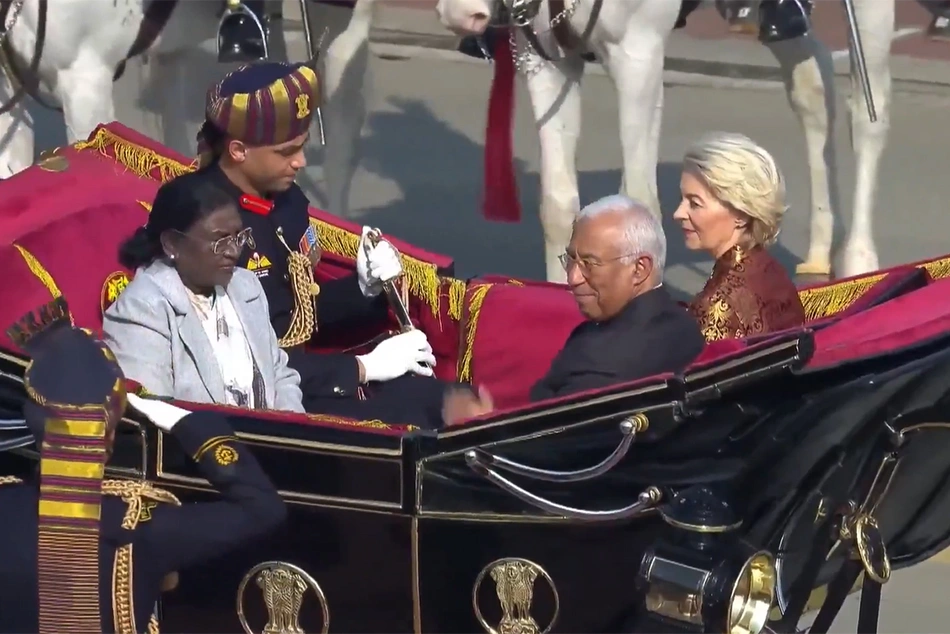
[President Droupadi Murmu, with President of the European Council, António Luís Santos da Costa and President of the European Commission, Ursula Von Der Leyen, arrives at the saluting dais at Kartavya Path in Delhi to witness the Republic Day Parade ]
At a time when global trade is fragmenting, security arrangements are under strain, and faith in multilateralism is wearing thin, timing matters as much as intent. So when the Presidents of the European Commission and the European Council, Ursula von der Leyen and António Luís Santos da Costa, attended India’s 77th Republic Day in January 2026, the visit was rightly called historic. But its real importance lies less in ceremony and more in context. India and Europe are choosing to deepen engagement just as the global order is becoming more uncertain and less predictable.
French political scientist Christophe Jaffrelot has described the current phase of India–Europe relations as a possible turning point, one where years of dialogue may finally translate into concrete outcomes. Former Indian diplomat Jawed Ashraf makes a similar argument in his 2025 Indian Express column, where he notes that the old world order is not coming back. Instead, he suggests, India and the EU have an opportunity to turn global instability into a source of resilience and shared prosperity for nearly two billion people living in diverse democratic societies.
Managing risk, not building alliances
What is driving this recalibration is not a sudden convergence of values, but a shared exposure to risk. A 2024 Bruegel report points out that semiconductor shortages during 2022–23 cost Europe’s automotive sector around €110 billion, laying bare the EU’s dependence on East Asian supply chains. India, meanwhile, faced its own vulnerabilities through reliance on imported pharmaceutical inputs and rare earths. The lesson for both was clear. The priority is diversification, not decoupling. This logic now shapes negotiations around the long-delayed India–EU Free Trade Agreement.
The European Council on Foreign Relations has also noted that Europe increasingly sees India as a stabilising partner in a volatile economic and geopolitical environment. From New Delhi’s side, External Affairs Minister S. Jaishankar has been consistent in stressing that partnerships should expand options, not restrict them. Strategic autonomy, in this sense, is not about distance but about freedom of choice.
The trade-offs of autonomy
Engagement with Europe, however, is not without costs. Aligning with EU regulatory frameworks can open doors to technology, capital, and markets, but it can also narrow domestic policy space.
At the same time, an excessive insistence on autonomy can slow economic gains. India’s approach has therefore been deliberately balanced: integrate where it strengthens capacity, resist where it limits long-term flexibility.
Security cooperation without alliances
Security cooperation has expanded quietly rather than dramatically. Institut Montaigne has argued that India’s preference for flexible, project-based security cooperation reflects realism, not reluctance.
Coordination with European partners on maritime security, cyber governance, and Indo-Pacific initiatives shows how cooperation can deepen without formal alliances.
This fits neatly with India’s broader foreign policy instinct to work with multiple partners without being locked into any single security framework.
European constraints and geopolitical frictions
Constraints remain, particularly on the European side. The EU Institute for Security Studies has warned that Europe’s credibility now depends on delivery, not declarations. Internal divisions within the EU could slow or dilute ambitious trade and security commitments, something Indian policymakers are acutely aware of from past experience.
Geopolitics further tests the relationship. India’s ties with Russia continue to sit uneasily with European priorities. Yet New Delhi frames its position as crisis management rather than ideological alignment. As Jawed Ashraf has argued, durable partnerships are built by managing differences, not pretending they do not exist. This logic underpins India’s engagement with Europe just as much as its wider global posture.
A quieter, more deliberate diplomacy
India’s engagement with Europe today is not about choosing sides. It is about widening strategic options in an unsettled world. At a moment when overreach has damaged trust elsewhere, New Delhi and Brussels appear to be experimenting with a more restrained form of cooperation, focused on trade, technology, and selective security coordination. This is strategic autonomy in practice: partnership without surrendering choice.
As talks continue on the Free Trade Agreement and broader bilateral priorities, India should push to place human capital at the centre of the partnership. One concrete step would be to propose a dedicated, Erasmus-style student exchange framework for Indian nationals, developed with EU institutions and member states. Budget constraints, domestic politics, and differing views on mobility within Europe are real challenges, but they should shape the design of such a programme rather than block it altogether.
A tailored students exchange, similar to Erasmus, framework would complement existing education pathways, expand access beyond a handful of destinations, and root India–EU relations in long-term people-to-people ties. Embedding academic mobility into the partnership would strengthen strategic autonomy not just through markets and security cooperation, but through shared skills, knowledge networks, and institutional trust that outlast political cycles.
[The writer, Mohammed Affan, is an Indian graduate in Political Science and International Relations. and an Erasmus scholarship recipient. He writes on diplomacy, security, human rights, and global governance, with a focus on North–South and South–South policy analysis.]
Follow ummid.com WhatsApp Channel for all the latest updates.
Select Language to Translate in Urdu, Hindi, Marathi or Arabic