Enhanced India-EU Partnership Strengthens in Fractured World
The enhanced partnership between India and European Union (EU) is going to eliminate tariffs on more than 90% of traded goods, besides imparting a thrust to services and facilitate investments between the two sides
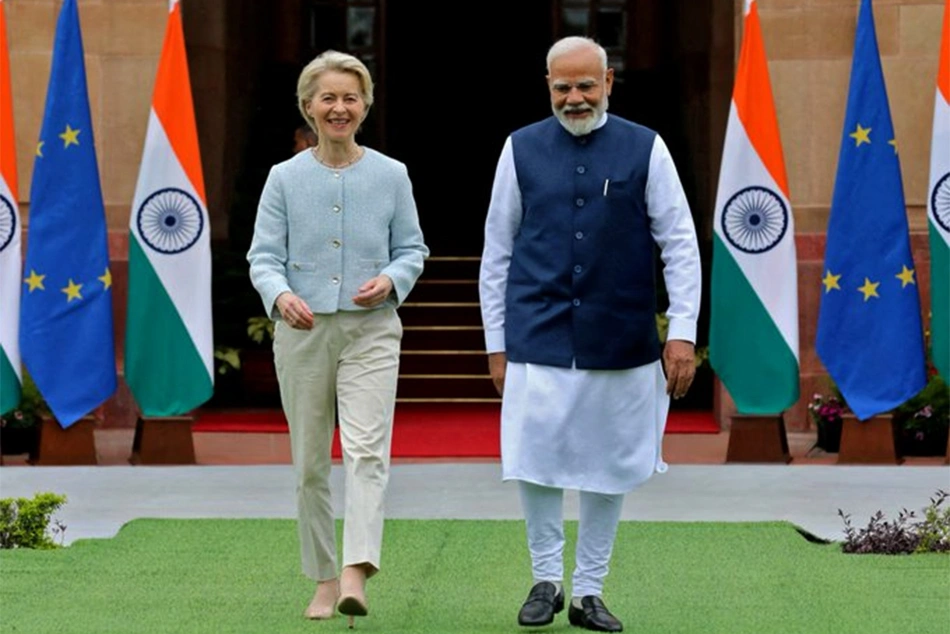
In today’s fractured world, fissures caused mostly by the ongoing Trumpomania, every nation is working post haste to forge new alliances particularly focused on trade. The best example of this is the India-EU partnership FTA, to be formalized on Monday (January 27). The enhanced partnership is going to eliminate tariffs on more than 90% of traded goods, besides imparting a thrust to services and facilitate investments between the two sides.
For every nation today, guarding its trade interests to boost its own manufacturing sectors and the associated services sector is of paramount interest. Bogged down by non-business-like tariffs imposition accompanied with various illogical concessions, by the Trump Administration, the global economy has faced a churn of its own based on the imperatives of conducting trade on an equal footing with other nations.
This has not only gone against but in favour of countries like India. India has been able to stitch together a Free Trade Agreement (FTA) with the European Union (EU) after 18-years long parleys, but which got an additional boost to reach a deal during the last year, particularly.
Today, i.e. Tuesday January 27 India and the European Union will elevate their long-standing strategic engagement with the signing of a Security and Defence Partnership (SDP) at the 16th India-EU Summit.
India-EU Trade Parleys
The EU-India FTA conclusion marks the end of a two-decade-old process, initiated in 2007. With bilateral trade already crossing $136 billion, this would be “one of the biggest” bilateral deals in the world.
The underlying emergency and interests which both the sides showed to agree to an FTA were coherently expressed by EU Commission President Ursula von der Leyen, when she said that India and the European Union are giving a “fractured world” an alternative.
While the FTA will be watched most closely, in terms of bilateral gains for both countries, it is the timing of the Summit, amidst unprecedented transatlantic tensions between the EU and the United States over territorial issues and trade, that is most significant.
“India and Europe have made a clear choice… strategic partnership, dialogue and openness,” said Ms. Von Der Leyen in a social media post. “We are showing a fractured world that another way is possible,” she added.
European Council’s President António Costa, has said that, “In our multi-polar world, it’s essential that the EU and India become closer and closer partners because we can together be strong providers of stability, protectability and reliability in international relations and to protect our international rules-based order.
“Our trade agreement, I think, is a very important geopolitical stabiliser and a showcase of how it’s possible to protect international rules-based trade,” Costa, who traces his roots to Goa, said against the backdrop of the turmoil created by the trade policies of the US.
India-EU Trade
The EU is India’s largest trading partner bloc, accounting for trade in goods worth €120 billion in 2024, or 11.5% of India’s total trade. In 2023, trade in services was worth €59.7 billion in 2023. The EU’s share of FDI in India touched €140.1 billion in 2023, up from €82.3 billion in 2019.
Once the FTA is signed and ratified by the European Parliament, a process that could take at least a year, the agreement could expand bilateral trade and lift Indian exports such as textiles and jewellery, hit by 50% US tariffs since last August.
For the EU, which has signed a new security and defence partnership and a free trade agreement with New Delhi, India will provide heft to the 27-nation European bloc on multiple fronts. For instance, the security and defence pact will lead to strengthening cooperation in areas such as maritime security, counter-terrorism, cyber-defence, and maritime domain awareness, with a focus on stability in the Indo-Pacific region.
Analysts say India-EU defence and security partnership would result in placing New Delhi within a framework that the 27-nation European bloc has so far extended to Japan and South Korea. It would provide an institutional platform for advancing security cooperation at a moment when both sides are reassessing their long-term security and defence priorities.
Moreover, a shift in geopolitical situation combined with Trump’s unpredictable behaviour, has compelled the EU to bring a change in its outlook towards India. Instead of just maintaining a buyer-seller relationship, largely dominated by France and Germany, the EU-India engagement will now evolve into a structured industrial partnership with long-term implications.
With the signing of the long-negotiated FTA, the EU will be benefitted by gaining deeper access to India’s huge market, thus diversifying supply chains, while at the same time expanding services exports. More than this, it will ultimately result in the EU decoupling itself from the US and other unreliable partners such as China.
For India, the FTA will provide it a much-needed opportunity to restore the Generalised System of Preferences (GSP) - which removes import duties from products coming into the EU market from developing nations. India’s garment, pharmaceutical and steel industries in addition to petroleum products and machinery will see a rise in exports to the EU market.
It is estimated that the two-way trade under the FTA could rise to $200-250 billion in goods and services within a decade, building on current figures of $137 billion in goods and $50 billion in services.
The US Reaction
As European Council’s President Costa had described the India-EU FTA as an “important political message to the world that India and that the EU believe more in trade agreements than in tariffs” at a time when protectionism is rising and “some countries have decided to increase tariffs.”
The typical US response came. The US doubled down on allegations that India's oil trade with Russia finances the war in EU-backed Ukraine.
“We have put 25 per cent tariffs on India for buying Russian oil. Guess what happened last week? The Europeans signed a trade deal with India,” US treasury secretary Scott Bessent said in an interview on Sunday.
Indian Economic Diplomacy
With the latest deal firmed-up, the Indian trade negotiators and diplomats are focussing on increasing trade relations and signing new FTAs with countries like Canada. Last week, Canada’s International Trade Minister Maninder Sidhu called for expanded trade with India as the two countries prepare to start trade negotiations. The Canadian Prime Minister Mike Carney is expected to visit India in March 2026, to finalise a new deal.
Meanwhile, last week Premier David Eby of the British Columbia, Canada’s western province led a delegation to India concentrating on business and technological cooperation rather than getting trapped in politics and straying away from its main objective of ensuring the standard of living of its people is not impacted by the US trade war.
David Eby and his team members advanced key partnerships with government and business leaders in Bengaluru, Karnataka, India’s largest innovation center, to attract investment, foster collaboration in innovation, and build long-term relationships.
Nonetheless, the trade deal between India and the EU has redefined not just ties between the two sides but also global economic alignments, especially when the traditional and old architecture of commerce and trade are facing serious challenges. India has also showed that it has various options besides the US and for it, ideological underpinnings does not mean much, when it comes to its trade interests.
Follow ummid.com WhatsApp Channel for all the latest updates.
Select Language to Translate in Urdu, Hindi, Marathi or Arabic