The Human Toll of Collapsing Madrasa Ecosystem in Uttar Pradesh
The stance on Madarasas in Uttar Pradesh changed dramatically between 2017 and 2026; from public promises of “modernization” for Madarasas, which was symbolised by the slogan “holding the Holy Quran in one hand and a computer in the other,” to systematic fiscal defunding, security audits, and their closure
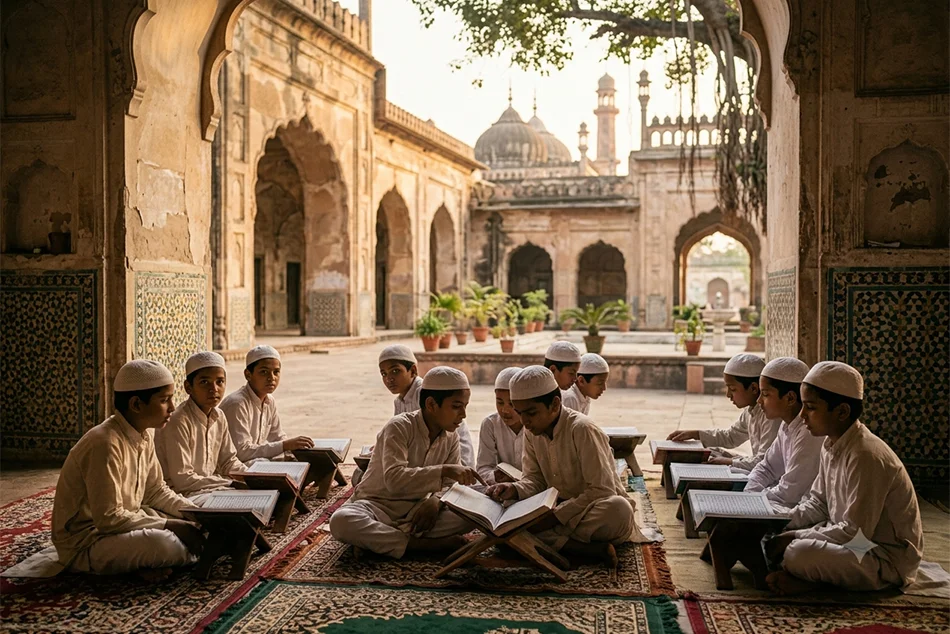
What happens when an educational system operating in a big city, that reaches more than one million children, undergoes a decade-long transition while experiencing a gradual reduction of its funding, a state inspection and a series of landmark lawsuits?
The stance on Madarasas in Uttar Pradesh changed dramatically between 2017 and 2026; from public promises of “modernization” for Madarasas, which was symbolised by the slogan “holding the Holy Quran in one hand and a computer in the other,” to systematic fiscal defunding, security audits, and their closure.
It is in this context that we will look at the multi-layered nature of government schemes, budgetary cuts, human survival and constitutional law and see how it transformed minority education in the most populous state of the country.
Fiscal Collapse of Modernization: The Shift from SPQEM to SPEMM
An understanding of the problem of the Uttar Pradesh madarasas is incomplete, unless we first consider how modern subjects like Science, Maths, English, Hindi, Social Studies and Computer Applications were brought into the traditional religious seminaries.
The Central Government initiated a nationwide drive to mainstream academics in the curriculum of madrassas in 1993-94 and further extended it in 2008 as the Scheme for Providing Quality Education in Madrasas (SPQEM), now known as the Scheme for Providing Education in Madrasas/Minorities (SPEMM).
The Cost-Sharing Formula and the 2016 Top-Up
In line with the terms of SPQEM, every participating recognized madrasa had the liberty to select up to three teachers from its academic staff for the modern academic subjects. The salary structure was based on the principle of joint financing of the Central and State governments:
- Central Share (60%): It is fixed at ₹6,000/month for a graduate teacher and ₹12,000/month for a post-graduate teacher or B.Ed-qualified teachers.
- State Share (40%): Matching funds for baseline honorarium.
- 2016 State Top-Up: The Uttar Pradesh government under Chief Minister Akhilesh Yadav launched an extra top-up of ₹2,000 for graduates and ₹3,000 for postgraduates in 2016. This increased the total monthly expected salaries to ₹8,000 and ₹15,000 respectively.
The Anatomy of a Budgetary Withdrawal
Imagine this funding partnership as a two-pillar bridge to support a road. Without the support of another pillar, one of those pillars will collapse and the whole bridge will eventually fall into the current below.
Since 2016-2017, teachers were no longer receiving funds from the Central. The scheme was transferred from the Ministry of Education to the Ministry of Minority Affairs in 2021. Soon afterwards, central allocations nose-dived:
- In 2021-22, the central budget stood at ₹160-174 crore.
- In 2022-23, central funding was drastically reduced to ₹30 crore (and spent well under that).
- In 2024-25, central allocation had been reduced to a paltry ₹0.01 crore (₹100,000) and more than ₹1,000 crore of central salary pendants remained unpaid in UP.
- In 2025-26 central allocation decreased to zero.
State Executive Disinvestment
Central funds were frozen and the UP state government initially kept paying a small ₹2000 to 3000 top-up. But in January 2024, the state government officially stopped paying the monthly honorarium, citing the official conclusion of the approved period of the central scheme. In addition, the state executive sought to formally repeal the salary law introduced by the Samajwadi Party in 2016 which guaranteed regular pay of madarasas’ staff and legal protection to them.
Most importantly, this removal of funds happened when Uttar Pradesh’s overall state budget is seeing an aggressive growth from the current FY 2024-25 of ₹7.36 lakh crore to the huge of ₹8.08 lakh crore in FY 2025-26. Even with this spending increase, the allocation of funds for modern subject teachers in recognised madarasas was systematically phased out.
Human Impact: Wage Delinquency, Debt and Miserable Work
The institutional statistics are just a cover for the lives of some 21,000 to 25,000 modern subject teachers in each of 7,442 government-aided and recognized madarasas in Uttar Pradesh. Interestingly, teacher association records show that there are about 40% of Hindu teachers who are recruited to teach the Hindi, Mathematics and Science subjects, while 60% are Muslims.
Many of these highly qualified educators have Master’s degrees or Ph.D qualifications have been tasked for periods of six to ten years (2013/2017 to 2026).However, they did not receive any central honorarium, nor did they receive the state top up later on.
Personal Debt and Livelihood Destitution
The amount of accumulated unpaid dues by individual teachers in 2024 was between ₹8.5 lakh and ₹10 lakh:
- Viresh Kumar (Barabanki): Amount due on salary without payment of any type was ₹9,37,674.
- Abhishek Pandey (Amethi): ₹9,14,333 dues.
- Rajesh Yadav (Azamgarh): Good salary claims made at ₹8,70,872.
The teachers took huge loans from local money-lenders and family members, hoping for repayment from the government in the form of arrears. Teachers were stuck in deep debt when they would not receive any of these.
Stories from the Ground
Mohammad Aqib (Sambhal) as a Mathematics teacher, he was appointed in 2014 with a Master’s Degree and computer diploma. After his salary ceased in 2017 he started driving an auto rickshaw every afternoon post his morning madarasas to pay for oxygen and treatment for his mother.
In 2023, 35-year-old English teacher Sarfuddin Ansari (Bareilly) collapsed several times in a mass protest at Eco Garden, Lucknow, in tears from depression and fatigue, crying out to police officers nearby not to allow him to starve as he was unable to feed his children or send them to school.
In 2019, Mohammad Arif, a 32-year-old teacher, died due to sudden cardiac arrest after remaining without a salary for 35 consecutive months, leaving his wife and old mother behind with a mentally disabled daughter, without any pension or social security benefits.
In such districts as Unnao, Ghazipur, Shravasti, and Varanasi, teachers with post-graduate degrees from leading institutes were pushed into the informal sector with jobs like selling tea and frying pakodas, vending vegetables, or doing daily wage work.
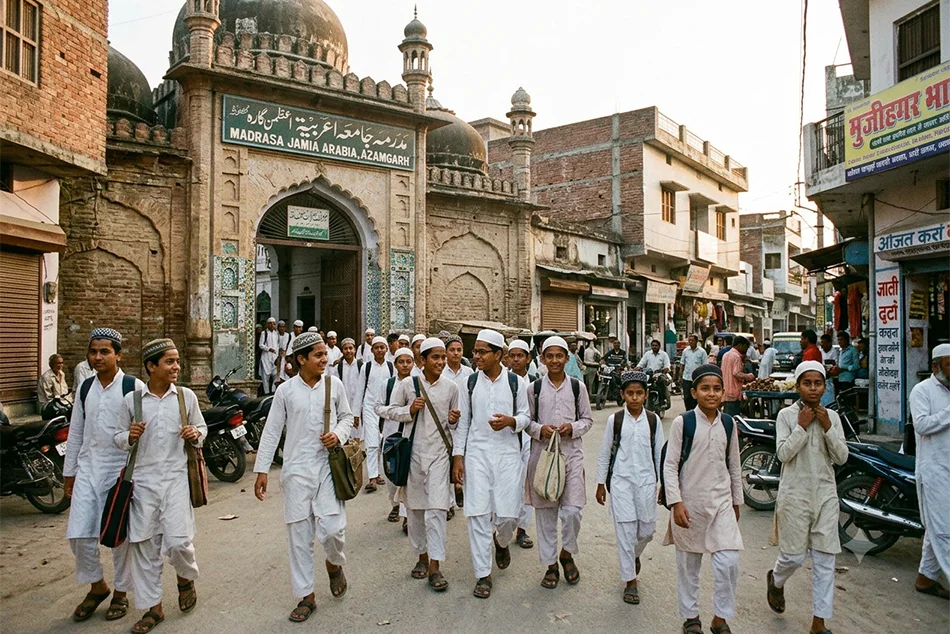
Administrative Scrutiny
Financial Defunding wasn’t a standalone event. This was accompanied by an unprecedented level of administrative audits, security investigations and physical inspections.
In the end of 2022, the state of UP ordered a detailed survey of the state to identify the unrecognized madarasas-institutions functioning without government funds and donated by the people, Zakah and Sadaqah. The survey came up with the number of 8,449 unrecognized madarasas.
The State government interpreted these independent institutions through a prism of security and thus formed a three-member Special Investigation Team (SIT) led by Anti-Terrorism Squad (ATS) to investigate foreign funding, especially in the districts bordering Nepal like Shravasti, Bahraich, Siddharthnagar, Maharajganj and Balrampur where madarasas are operating.
However, the representatives of the UP Madarsa Board pointed out that the general atmosphere of fear had been built by the regular ATS and police scrutiny of specific schools and a probe into an SIT into the irregularities in Mirzapur which led to FIRs against 42 madarasas run by its managers.
The Surrender of Recognition
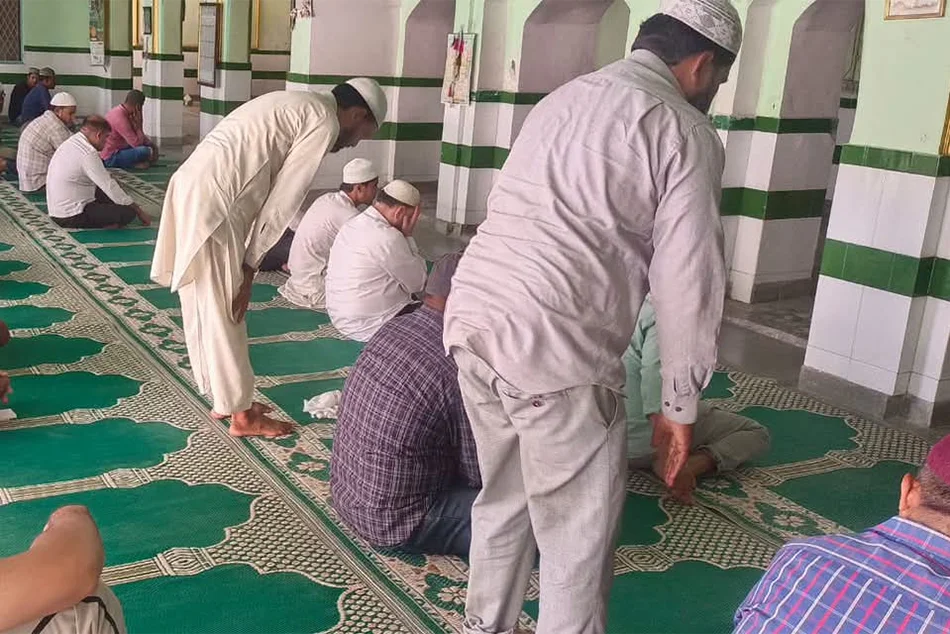
When the madarasas were facing zero state funding, unpaid teachers, very strong administrative scrutiny, and higher running costs, the madarasas’ management finally had enough. Institutions started making concerted efforts to be de-recognised.
At the end of 2024, data from UP Madarsa Shiksha Parishad showed that 513 madarasas had formally applied to withdraw from government recognition and close their schools.
- Ambedkar Nagar: 234 madarasas applied for voluntary closure as they were totally bankrupt after the collapse of SPQEM.
- Jhansi: 241 madarasas wanted to discontinue recognition, saying they were facing shortage of resources and students.
- Lucknow: 11 madarasas applied for closure and it was found from the ground that several of them had already closed or been converted into low cost private madarasas.
Judicial Battlefield
The constitutionality of madarasas in Uttar Pradesh has been challenged all the way up to the Supreme Court of India from 2024 to 2026. The controversy was over three basic constitutional principles namely, Secularism, Right to Education (article 21A) and Minority Rights to establish education institutions (article 30).
The Allahabad High Court on March 22, 2024, ruled the Uttar Pradesh Board of Madarsa Education Act, 2004 to be unconstitutional. The High Court decided that:
The Act was a breach of the principle of secularism (a basic structure of the Constitution) in establishing a state funded board for religious education.
The quality of education provided was not of the standard as per article 21A (Right to Education).
The state should liquidate the Board and promptly enrol all enrolled pupils into the government primary and secondary schools.
Spotting the writing on the wall, the Supreme Court intervened, issuing a landmark verdict on November 5, 2024.
In April, 2024, the Supreme Court stayed the High Court order and on November 5, 2024, a three-judge bench led by Chief Justice of the Supreme Court D.Y. Chandrachud set aside the High Court judgment and reinstated the constitutional validity of the UP Madarsa Act, 2004.
The Supreme Court laid down in very clear terms the following legal principles:
- Secularism and Basic Structure: A statute can be overturned only if it offends constitutional provisions or else it offends the “basic structure,” which is merely an abstract concept. The state has a positive duty to ensure that minority students meet academic standards to be able to participate in society.
- Conciliation of Article 21A and Article 30: Article 30 gives minorities the right to set up and manage its educational institutions. Academic standards set by the state, while not interfering with majority management of the day, are constitutional and desirable.
The Supreme Court held that the provisions of higher education degrees, for example, Kamil (undergraduate) and Fazil (postgraduate) were severable as they related to a distinct subject from that of the primary and secondary education Act, which was upheld.
The Court’s judgment was that the power to grant degrees in higher education is a power of the Union Government and shall vest with the University Grants Commission (UGC) under Entry 66 of List I (Union List).
The Executive Legislative Alignment, August 2026
The UP Cabinet formally revised the 2004 act in August 2026 in line with the verdict given by the Supreme Court. This was because the jurisdiction of the UP Madarsa Board was limited to the education up to class 12 equivalency while education up to higher degrees (Kamil and Fazil) was shifted to the State Universities including Khwaja Moinuddin Chishti Language University, Lucknow.
In another crucial order, the Allahabad High Court in Lucknow set aside district orders to forcefully seal unrecognised madarasas in Shravasti district in Madarsa Ahle Sunnat Imam Ahmad Raza v. State of UP case.
Justice Subhash Vidyarthi found that the UP Non-Governmental Arabic and Persian Madarsa Regulations (2016) do not seek to deny the recognition to any institution, but only gives it the option of not taking government recognition. The executive authorities have no statutory authority to compel the closing or sealing of an educational institution for failure to recognize it.
The educational dislocations and transition to informal work
What happens to children when madarasas are closed, teachers move to other schools, or fees are too expensive?
State policies intended to mainstream children, but empirical evidence suggests that there are many challenges in implementation that led to high dropout rates and that children were displaced in the informal economy.
The Enrollment Collapse
There was a significant drop in participation of the madarasas from 2016 to 2025 as per data of the Unified District Information System for Education (UDISE+) and the state exam boards, there were more than 4.22 lakh candidates appearing for the Board exams in 2016 but only 88,082 appeared for the exams in 2025.
The un-recognised madarasas show an 87% decline in official tracking systems, which in part is due to a tough enforcement of the Aadhaar programme, but was also due to many madarasas being closed on-site.
The overall student drop out rate of recognized madarasas was around 61% between 2016 and 2021.
Friction Points in Mainstream Integration
Once the madarasas were closed or their faculty of modern academics, the poor families had to deal with serious restrictions in transferring their children to the mainstream public or private schools such as, documentation barrier, formal Transfer Certificates (TCs) were frequently missing from children’s documentation and children from unrecognized madarasas were denied admission to mainstream government schools for failing to produce document of their age grade.
Further, public primary schools in rural areas were typically miles away, or overcrowded. The monthly fees of private schools were (₹1,500-2,000) plus the expenses of uniforms, books and transportation which were unaffordable for the families of 90% of the students of madarasas. And there was a disproportionate impact on female students. Where parents were willing to send young girls to the neighborhood madarasas, they would not be able to send their daughters to distant government schools that were co-educational, thus preventing girls from pursuing formal education.
The Path to Informal Labour
When schooling opportunities are limited, the economic burden on poor households forces adolescent children into the informal sector, who are absorbed in embroidery work (Zardozi) and endure eye strain for a nominal amount of money per day, young boys accompany migrating parents to roadside eateries (dhabas), automotive repair shops or seasonal brick kilns.
This non-conforming creates a direct clash with state obligations as per the Right to Education (RTE) Act, 2009 and Article 21A of the constitution, as it leaves vulnerable children completely out of the schooling system, if schools are closed and/or defunded without providing alternative, accessible and free public seats to them.
The withdrawal of state support and heavy administration pressure on madarasas in the state of Uttar Pradesh from 2017 to 2026 exemplifies the destabilisation of a school system, which educates more than one million children belonging to minority groups.
Mainstreaming and modernization were discussed, but there was unpaid salary for 21,000+ teachers, many teachers gave up institutional recognition, and there were more dropouts of students.
The judiciary was instrumental in performing a balancing function, with the Supreme Court affirming the rights of the minorities under Article 30 and making the higher education degrees uniform under the UGC, and with the High Court limiting arbitrary executive closures.
[The writer, Farhan Siddiqui, is an independent researcher with a postgraduate degree in Human Rights from Aligarh Muslim University (AMU). His research interests include indigenous rights, environmental justice, tribal governance, constitutional law, and sustainable development. He is actively engaged in human rights research, advocacy, and socio-legal studies.]
Follow ummid.com WhatsApp Channel for all the latest updates.
Select Language to Translate in Urdu, Hindi, Marathi or Arabic