When Political Fronts Multiply, Who Gains?
The new AIMIM–Azad Samaj Party alliance, political realignments and the arithmetic of power in Uttar Pradesh
Indian politics has a long record of leaders and parties changing alliances. Late Ram Vilas Paswan, a prominent Dalit leader who also enjoyed support among Muslim voters, moved from the NDA to the UPA in 2004 and returned to the NDA in 2014. Nitish Kumar left the NDA in 2013, returned in 2017, joined the opposition again in 2022 and rejoined the NDA in January 2024. Chandrababu Naidu’s Telugu Desam Party (TDP) left the NDA in 2018 and returned in 2024.
In Maharashtra, late Ajit Pawar, then a senior leader of the undivided NCP, joined the BJP-led government in July 2023. The NCP had been a constituent of the UPA, while Ajit Pawar himself had served in Maharashtra’s Congress–NCP coalition government. Assam’s current Chief Minister, Himanta Biswa Sarma, was once a prominent Congress leader who enjoyed support among sections of Muslim voters but is now a leading BJP politician.
These journeys show how political alignments change, even when leaders are elected on mandates shaped by entirely different political alliances. Many prominent Muslim politicians and political parties would, of course, join the BJP-led NDA if the BJP were willing to welcome them.
The BJP’s own political arithmetic does not appear to favour welcoming Muslims (read: Abduls) into its fold. Otherwise, its long-cultivated polarising rhetoric could lose credibility and its anti-Congress vote base could be jeopardised. However, its short-lived political partnership with Mehbooba Mufti in Jammu and Kashmir was an exception, driven by strategic calculations. The BJP withdrew support from her government in 2018, and the BJP-led Union government subsequently detained her in 2019.
Also Read: Who Owns Mandate: Question as MPs, MLAs Switching Sides Becomes a Norm
The record of AIMIM’s former allies is equally relevant. In Bihar’s 2020 Assembly election, Upendra Kushwaha’s Rashtriya Lok Samata Party (RLSP), Mayawati’s BSP, Om Prakash Rajbhar’s Suheldev Bharatiya Samaj Party (SBSP), AIMIM and two other parties formed the Grand Democratic Secular Front.
In Uttar Pradesh, Rajbhar’s SBSP was also part of the Bhagidari Sankalp Morcha, which included AIMIM, ahead of the 2022 Assembly election. Rajbhar joined the BJP-led NDA in July 2023. Kushwaha’s RLSP merged with JD(U) in 2021. Kushwaha later left JD(U), formed his own party and allied with the NDA.
All these short-lived past alliances arithmetically went against the UPA (now part of the INDIA bloc) and favoured NDA in the outcome. These precedents are relevant to any discussion of political consistency at any point of time.
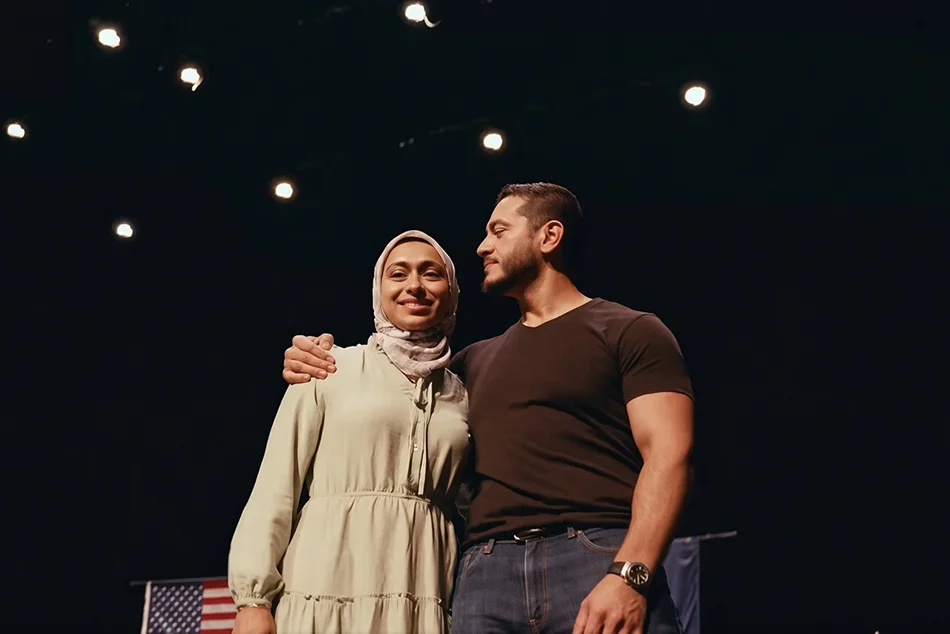
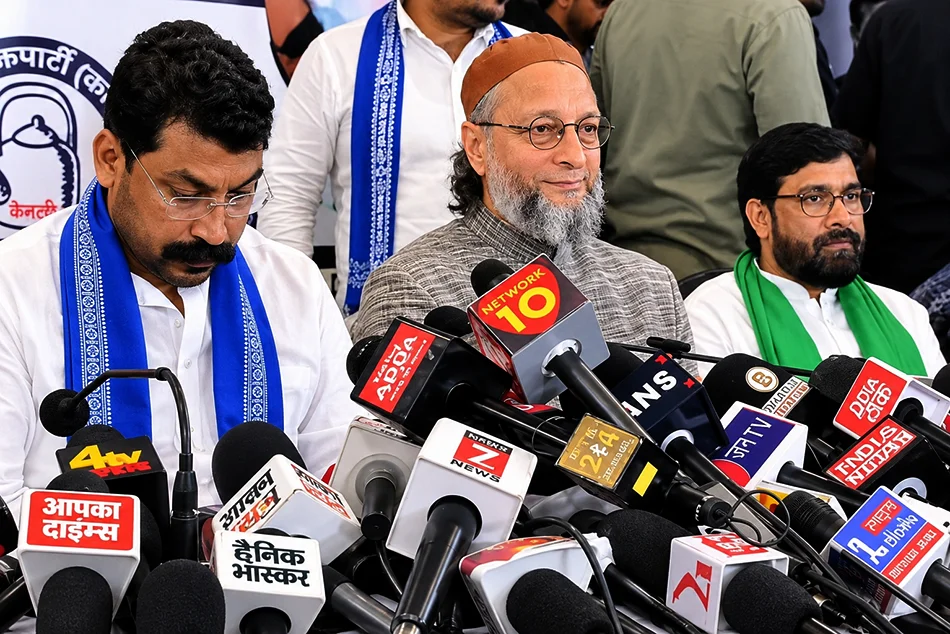
Against this background, Asaduddin Owaisi’s AIMIM and Chandrashekhar Azad’s Azad Samaj Party (Kanshiram) have once again announced the Samajik Parivartan Morcha for the 2027 Uttar Pradesh Assembly election. They say the alliance will contest all 403 seats, with Azad as its chief minister candidate.
Also Read: Abdul Won in America, So Abdul will Win in UP too: An Illusion!
Owaisi and Azad both describe their alliance as a platform for Dalits, Muslims, backward classes and marginalised communities. That stated objective deserves consideration, as does the electoral effect of fielding candidates across a state where opposition votes are already divided.
Uttar Pradesh elections are decided constituency by constituency, and many contests can be settled by narrow margins. Even a modest shift in votes can change the result. If the new front draws most of its support from voters who would otherwise back the INDIA bloc, while making little inroad into the NDA’s vote base, the BJP-led alliance could gain an advantage through opposition fragmentation. This is the arithmetic any critic of the front would raise. The question is how many votes it attracts — and from where? And how many MLAs can it win? What impact will they make?
Chandrashekhar Azad is an emerging, self-made Dalit leader whose rise has coincided with the decline of the BSP’s earlier dominance among sections of Dalit voters. His right to seek office is not in question. But Owaisi’s recent assertion that “Abdul” will no longer fix punctures or lay carpets for political leaders, but will become a leader himself, invites a practical question: If the larger objective is to make “Abdul” a leader, why should Azad automatically be the preferred choice for Abdul as chief minister?
Also Read: These stats show AIMIM indeed helped BJP win UP polls
Akhilesh Yadav has already served as chief minister and leads an established state-wide party. The Congress, too, represents a nationally recognised political formation, although its organisational strength in Uttar Pradesh is considerably different. Voters may reasonably ask what administrative experience, legislative strength and coalition support stand behind such a claim. Announcing a candidate before an election is not the same as demonstrating the ability to command a majority afterwards.
Notably, in the 2022 Uttar Pradesh Assembly elections, Asaduddin Owaisi’s AIMIM and Chandrashekhar Azad’s Azad Samaj Party fielded 95 and 110 candidates, respectively. Between them, contesting 205 seats, they failed to win a single seat, but they affected many outcomes.
This distinction matters because representation and governance are not the same thing. A state is governed by the party or coalition that commands a majority in its elected Assembly. Budgets, laws and major policy decisions are made through the legislature; one, two or a handful of members cannot ordinarily enact a programme on their own. Their influence depends on numbers, alliances and negotiating strength. A party may win votes and gain visibility, yet remain far from directing a government. The politically marginalised people of UP, including Muslims, are looking for legislative power, not a handful of token MLAs.
The question, then, is not whether smaller parties have the democratic right to contest elections — they do. It is whether their strategy strengthens the representation they promise or fragments an existing electoral coalition without creating a viable alternative for a poor-friendly government and legislation.
Fragmentation may create opportunities for individual politicians and parties, but its consequences will be reflected in the next Assembly and the government it produces. The interests of Dalits, Muslims and other marginalised citizens require more than slogans or symbolic claims: they require durable representation, legislative influence and accountable governance.
Voters must therefore assess every alliance not only by the promises made at its launch, but also by the electoral arithmetic it creates and the governing power it can realistically exercise.
[The writer, M. Burhanuddin Qasmi, is Editor, Eastern Crescent, Mumbai.]
Follow ummid.com WhatsApp Channel for all the latest updates.
Select Language to Translate in Urdu, Hindi, Marathi or Arabic