Who is The Indian Education actually working for?
Under the present education system, a tiny minority gets the space to explore and thrive; millions in the middle burn their youth and family savings chasing scarce entrance-exam ranks; and millions at the bottom collect certificates without acquiring the foundational skills needed to build a dignified life
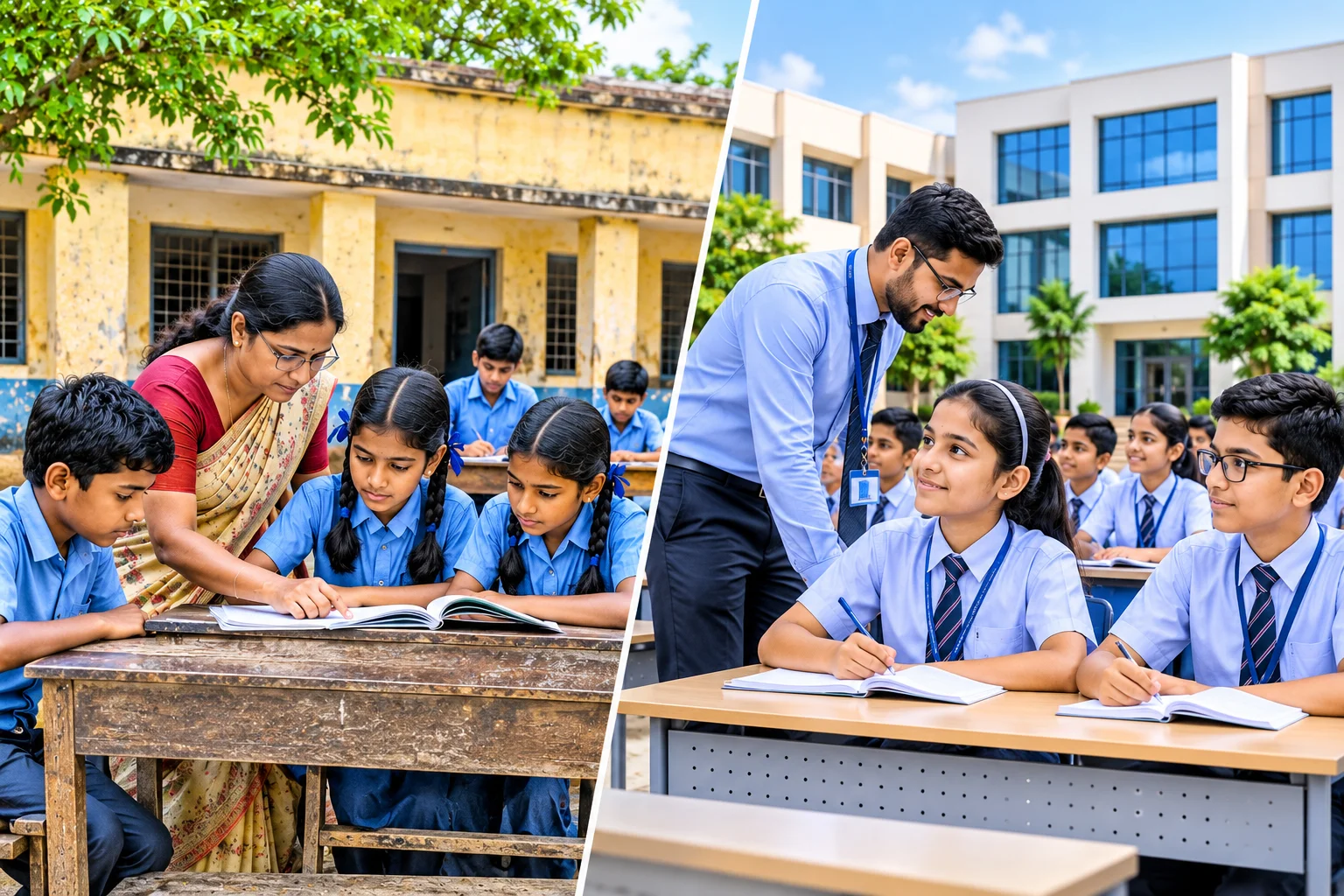
Last week, my wife and I spent Diwali with relatives whose teenagers attend an international school where the fees run to around ₹12 lakh a year. Though they were still in high school, their parents were already mapping out undergraduate degrees in Europe and North America. Their afternoons were packed — sports coaching, a foreign language, specialised training in areas they genuinely loved, sometimes even involving summer programmes abroad.
Watching them, I realised how rare that privilege is. These children weren’t merely being pushed; they had the resources and freedom to discover what they were good at and pursue it seriously. Yet sitting in that living room, it struck me how completely disconnected this world is from the reality of almost every other child in the country.
A few days later, chatting with my three-and-a-half-year-old grandson in San Jose, I noticed he was playing with the same toys and watching the same shows as the kids I meet in urban India. Many affluent Indian parents speak to their children mostly in English now, preparing them early for global universities. English is a wonderful passport, and global exposure is a gift. Still, I sometimes wonder what quietly slips away when local languages, stories, and neighbourhood life become optional extras. It isn’t about holding children back from the world; it’s a quiet question about what we choose to pack in their bags before they leave.
Three Worlds Under One Roof
Step outside that affluent circle, though, and Indian education fractures into at least three distinct worlds, each playing by entirely different rules.
At the top is a small, globally mobile elite buying world-class schooling and tailored mentorship. At the other end are lower-income households — often earning under ₹5 lakh a year, who rely largely on the state. According to the Ministry of Statistics’ 2025 survey, government schools still educate 55.9 per cent of India’s schoolchildren, and two-thirds of those in rural areas.
Of course, India is too vast for a single brushstroke. Southern states, like Kerala and Tamil Nadu, have long led the way in school infrastructure, mid-day meals, and keeping girls in class—just as central institutions like Kendriya Vidyalayas and Navodaya Vidyalayas routinely deliver strong results nationwide. But high enrolment does not automatically translate into strong foundational learning. Outside standout performers like Kerala, basic reading levels in several southern states remain surprisingly close to the national average—where, according to the 2024 ASER survey, only 23.4 per cent of Class III children in rural government schools (and 35.5 per cent in private ones) could read a simple Class II text. Across much of India, getting children into classrooms has proved far easier than ensuring they learn once they are there.
I saw what happens in that gap through a woman who worked with our family for nearly ten years. She had arrived from a village in Uttar Pradesh after middle school, and with my wife helping her study, she enrolled in an open-schooling programme. Over five years of remarkable grit, she passed both her Class X and Class XII exams. We were thrilled for her. Yet when I happened to see her writing later, I was taken aback—she still struggled to put together basic sentences in Hindi or English. Her determination was inspiring, and open schooling gave her a vital second chance. Still, it exposed a troubling flaw: we measure progress by pass percentages and degrees awarded, even when a certificate hides the absence of basic skills.
The Parallel Economy of Anxiety
Between these two extremes sits India’s vast, anxious middle—striving lower-middle and middle-income families, earning anywhere from ₹5 lakh to ₹25 lakh a year, for whom education is the primary ladder to upward mobility. Their worry isn’t basic literacy; it’s the fear of being left behind. That quiet panic has built a massive parallel industry. Today, India’s private coaching market is worth roughly ₹1 to ₹1.1 lakh crore—nearly 80 per cent of the Union government’s entire education budget of ₹1.286 lakh crore—and 27 per cent of school students take private coaching. From Kota’s engineering hostels and Delhi’s civil-services hubs to Hyderabad’s integrated junior colleges—where regular schooling and entrance coaching merge into a single 12-hour grind—families pay for schooling and then pay all over again for coaching, convinced that school alone cannot get their children across the finish line. Roughly two-thirds of this test-prep economy feeds into government recruitment exams, while the rest powers the fierce race for engineering, medical, and management seats—a clear sign that coaching isn’t really about learning; it’s about buying economic security.
That bottleneck turns brutal at college admissions. A friend’s son missed out on an IIT seat and pivoted to become a Company Secretary; his daughter scored 92 per cent in Class XII, missed her preferred Delhi University course, and enrolled in Patiala instead. Whenever desirable seats are scarce, public debate quickly gets tangled in arguments over cut-offs and reservations. Yet watching families navigate this, it becomes clear that the deeper crisis is an acute shortage of trusted, high-quality institutions. While new IITs, IIMs, and AIIMS campuses have expanded numbers on paper, many still lack the seasoned faculty, clinical depth, and campus culture of the older flagships. Meanwhile, the vacuum has been filled by a boom in private engineering, medical, and management colleges that charge astronomical fees while offering uneven, often mediocre education.
Sorting Instead of Educating
Looking across these three worlds, it is clear that India is too vast and regionally varied for easy generalizations. Public schooling in Kerala looks very different from a village classroom in Uttar Pradesh, and disparities in educational quality exist everywhere in the world—from the United States to Europe. What makes India’s divide so striking, however, is how acute the gap has become, and how deeply the system has shifted from educating children to sorting and credentialing them.
A tiny minority gets the space to explore and thrive; millions in the middle burn their youth and family savings chasing scarce entrance-exam ranks; and millions at the bottom collect certificates without acquiring the foundational skills needed to build a dignified life.
You cannot fault parents for playing the hand they’re dealt, or for spending whatever they can to give their children a shot. But until we strengthen foundational learning in ordinary classrooms and build genuinely good colleges at scale, education in India will remain less an engine of opportunity—and more a mirror of the family a child happens to be born into.
[The writer, Vinay Kumar, is former Journalist, RBI Banker and International Development Leader.]
Follow ummid.com WhatsApp Channel for all the latest updates.
Select Language to Translate in Urdu, Hindi, Marathi or Arabic