2026 West Bengal Elections While 'Infiltrations' Go Unchecked
The unfolding controversy around the Special Intensive Revision (SIR) in West Bengal has reopened old wounds — raising fundamental questions about citizenship, belonging, and the democratic right to vote.
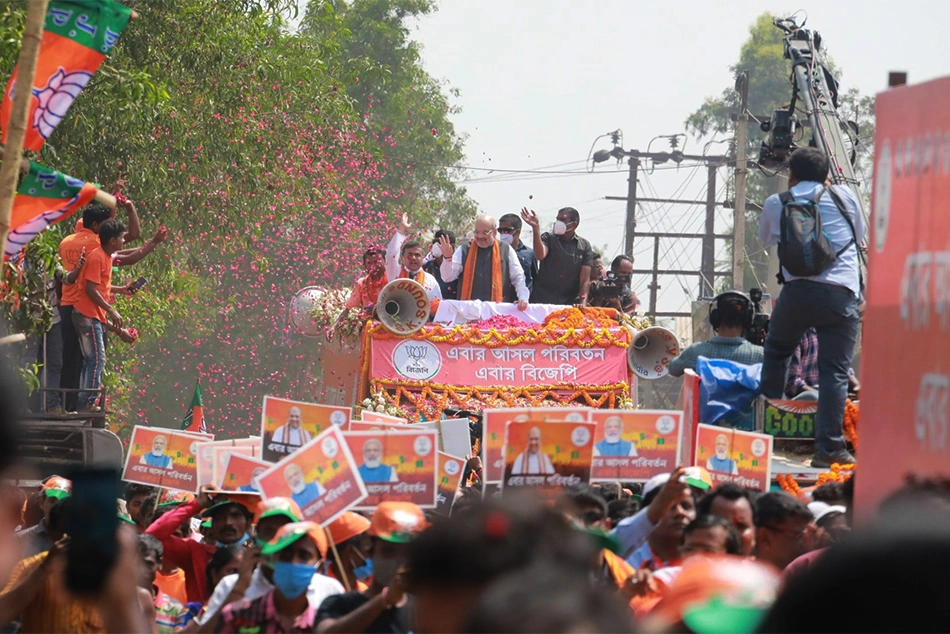
With the hand that bestows boons on their heads, the Hindus of Bengal must not be afraid of losing their voting rights. This is the candid message from Home Minister Amit Shah to the Hindus of Bengal, especially the Matuas — Dalit Hindus, whose names, at least 40 percent of the total Matua population, have been relegated to the category of “logical discrepancy.”
Though his assurance counters both the eligibility criteria and the norms laid down by the Election Commission of India (ECI) for exercising the right to vote, he has been emphatic that no power can deter them.
With his abrasive style of functioning, Amit Shah has managed to build the image of a muscleman politician — someone above the law whose words themselves become law.
In this backdrop, his claim is expected to be believed. He can go to any extent to twist legal norms and provisions to help his Hindu voters. But, fully conscious of the implications of what he said, he simply reinforced the common perception — without ambiguity, that the Special Intensive Revision (SIR) exercise, which has been underway in Bengal and already completed in Bihar, was initiated by Chief Election Commissioner Gyanesh Kumar at the behest of his political masters, Narendra Modi and Amit Shah, to disenfranchise Muslims and subsequently turn them into non-entities and infiltrators — landless in their own land.
Justifying his position, Shah on February 2, while addressing the BJP’s Poriborton Yatra in South 24 Parganas district, declared that “only names of infiltrators are being deleted now,” and they would be “pushed out of the state” once the party comes to power with a full majority in West Bengal. Amit’s assertion implicitly suggests that the saffron ecosystem is engaged in a dangerous political game.
The question Shah prefers to ignore is this:
Why, as Home Minister, did he not initiate action against the Bengal government, or against Mamata Banerjee, for allegedly turning Bengal into a “swarg (heaven) for infiltrators” and compromising the security of a border state by allowing illegal immigration?
His second accusation is even more serious: How could a state government or chief minister force the state’s security apparatus to compromise? His failure to act only reinforces the perception of incompetence or lack of security vision and determination.
He is simply indulging in a game of one-upmanship to portray the state government and Mamata Banerjee in a poor light. This comes as no surprise. It is part of the saffron playbook — resorting to exaggerated claims to justify political narratives.
If Amit Shah can assure Hindus that they will be allowed to vote despite being categorised under “logical discrepancy,” why cannot the same assurance be extended to others placed in the same category? A logical discrepancy refers to a data inconsistency identified by automated systems when comparing information across datasets — such as unreasonable age differences between relatives, mismatched names, or invalid mapping to earlier records.
Obviously, a logical discrepancy does not make a voter anti-national or an infiltrator. If Hindus are victims of the Election Commission’s automated system, Muslims too are victims of the same mechanism. Then, if Shah can facilitate Hindus to vote, he could extend the same facility to Muslims.
Bengal is a border state. It is possible that some Bangladeshi Muslims have crossed into Indian territory. But that does not mean all Muslims living along the Bangladesh border are infiltrators.
Shah was emphatic that only the BJP can provide security to Bengal. Fair enough — but what has he been doing for all these years as Home Minister? It is Amit Shah’s primary responsibility to check cross-border infiltration. Instead, he has been indulging in the familiar game of passing the buck and maligning Mamata Banerjee.
His remarks come against the backdrop of the post-Special Intensive Revision electoral rolls published on February 28, which recorded 63.60 lakh deletions — 8.3 percent of the electorate, since the exercise began in November. This has reduced the voter base to just over 7.04 crore, significantly redrawing constituency arithmetic ahead of the 2026 Assembly elections.
How can Amit Shah guarantee that infiltration and corruption will stop when the BJP comes to power with a full majority? Has the BJP succeeded in eliminating corruption in Bihar or in other states where it is in power?
At present, seven lakh Bengal voters have been deleted and 63.60 lakh are under adjudication. It is feared that by the time the SIR process is completed, the number of deletions may rise further. These voters are considered suspect by the ECI and are awaiting verification. Election officials maintain that deletions were primarily due to death, migration, duplication, and untraceability.
Amit Shah’s confidence owes much to the groundwork done by Gyanesh Kumar in preparing the electoral terrain. Kumar reportedly intends to hold the election in the last week of March or the first week of April. The full bench of the ECI headed by him will meet in Kolkata on March 8, 2026 to finalise the dates.
Critics allege that Kumar does not intend to give sufficient time to voters whose names have been shifted to the “logical discrepancy” category to rectify their records. Once the elections are over, their exclusion could be justified on the grounds that the cases remained unresolved due to lack of time.
With a large number of under-adjudication voters coming from minority belts, the Trinamool Congress (TMC) faces a serious electoral challenge. Even if the judicial officers assigned to handle these cases work overtime, they may not be able to dispose of more than half of the 63.60 lakh cases before the last date for filing nominations — which is also the deadline for voter inclusion.
Currently, each of the 501 judicial officers is disposing of about 225 cases a day. At that rate, clearing the entire backlog would take around 53 days.
There is no denying that the façade of “logical discrepancy” appears to have been created in a manner that could electorally benefit the BJP.
Since its formation, the Trinamool Congress has maintained a support base of nearly 40 percent. The BJP’s core support base historically remained around 10 percent. In the 2016 Assembly elections, TMC secured 44.97 percent of the vote while the BJP received about 10 percent.
The BJP’s first major surge came in the 2019 Lok Sabha elections, when its vote share jumped to around 40 percent, while the TMC secured 43.37 percent. But in the 2021 Assembly elections, the BJP’s vote share declined to 38 percent, while the TMC’s rose to 48 percent.
The 2021 results showed that the BJP could not sustain its 2019 momentum. That year it won 77 seats but finished second in 215 constituencies. It lost nearly 32 seats by margins of less than 4 percent and about 30 seats by margins between 5 and 10 percent.
The deletion of voters seemingly aimed at filling this gap in around 62 constituencies. If even an average of 1,000 votes per constituency were deleted, the exercise could potentially swing 50–60 seats. Such a shift would reduce TMC seats by a similar number.
In effect, Amit Shah is engaged in a high-stakes psychological and electoral strategy. Whether Mamata Banerjee succeeds in countering this strategy remains to be seen.
An official admitted, “It’s clear that most of the voters under adjudication are from minority-dominated areas. If close to 30 lakh cases remain pending before the polls, these voters will not be able to vote. This will be a blow to the ruling party.”
More than that, it would amount to a virtual denial of the right to vote.
The controversy has also revived anxieties among the Matua community — Dalit Hindu refugees from Bangladesh. Despite being eligible under the Citizenship Amendment Act (CAA), many are still struggling to obtain formal Indian citizenship. Though many possess voter IDs, they remain uncertain about their legal status due to complex documentation requirements.
The community is a crucial electoral bloc in Bengal, influencing at least 24 Assembly segments. Both the BJP and the TMC have sought their support, often offering conflicting guidance regarding citizenship procedures.
The spectre of voter-list deletions among Matuas has triggered panic in Matua-dominated regions. Estimates suggest that 30–40 percent of voters in some areas are affected because they cannot produce historical documents proving their ancestry.
The SIR process requires voters to establish their own or their ancestors’ presence in India, often linking documents to the 2002 electoral roll. Many Matuas — refugees who migrated decades ago — simply do not possess such records. With influence in more than 50 Assembly seats across south and north Bengal, the community’s anxiety over identity, documentation and belonging has deepened.
The Matuas, followers of a 19th-century reformist movement that challenged caste hierarchies, began migrating from East Pakistan in the 1950s. Today they constitute nearly 17 percent of West Bengal’s population and form the state’s largest Scheduled Caste group.
Once courted by the Left and later by the TMC, many Matuas shifted toward the BJP after 2019, when the party foregrounded the citizenship issue. Yet, despite promises, citizenship certificates issued so far remain minuscule compared to an estimated one crore eligible applicants.
The unfolding controversy around the SIR exercise has therefore reopened old wounds — raising fundamental questions about citizenship, belonging, and the democratic right to vote.
[The writer, Arun Srivastava, is a Senior Journalist.]
Follow ummid.com WhatsApp Channel for all the latest updates.
Select Language to Translate in Urdu, Hindi, Marathi or Arabic