White Paper on 12 Years of Modi Rule in India
Supporters present a list of success, however, critics argue that the Narendra Modi government has been marked by economic shocks, democratic backsliding, rising inequality, unemployment, weakening institutions, and a politics heavily driven by perception management
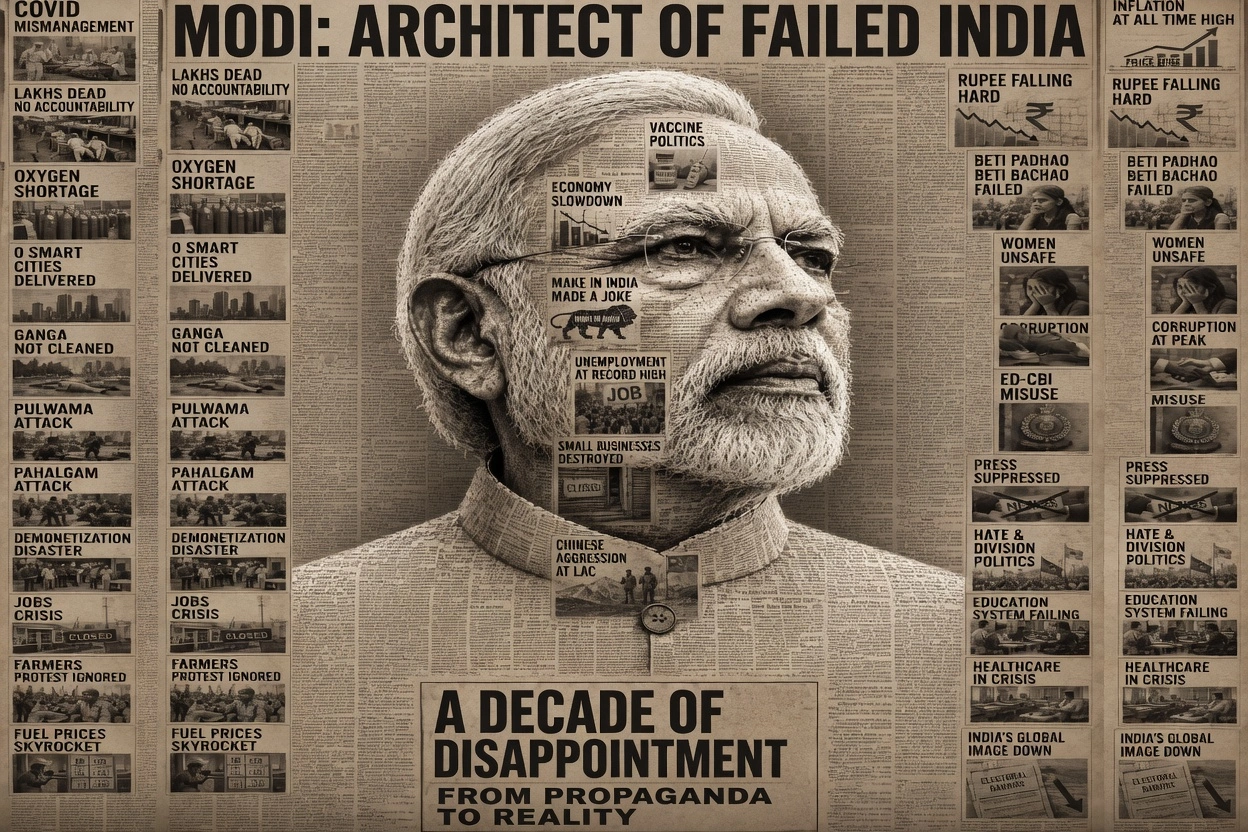
On 26th May, Narendra Modi completed 12 years in office as the Prime Minister of India. While his supporters celebrated the occasion and congratulated him, critics argue that these 12 years have been marked by major failures, aggressive image-building, and political PR aimed at shaping public perception ahead of elections. His rise to power in 2014 was built on extraordinary promises — “Achhe Din,” two crore jobs annually, corruption-free governance, recovery of black money, minimum government and maximum governance, and a new India driven by development.
Twelve years later, India remains deeply divided over his legacy. Supporters point to infrastructure growth, welfare schemes, digital transformation, and India’s growing global visibility. Critics, however, argue that the Modi era has been marked by economic shocks, democratic backsliding, rising inequality, unemployment, weakening institutions, and a politics heavily driven by perception management.
In this article, we will examine the criticisms of the Modi years through data, surveys, economic indicators, and media reports.
The Promise of Jobs Vs. the Reality of Unemployment
One of the biggest promises of the Modi era was employment generation. In 2014, the BJP promised two crore jobs annually. Yet unemployment has remained one of the most persistent criticisms of the government.
A recent Reuters report on the rise of youth-driven political satire groups highlighted growing anger among India’s young population over unemployment and economic insecurity. The report cited surveys showing widespread anxiety among youth regarding jobs and the future.
According to the Reuters report, unemployment among Indians aged 15–29 was around 9.9%, while youth concerns over inflation and opportunities continue to grow.
The frustration is not limited to opposition parties. Social media movements, student protests over exam paper leaks, and dissatisfaction among graduates reflect a widening gap between aspiration and opportunity.
Critics argue that despite headline GDP growth, India has struggled to create enough quality jobs, especially in manufacturing. The informal sector the backbone of employment in India was severely disrupted by demonetisation and the early implementation of GST.
Demonetisation: A “Masterstroke” or Economic Disaster?
On November 8, 2016, the Modi government announced demonetisation and banned ₹500 and ₹1,000 currency notes overnight. The government said the move would help eliminate black money, fake currency, and terror funding. However, critics argue that demonetisation failed to achieve its main objectives.
Economists and opposition leaders pointed out that almost all the banned currency eventually returned to the banking system. This raised serious questions about the government’s claim that large amounts of black money would be destroyed. Critics also said the sudden decision badly affected small businesses, daily wage workers, and the informal sector, which largely depended on cash transactions.
The cash shortage created major problems across the country. Small businesses suffered heavy losses, many workers lost their jobs, long queues were seen outside banks and ATMs, and rural consumption declined sharply. People struggled for weeks to access their own money.
Supporters of the government defended demonetisation by saying it encouraged digital payments and brought more transactions into the formal economy. However, critics believe that the economic damage caused by the move was far greater than its benefits.
Later, revised GDP figures showed stronger-than-expected economic growth during the demonetisation period, which supporters used to justify the policy. But many economists questioned whether GDP data truly reflected the suffering and disruption faced by India’s vast informal economy.
GST: Reform with Structural Pain
The Goods and Services Tax (GST) was presented as “One Nation, One Tax.” While economists broadly supported tax unification in principle, the rollout faced severe criticism.
Small traders and MSMEs complained about:
- Complex compliance systems
- Multiple tax slabs
- Frequent rule changes
- Digital filing burdens
Critics argued that poorly implemented GST hurt India’s informal sector and small enterprises already weakened by demonetisation. Even reports broadly favorable to the Modi government acknowledged that job growth remained slow despite reforms.
Rising Inequality and Corporate Concentration
Another major criticism of the Modi years has been the concentration of wealth and the growing perception of crony capitalism. Opposition leaders and independent analysts have repeatedly accused the government of favoring large corporate groups while small businesses struggle. Critics point to:
- Privatization drives
- Tax cuts for corporations
- Increasing market dominance by a few conglomerates
- Weak support for MSMEs
Financial crises, inflationary pressures, and stagnant wages have intensified this criticism.
The Financial Times recently reported concerns about rising economic stress, inflationary fears, and public anxieties over economic hardship.
Inflation and Cost of Living
The Modi government initially benefited from low global oil prices, which helped keep inflation relatively controlled during its early years. However, rising fuel prices, food inflation, and cost-of-living pressures have increasingly affected ordinary Indians in recent years.
Critics argue that despite strong branding around development, the economic burden on middle- and lower-income households has grown significantly. A Reuters report on youth concerns identified inflation as one of the biggest anxieties among India’s younger generation and the current crisis is making things bad to worse.
Democratic Backsliding and Media Freedom Concerns
One of the sharpest global criticisms of the Modi era concerns democracy and institutional independence. International media organizations, civil liberties groups, and opposition leaders have raised concerns about:
- Pressure on journalists
- Investigative agencies targeting opposition leaders
- Weakening parliamentary debate
- Arrests under anti-terror laws
- Online censorship
- Shrinking space for dissent
A Guardian analysis after the 2024 elections described the result as a pushback against what critics called “authoritarian tendencies.” Recent Reuters reporting on viral youth political movements also referenced allegations of crackdowns and intimidation faced by government critics online. Critics argue that the Modi government has increasingly centralized power around the Prime Minister’s Office, reducing institutional autonomy.
The Politics of Narrative and Image Management
The Modi era has significantly changed political communication in India. The government has made extensive use of social media, centralized messaging, large-scale branding, event-based politics, and personality-centric campaigning in ways never seen before in Indian politics. Critics argue that this style of politics focuses more on creating a strong public image than ensuring accountability. They say government achievements are heavily promoted, while failures are often blamed on previous governments, global situations, or state administrations. On the other hand, supporters believe this communication strategy represents modern political outreach and allows direct engagement with the public.
Polarization and Identity Politics
Another major criticism has been increasing religious polarization. Critics accuse the BJP ecosystem of using:
- Religious mobilization
- Hindu nationalist narratives
- Polarizing election rhetoric
- Targeted political messaging
To consolidate electoral support the opposition parties and activists argue that communal tensions and hate speech incidents have increased during the Modi era. Supporters counter that the government has promoted cultural confidence and corrected historical imbalances. This divide remains one of the defining features of contemporary Indian politics.
Welfare vs Structural Reform
The Modi government has undeniably expanded welfare delivery through schemes such as:
- Ujjwala Yojana
- PM Awas Yojana
- Free ration distribution
- Jan Dhan bank accounts
- Direct benefit transfers
Supporters see these as transformative social interventions.
However, critics argue welfare expansion has not solved deeper structural issues such as:
- Job creation
- Agricultural distress
- Healthcare infrastructure
- Educational quality
- Income inequality
The criticism is that welfare has often substituted for long-term structural economic transformation.
Electoral Success Despite Criticism
Despite intense criticism, the BJP under Narendra Modi has remained electorally dominant for much of the last decade. Surveys by Pew Research Center showed very high approval ratings for Modi during his early years in office. Supporters continue to view him as a strong and decisive leader compared to a fragmented opposition.
However, critics and opposition parties have increasingly raised concerns about the functioning of democratic institutions during the Modi era. The BJP has often faced allegations of misusing central agencies and institutions to strengthen its political position. Opposition leaders have accused agencies such as the Election Commission of India (ECI), Enforcement Directorate (ED), and Central Bureau of Investigation (CBI) of acting selectively against opposition parties while remaining soft on ruling party leaders.
Recent controversies surrounding the Special Intensive Revision (SIR) process have also triggered allegations that electoral mechanisms are being used to influence outcomes in favour of the ruling party. Critics argue that such moves raise serious concerns about transparency and fairness in the electoral process.
Congress leader Rahul Gandhi has repeatedly alleged “vote chori” (vote theft) and manipulation of electoral systems during press conferences and public speeches. According to the opposition, these allegations reflect a growing fear that elections are no longer being fought on a level playing field. BJP leaders, however, have strongly rejected these accusations and described them as baseless attempts by the opposition to justify electoral defeats.
These debates highlight a larger political reality in India today — while millions continue to support Modi and the BJP, concerns over institutional independence, electoral fairness, and democratic accountability have also become central to the national political discourse.
Conclusion
The story of the Modi years remains deeply debated and politically divisive. Supporters see this period as an era of national pride, welfare expansion, infrastructure development, strong leadership, and India’s growing global influence. They believe Narendra Modi has transformed India’s image on the world stage and strengthened the country politically and economically.
However, many view these 12 years very differently. They argue that many major promises remained unfulfilled and point to rising unemployment, economic disruptions, growing inequality, democratic erosion, and increasing polarization in society. According to them, governance during this period has often focused more on image-building and political narratives than on accountability and addressing ground realities.
Twelve years later, the Modi era continues to be one of the most transformative as well as controversial chapters in modern Indian political history. The debate over whether it represents India’s rise as a stronger nation or a period of democratic decline is likely to shape the country’s political future for many years to come.
[The writer, Mohd Ziyauallah Khan, is a freelance content writer & editor based in Nagpur. He is also an activist and social entrepreneur, cofounder of the group TruthScape, a team of digital activists fighting disinformation on social media.]
Follow ummid.com WhatsApp Channel for all the latest updates.
Select Language to Translate in Urdu, Hindi, Marathi or Arabic