Best Crypto Derivatives Platforms in 2026: Liquidity and Slippage Compared
The number of crypto derivatives platforms with verifiable trust scores has grown since 2024 — but execution quality still varies wildly between them, scroll through any leaderboard and you'll see dozens of platforms advertising perpetual futures
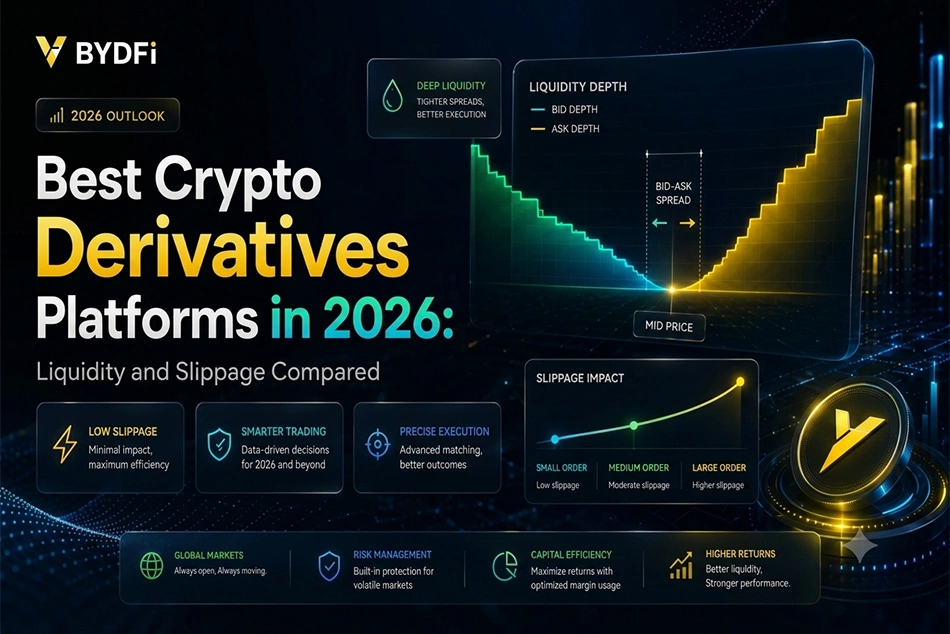
Crypto Derivatives Platforms: Liquidity & Slippage Compared
The number of crypto derivatives platforms with verifiable trust scores has grown since 2024 — but execution quality still varies wildly between them. Scroll through any leaderboard and you'll see dozens of platforms advertising perpetual futures. The real differentiator isn't whether a platform lists derivatives. It's how much each trade actually costs once you account for slippage, fee drag, margin conversion overhead, and the time it takes to go from signup to open position.
Most comparison guides rank platforms by pair count or max leverage and leave it there. That misses the structural factors quietly draining accounts over hundreds of trades. We're taking a different angle here: looking at design choices — margin type diversity, fee tier depth, onboarding friction, position management tools — that tend to correlate with better execution on crypto derivatives platforms.
One caveat upfront: Real liquidity depth and slippage can only be measured against a live order book. No static review replaces that. What we can compare are the structural indicators that tend to produce tighter fills.
Why Slippage on Crypto Derivatives Platforms Costs More Than You Think
On a derivatives platform, effective slippage is the total hidden cost per trade — a composite of order book depth on the specific pair, maker/taker fees baked into each execution, conversion costs if your collateral doesn't match the contract's margin currency, and latency from onboarding delays when a market-moving opportunity appears.
A trader paying 0.06% taker fees on every entry and exit racks up 0.12% round-trip before price movement even enters the picture. Across hundreds of trades, that fee drag compounds into a cost that behaves exactly like chronic slippage. As [Investopedia's explanation of futures trading](https://www.investopedia.com/terms/f/futures.asp) notes, transaction costs are a critical but frequently underestimated component of derivatives profitability.
The Hidden Cost of Limited Margin Options
If a platform only supports USDT-margined perpetuals and you're holding ETH or BTC as collateral, you're forced to convert before opening a position. That conversion carries its own spread and fee — value lost before the trade even begins.
Crypto derivatives platforms offering multiple margin types cut this friction. [BYDFi](https://www.bydfi.com/en) lists 500+ perpetual contract pairs across three margin types: USDT-M, USDC-M, and COIN-M futures. The USDC-M option came in August 2025, giving traders who hold stablecoins beyond USDT a native collateral path. That three-margin structure adds real flexibility for managing collateral and cutting conversion-related costs.
A broader contract offering can improve trading flexibility and capital deployment options, although liquidity ultimately varies by market.
Fee Tiers That Quietly Shape Every Trade
Fees are the one execution-cost variable you can directly control through platform selection and volume thresholds. The spread between base-tier and high-volume pricing across crypto derivatives platforms is substantial.
The platform's base-tier structure sits at maker 0.02% / taker 0.06%. The real savings come through a 7-tier VIP program (VIP 0 through VIP 6), based on 30-day futures volume or asset balance. At VIP 6, fees drop to maker 0.008% / taker 0.032% — a 60% reduction from base rates.
Over hundreds of trades, that gap adds up fast. For anyone trading actively, understanding how fee tiers scale with volume is one of the highest-leverage decisions you can make about platform selection.
Onboarding Friction: A Different Kind of Slippage
There's a form of slippage that never shows up on any trading dashboard — time-to-market. A trader spots an asymmetric setup — maybe a [funding rate](https://www.coingecko.com/en/coins/bitcoin/funding_rate) divergence or a breakout confirmation — and then faces 24 to 72 hours of KYC verification before they can act. By the time the account goes live, the entry price has moved. It's one reason traders increasingly seek out a no KYC crypto exchange that lets them move from registration to live trading without delay.
The platform allows email-only registration with immediate access to derivatives trading within tier-based withdrawal limits. Higher thresholds require identity verification. Once registered, users can access spot trading across 600+ pairs, futures across 500+ pairs, copy trading, trading bots, and demo trading.
Position Management That Reduces Forced Liquidation
Unnecessary liquidations during volatile conditions are effectively extreme slippage events — the worst execution outcome a derivatives trader can face. In December 2024, the exchange upgraded its perpetuals system with features targeting this problem: the ability to open new positions without unrealized profits, bi-directional long/short hedging, and shared funds in full-margin mode to reduce liquidation risk.
Both cross margin and isolated margin are supported, with leverage from 1x to 200x. Order types include Limit, Market, Stop Limit, and Stop Market, with TP/SL and Reduce-Only controls. The bi-directional hedging capability lets traders hold simultaneous long and short positions on the same pair without netting — genuinely useful during choppy, directionless markets.
Complementary Tools: Demo, Copy Trading, and Bots
Want to evaluate a crypto derivatives platform's execution quality before putting real money on the line? The demo trading account comes preloaded with 50,000 USDT and replicates real market conditions across both USDT-M and Coin-M perpetuals. It's a practical way to test how orders fill under different volatility regimes.
For newer traders, copy trading launched in January 2025, followed by Perpetual Smart Copy Trading in August 2025. The platform also offers four automated bot types — Spot Grid, Spot DCA, Futures Grid, and Spot Martingale — plus a Bot Marketplace for community-created strategies. The exchange has operated continuously since 2020, now serving over 1,000,000 users across 190+ countries, and publishes Hacken-audited Proof of Reserves reports covering BTC, ETH, and USDT.
FAQ
What structural factors affect slippage on crypto derivatives platforms?
Slippage is shaped by order book depth, margin type diversity (which reduces conversion costs), maker/taker fee structure, pair breadth, and onboarding speed. Platforms offering multiple margin types and competitive fee tiers tend to deliver better net execution costs.
How do fee tiers reduce the effective cost of trading futures?
Volume-based VIP programs lower maker and taker fees as activity increases. At VIP 6, fees drop to maker 0.008% / taker 0.032% — a 60% discount from base rates — which compounds into meaningful savings over hundreds of trades.
Can you trade on crypto derivatives platforms without KYC verification in 2026?
Some platforms allow derivatives trading without full identity verification within tier-based limits, as requirements vary significantly across regions.
What margin types should derivatives traders look for?
Crypto derivatives platforms offering USDT-margined, USDC-margined, and coin-margined contracts let you post collateral natively without converting assets, reducing conversion-related costs and improving capital efficiency.
Bottom Line
Execution quality on crypto derivatives platforms comes down to structural choices — margin flexibility, fee architecture, and how quickly you can get from zero to live position. The platforms that nail those details tend to cost traders less per trade, compounded across hundreds of executions. That's where the edge is.
Follow ummid.com WhatsApp Channel for all the latest updates.
Select Language to Translate in Urdu, Hindi, Marathi or Arabic