West Bengal where the Constitution is now taken for a toss
India’s democratic pride is required to be upheld not just in law and letters, but also in its essence, its spirit, not overlooking the concerns of the electors once elected, instead by creating a space for stronger dialogues, criticism, and responsibility of the opposing voices
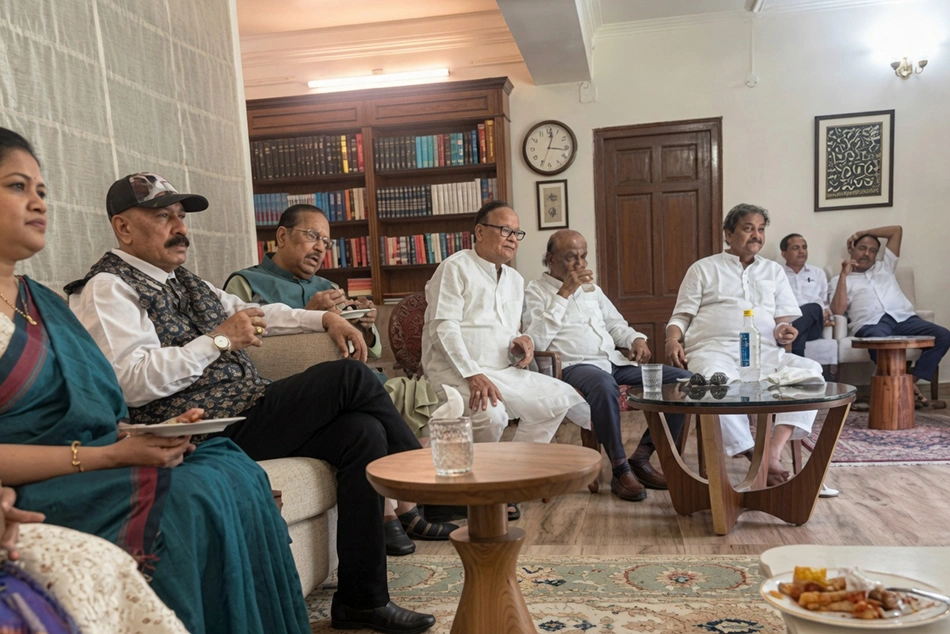
[TMC rebel MPs in a meeting.]
The current turbulence in West Bengal’s politics should have sparked a debate on defection by now. Seeing that it has not, it is important to analyse all that’s happening from the perspective of what the laws allow, and whether all that the laws allow. is enough to maintain the democratic standards.
Something that has lately been in discussion is Paragraph 4 of the 10th Schedule of the Indian Constitution, which allows an exception in terms of a member not having to face disqualification if their original political party merges with another, and at least two-thirds of the members of the legislative party agree to the merger.
This, in fact, was the last resort of Raghav Chadha and the other former AAP members , whose defection to the BJP did not require them to lose their Rajya Sabha seats. However, concerns regarding whether the “legislative majority” can be a proper test to determine which faction is real have remained.
Questions arise about the very spirit of the Anti-Defection Law and its actual addressal of the very problems it sought to address at its inception, owing to a turbulent period marked by unprincipled defections in between 1967-85. This is so because, in allowing certain kinds of defection, often, especially in the cases like that of Goa, Maharashtra, and with some probability, West Bengal in the future, the objective to curb defections has been somewhat questionable.
In India, there has been an increasing tendency in every act of life, and especially those concerning the centres of power, to make use of the alleged loopholes in the law to somehow justify what would otherwise be considered wrong in a legally robust system and is considered ethically wrong. Systems in Singapore, New Zealand, and Kenya have been in a very strict way, able to curb defecting tendencies through a stricter framework to regulate defections and deter them.
Beyond the purview of law and understanding all of it just from the perspective of what law allows and what it does not, questions on the moral viability and conscionability of such defections remain.
Let us consider a very practical situation:
One votes for a person to power, seeing the political party s/he represents, the promises s/he has made. After the election, s/he defects, but does not lose her/his seat because of doing so as per the permissible ways to defect as per our Constitution.
This is one of the most common scenarios in today’s times. From the point of view of a voter, s/he is not only voting for this person based on what s/he represents, but also based on who s/he opposes. Essentially speaking, when in the majority of the cases, s/he defects to the very political faction her/his voters voted her/him for being against, how is the democratic spirit upheld at all?
Also Read: The Great Indian Turncoat Bazaar
In a parliamentary democracy, instead of focusing more on a constructive interaction to welfare through a constructive rapport between the Government and the Opposition, if such defections, just to satisfy the hunger of power for some, are often constitutionalised, the essence of our laws, and whether they are meant to serve the purpose of either holding one accountable when required or punish the wrongdoer or simply serve as a resort to defaulters, habitual defectors by making use of its gaps.
Defection has shamelessly become a habitual, periodic favourite of many of India’s self-acclaimed leaders. Currently, the supposed West Bengal Legislative Assembly’s Leader of the Opposition from the Trinamool Congress (TMC) started his political career in the CPI (M), defected to TMC and has further defected to identify himself and some other MLAs as the actual TMC Legislative Party in the Assembly. Much of the defectors’ reasoning has been based on the increasing allegations of corruption against the previously incumbent TMC Government. However, very straightforward questions on their newfound conscience and how all of that was missing while they continued to enjoy the benefits of the previously incumbent Government, rather justifying all that was then being done, can definitely not be ignored.
Our Constitution has often been cited as a ‘living document’. However, in this particular matter concerning defections, has that ‘living’ nature been compromised somewhat because of the relatability of this matter to the central powerhouses of India?
This is a question that can be debated for hours without reaching any definitive answer.
However, India’s democratic pride is required to be upheld not just in law and letters, but also in its essence, its spirit, not overlooking the concerns of the electors once elected, instead by creating a space for stronger dialogues, criticism, and responsibility of the opposing voices.
[The writer, Ritam Bhattacharya, is an undergraduate student of Law at St.Xavier’s University, Kolkata. He has a keen interest in the intersection of law and policy. He believes it is necessary to devise a more pragmatic approach to the making and breaking of laws and their implementation. His hobbies include reading, practising music, and watching films.]
Follow ummid.com WhatsApp Channel for all the latest updates.
Select Language to Translate in Urdu, Hindi, Marathi or Arabic