Reusable Rocket: China rewrites history, but with tech different from SpaceX
China on Friday July 10, 2026 became only the second nation in history after US (via SpaceX and Blue Origin) to achieve the controlled recovery of an orbital-class rocket booster, notably with a different technology.
Beijing: China on Friday July 10, 2026 became only the second nation in history after US (via SpaceX and Blue Origin) to achieve the controlled recovery of an orbital-class rocket booster, notably with a different technology.
China created the history after successfully retrieving part of its Long March-10B reusable rocket during its maiden launch on Friday.
The Long March-10B lifted off from the Hainan commercial space launch site at 12.15pm local time (0415 GMT), state broadcaster CCTV reported, and placed a satellite into its preset orbit.
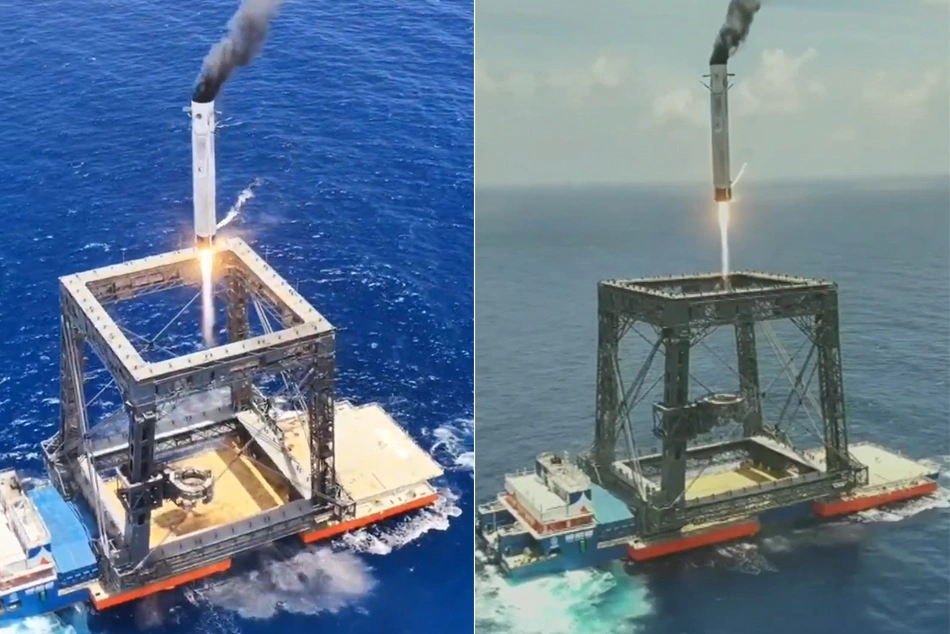
The rocket's first stage separated from the second stage after liftoff and returned to a platform in the sea, the state owned Xinhua news agency reported.
CCTV said the booster came down vertically and was captured on the offshore platform roughly six minutes after separating from the upper stage.
“China’s Long March-10B has successfully completed its maiden flight—and recovered its first stage via a sea-based net. This marks the country’s first-ever controlled rocket recovery. A major leap toward reusable launch capabilities”, Mao Ning, Spokesperson of Ministry of Foreign Affairs of China, said.
China achieved its first-ever controlled recovery of a launch vehicle’s first stage, as the first stage of its Long March 10B carrier rocket launched on Friday was successfully captured on a seaborne platform via a net-capture system, which also marked the world’s first net-based recovery of a launch vehicle.
Technology Difference
Elon Musk's SpaceX was the first company to launch and reuse rocket boosters, debuting the technology with the Falcon 9, in December 2015 and marking the first such recovery. Jeff Bezos owned Blue Origin's New Glenn matched the feat only a decade later, in November 2025.
China however claimed it used a different technology than the one used by the two American companies.
SpaceX's Falcon boosters typically land upright on ground-based pads or drone ships at sea. On the other hand, China's Long March-10B returned to a platform near its own launch site.
SpaceX's booster does all the precision work itself, hovering and touching down exactly on a fixed pad using its own legs.
Watch Video
A historic day in China’s space program!
— Mao Ning 毛宁 (@SpoxCHN_MaoNing) July 10, 2026
China’s Long March-10B has successfully completed its maiden flight—and recovered its first stage via a sea-based net. This marks the country’s first-ever controlled rocket recovery. A major leap toward reusable launch capabilities.… pic.twitter.com/FWuQXLltaD
On the other hand, China's method is different where the rocket only needs to get close enough (near hover, near zero relative motion) and the net/hook system on the ship does the final capture.
“Net-based recovery helps simplify the rocket's onboard structure, reduces vehicle mass and increases payload capacity. It is also highly adaptable to landing-point deviations, as coordinated net systems can effectively expand the capture window,” Chen Muye, an expert at the China Academy of Launch Vehicle Technology (CALT) told Xinhua.
SpaceX carries the weight of legs on every single flight whereas China's recovery vessel is cheaper by design and a one-time investment, amortized over many launches.
According to South China Morning Post, two other Chinese rockets - Zhuque-3 and Long March-12A, had attempted SpaceX-style vertical landings using grid fins and landing legs in December last, but both failed.
Zhuque-3, a privately developed methane-liquid oxygen rocket from LandSpace, had its first stage crash near the target recovery area. The state-owned Long March-12A’s first stage crashed mid-air after an engine failed to relight for the final landing burn.
Follow ummid.com WhatsApp Channel for all the latest updates.
Select Language to Translate in Urdu, Hindi, Marathi or Arabic