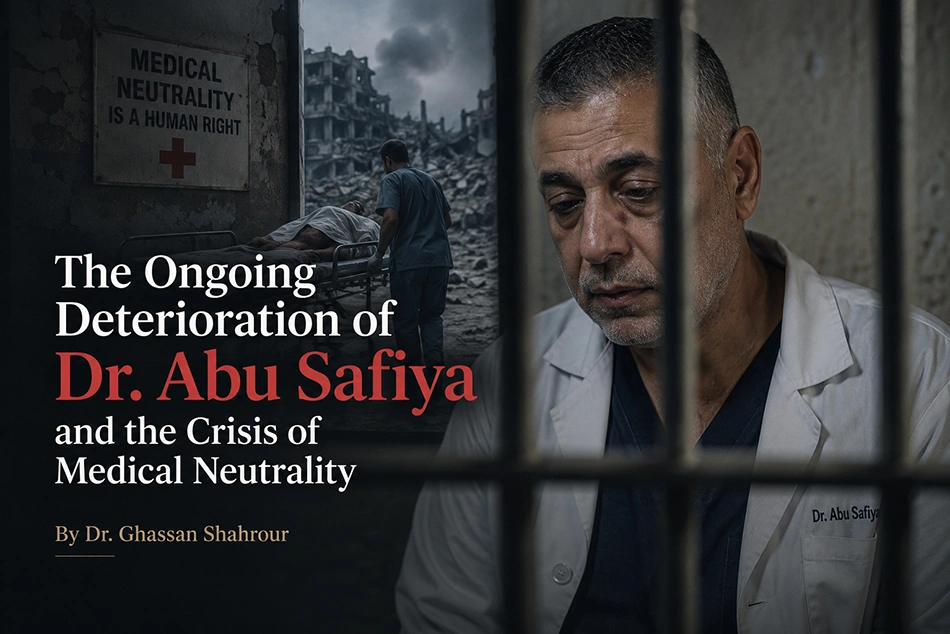
The Ongoing Deterioration of Dr. Abu Safiya and The Crisis of Medical Neutrality
In the early hours of December 27, 2024, Dr. Hossam Abu Safiya, Director of Kamal Adwan Hospital, walked in his white medical coat toward Israeli military vehicles surrounding the facility, then the last major hospital still functioning in northern Gaza. Minutes later, he was arrested without charge
I will never forget the AVAAZ petition - launched by a global movement whose very name means “voice”, because it was one of the rare moments when the world seemed to raise its voice for a single human being amid the ruins. It was more than an online campaign; it was a moral pause that restored the human face of the tragedy: a doctor whose son was killed, whose hospital was bombed, who was denied the medical supplies he needed to save children screaming in pain, and who nevertheless remained at his post until the moment of his arrest.
At that moment, the question was no longer “What is happening in Gaza?”
It became: “How can the world allow the targeting of the last remaining protectors of life?”
THE WITNESS WHO WAS SILENCED
In the early hours of December 27, 2024, Dr. Hossam Abu Safiya, Director of Kamal Adwan Hospital, walked in his white medical coat toward Israeli military vehicles surrounding the facility, then the last major hospital still functioning in northern Gaza. Minutes later, he was arrested without charge.
International humanitarian law is unequivocal.
Under the Geneva Conventions:
- GC I (1949), Articles 19-24: Medical units and personnel must be respected and protected at all times.
- GC IV (1949), Article 18: Civilian hospitals may not be attacked and must be protected.
- Additional Protocol I (1977), Articles 12-16: Medical personnel shall not be punished or detained for performing medical duties consistent with medical ethics.
Multiple UN bodies have stated that the arrest of Dr. Abu Safiya constitutes a direct violation of these protections.
Israel, however, presents a different position. Israeli officials argue that some hospitals in Gaza have been used for military purposes, that certain medical staff may have cooperated with armed groups, and that detentions under the “unlawful combatant” law are preventive security measures rather than punitive actions. They also claim that evidence cannot always be disclosed publicly due to security restrictions. These claims remain disputed by international organizations, which insist that protected status cannot be removed without clear, verifiable proof.
His detention removed not only a physician but the final witness documenting the collapse of Gaza’s northern health system. He provided international organizations with real-time data on shortages, supervised therapeutic feeding units, and expanded capacity under bombardment. His absence meant the last source of verified medical testimony had been silenced.
A HUMAN STORY BEYOND THE REACH OF REPORTS
For months, Dr. Abu Safiya lived inside the hospital with his Kazakhstani wife and their children under constant shelling. On October 26, 2024, his son Ibrahim was killed near the hospital, and Dr. Abu Safiya himself was later injured. Despite his wounds, he insisted on leading his son’s funeral prayer among his colleagues while explosions echoed in the background.
Although opportunities to leave were available, he refused to abandon his patients at a moment of extreme need. These human details, often absent from technical reports, reveal the essence of the case: he was not merely a hospital director; he was the final line of defense for life in a place stripped of protection.
DETENTION WITHOUT CHARGE AND DOCUMENTED ABUSE
After the storming and evacuation of the hospital, Dr. Abu Safiya was transferred to the Sde Teiman detention facility and later to Ofer Prison. He was held under Israel’s “unlawful combatant” law, which permits prolonged detention without charge and restricts access to legal counsel and medical care.
Israel states that such detentions are necessary to prevent future attacks and gather intelligence. Yet testimonies from his lawyer and independent human rights organizations describe a different reality: he lost nearly 40 kilograms, was subjected to beatings and ill-treatment, held in underground isolation cells, and denied adequate medical attention. His first public appearance in February 2025, shackled and visibly emaciated, triggered widespread international condemnation and was widely described as deliberate humiliation.
AN INDIVIDUAL CASE REVEALING A STRUCTURAL PATTERN
Dr. Abu Safiya’s case reflects a broader pattern documented by the World Health Organization, OCHA, and UNRWA:
- Over 70 percent of Gaza’s health infrastructure destroyed or incapacitated
- Repeated strikes on hospitals and ambulances
- More than 1,500 health workers killed
- Approximately 90 doctors and paramedics detained
- At least five health workers who died in detention
Israel disputes some of these figures, arguing that militant groups embed themselves within civilian infrastructure and that military operations target combatants, not medical staff. However, international organizations maintain that the scale and consistency of the damage indicate systematic violations of medical neutrality.
This pattern erodes not only infrastructure but also medical memory, professional expertise, and the witnesses essential for accountability. It undermines one of the oldest principles of humanitarian law: the protection of those who protect life.
HOW THE CASE TRANSCENDED GAZA
Dr. Abu Safiya’s detention has generated significant international response. Medical associations, academic institutions, and civil society groups across Europe and North America issued statements calling for his release.
A concrete example came on January 15, 2025, when UK Member of Parliament Dr. Philippa Whitford submitted a written parliamentary question asking what steps the government was taking regarding “the detention and reported ill-treatment of Dr. Hossam Abu Safiya” and how it intended to uphold protections for medical personnel in Gaza.
Similarly, in February 2025, the German Medical Association (Bundesaerztekammer) issued a public statement calling for “the immediate release of Dr. Abu Safiya and all detained medical personnel, in accordance with the Geneva Conventions and the ethical obligations of medical neutrality.”
These interventions helped move his case beyond Gaza and into global discussions on the credibility of protections afforded to medical personnel in conflict zones.
A PERSONAL MOMENT WITHIN THIS GLOBAL REACH
During a walk near the White House months ago, I stopped at a protest stand displaying a photograph of Dr. Abu Safiya held by American solidarity activists. Speaking with them, I saw how his story had reached the heart of Washington, far removed from geography and politics, as a purely human case.
It was a reminder that suffering has no borders, and that the voices of victims can travel far when carried with honesty and humanity.
WHY THIS MATTERS
Targeting health workers is not a marginal violation; it is an assault on the foundations of humanity itself. The detention of Dr. Abu Safiya is not merely the arrest of an individual; it is an attempt to silence the last voice documenting what was happening inside besieged hospitals.
Protecting doctors is not a Palestinian issue alone; it is a universal principle. If it collapses in Gaza, it will collapse in every future conflict.
CONCLUSION: WHAT REMAINS WHEN THOSE WHO PROTECT LIFE ARE TARGETED?
Ultimately, the case of Dr. Hossam Abu Safiya is not just the story of a doctor; it is a moral question hanging over the conscience of the world:
What remains of our humanity when those who protect life are themselves targeted?
When the last witness to suffering is imprisoned, the danger extends beyond Gaza to the very idea upon which international humanitarian law was built. Protecting doctors is not a legal technicality; it is the minimum proof that we still retain the capacity to distinguish between war and the collapse of civilizational restraints.
REFERENCES
United Nations Bodies
- Office of the High Commissioner for Human Rights (OHCHR)
- World Health Organization (WHO)
- UN Special Rapporteur on the occupied Palestinian territory (Francesca Albanese)
Independent International Organizations
- International Committee of the Red Cross (ICRC)
- Medecins Sans Frontieres (MSF)
- Human Rights Watch (HRW)
- Amnesty International
Additional Sources
- Physicians for Human Rights - Israel (PHRI)
- The Lancet
- UNRWA
- Euro-Med Human Rights Monitor
[About the Author: Dr. Ghassan Shahrour, Coordinator of Arab Human Security Network, is a medical doctor, prolific author, and human rights advocate specializing in health, disability, disarmament, and human security. He has contributed to global campaigns for peace, disarmament, and the rights of persons with disabilities.]
Follow ummid.com WhatsApp Channel for all the latest updates.
Select Language to Translate in Urdu, Hindi, Marathi or Arabic