Palestinianism: A New Lens for Understanding Resistance and Defense of Human Dignity
At its core, Palestinianism rests on a simple proposition: Before domination becomes a project of force, it becomes a project of definition
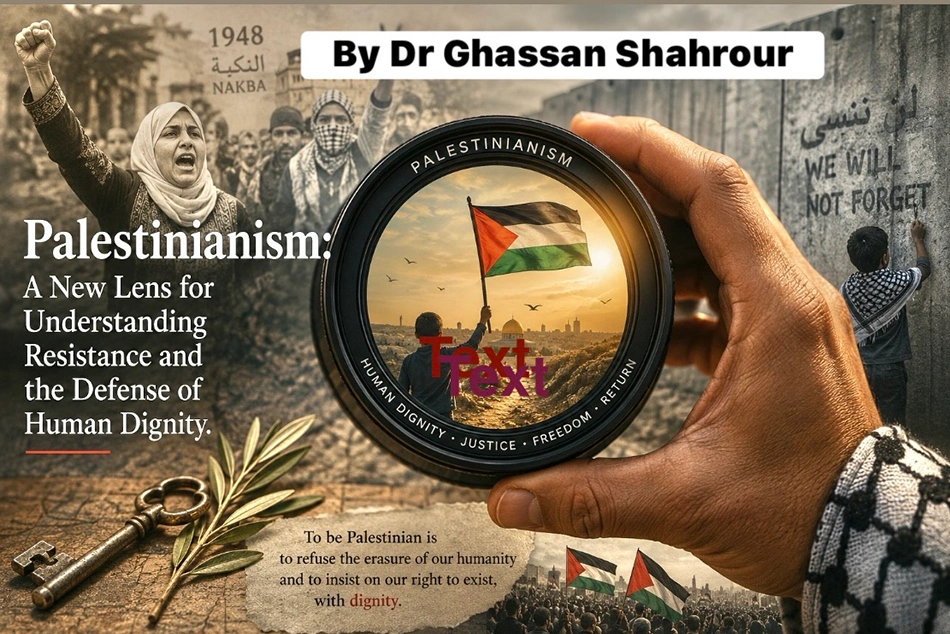
For years, I searched for a concept that could capture not only the Palestinian struggle, but a broader human reality: the struggle against erasure. I sought a framework capable of explaining why some communities continue to resist not only occupation or discrimination, but also attempts to define their reality for them, silence their voices, and erase their memory.
In earlier writings, I introduced Palestinianism as a way of thinking about this deeper dimension of resistance. What began as scattered reflections has evolved into a coherent framework. This essay presents Palestinianism in a public, accessible form — as both an invitation and a foundation for further development.
Across the humanities and social sciences, scholars have long examined how power operates through institutions, language, knowledge, and culture. Concepts such as colonialism, decolonization, nationalism, and human rights illuminate important aspects of these struggles. Yet none fully captures a central feature of many contemporary conflicts: the struggle against erasure itself.
Palestinianism is proposed as a framework for understanding that struggle.
It is not a national identity, nor a political slogan. Rather, it is an ethical and epistemic lens through which we can examine how individuals and communities resist erasure by reclaiming narrative agency, preserving memory, and defending human dignity.
What is Palestinianism?
At its core, Palestinianism rests on a simple proposition:
Before domination becomes a project of force, it becomes a project of definition.
Power seeks not only to control territory, but also to determine what is true, whose story matters, which memories survive, and which lives are considered worthy of recognition.
Maps can be redrawn.
History can be rewritten.
Language can be manipulated.
Human suffering can be normalized or denied.
If domination operates through the power to define reality, then resistance must begin with reclaiming the right to interpret reality.
Palestinianism therefore centers on the defense of human dignity against erasure — a concept that includes not only physical displacement, but also:
- Removal of people from land
- Deletion of history from public memory
- Silencing of voices
- Renaming of places
- Denial of suffering
- Reduction of human beings to abstractions
Palestinianism seeks to understand how individuals and communities resist these forms of disappearance and preserve their humanity in the process.
The framework rests on four interconnected pillars:
Knowledge as liberation, Narrative as resistance, Ethics as the foundation of struggle, and the Global interconnectedness of human dignity.
1. Knowledge as Liberation
The first pillar of Palestinianism is epistemic.
Power operates not only through armies and institutions, but also through the ability to define, categorize, and legitimize. For Palestinians, this has often meant being spoken about rather than spoken to; having their history narrated by others; and being reduced to security concerns or political abstractions.
Yet efforts to challenge these narratives have emerged from many directions.
International medical volunteers— surgeons, nurses, paramedics, and humanitarian workers — have repeatedly returned from Gaza and the West Bank bearing witness to what they have seen. Their testimonies are not simply clinical reports; they are acts of moral and epistemic resistance against silence and denial.
Jewish scholars, Western academics, and international journalists have also played a crucial role. Many have risked careers, reputations, and sometimes safety to document realities that powerful institutions prefer to obscure. Their work embodies a central insight of Palestinianism: that knowledge, conscience, and human dignity are inseparable.
And nowhere is this clearer than in the Freedom Flotilla. Hundreds of volunteers — doctors, clergy, students, retired sailors, activists, and journalists — including Jewish peace activists and Western academics, have risked their lives to break the siege on Gaza. Their presence on those boats is not symbolic. It is a declaration that truth, solidarity, and human dignity cannot be blockaded.
In this sense, knowledge becomes a form of liberation. To witness truthfully, to document honestly, and to refuse erasure are themselves forms of resistance.
2. Narrative as Resistance
Narrative is not merely a description of events.
It is a site of struggle.
Attempts to erase villages, rename geography, suppress memory, or delegitimize grief are not isolated acts. They are efforts to shape collective understanding of reality itself.
Palestinianism views narrative as a form of resistance because stories preserve memory, affirm identity, and restore humanity. Narrative resistance seeks to:
- Preserve memory
- Rehumanize the marginalized
- Challenge imposed frameworks of interpretation
- Protect historical continuity
The struggle over narrative is therefore not secondary to political struggle. It is often one of its most important dimensions.
3. Ethics at the Center of Struggle
Palestinianism is not only analytical; it is fundamentally ethical.
It begins with the conviction that human dignity possesses intrinsic value. Its central commitments are simple:
- Dignity is non‑negotiable
- Justice must remain universal
- Every human life deserves moral recognition
This ethical foundation distinguishes Palestinianism from approaches that reduce human beings to strategic interests or demographic categories. Resistance, within this framework, derives legitimacy from its commitment to protecting human dignity.
For this reason, Palestinianism resonates with broader struggles against dehumanization wherever they occur.
4. A Global Method, Not a Local Theory
Although Palestinianism emerges from the Palestinian experience, it is not confined to it.
The framework can help illuminate other struggles in which communities confront attempts to erase memory, identity, dignity, or historical presence.
In this sense, the legacy of Palestinian struggle — its resistance to erasure and its defense of human dignity — becomes a transferable resource that can be invested in addressing struggles for justice and recognition wherever they arise.
Also Read: Why Palestinianism Is Misread as Hostility, and Why This Misreading Must End
One can find echoes of its principles in the moral resistance of Mahatma Gandhi, in Nelson Mandela’s insistence on human dignity under apartheid, and in the educational vision of Khalil al‑Sakakini, who emphasized human development and intellectual freedom.
Its relevance extends to Indigenous communities defending cultural memory, marginalized populations seeking recognition, and social movements struggling against exclusion and dehumanization.
International solidarity efforts — humanitarian missions, human rights documentation, medical relief work, civil society advocacy, and the Flotilla itself — further illustrate a shared belief: that human dignity is indivisible, and that the suffering of one community concerns humanity as a whole.
How Palestinianism Differs from Existing Theories
Some readers may ask how Palestinianismdiffers from existing frameworks such as decolonial theory, critical theory, collective memory studies, or human‑rights discourse. Palestinianism intersects with all of these, but its distinctive contribution lies in its focus on erasure as the central mechanism of domination.
While decolonial and critical theories analyze structures of power, Palestinianism examines the attempt to make a people disappear — from land, from history, from narrative, and from moral recognition.
By placing resistance to erasure at the center of analysis, Palestinianism offers a new lens for understanding how communities defend memory, dignity, and existence itself.
A Closing Reflection
Palestinianism is not a theory of despair.
It is a theory of insistence.
It insists that human beings possess the right to narrate their own existence, preserve their memory, defend their dignity, and resist attempts to erase them from history.
It begins with Palestine, but it does not end there.
Rather, it offers a language for understanding how individuals and communities defend memory against forgetting, dignity against dehumanization, and truth against erasure — in a world increasingly defined by struggles over narrative, recognition, and human worth.
[About the Author: Dr. Ghassan Shahrour, Coordinator of Arab Human Security Network, is a medical doctor, prolific author, and human rights advocate specializing in health, disability, disarmament, and human security. He has contributed to global campaigns for peace, disarmament, and the rights of persons with disabilities.]
Follow ummid.com WhatsApp Channel for all the latest updates.
Select Language to Translate in Urdu, Hindi, Marathi or Arabic