Greenland Annexation and Probable European Response
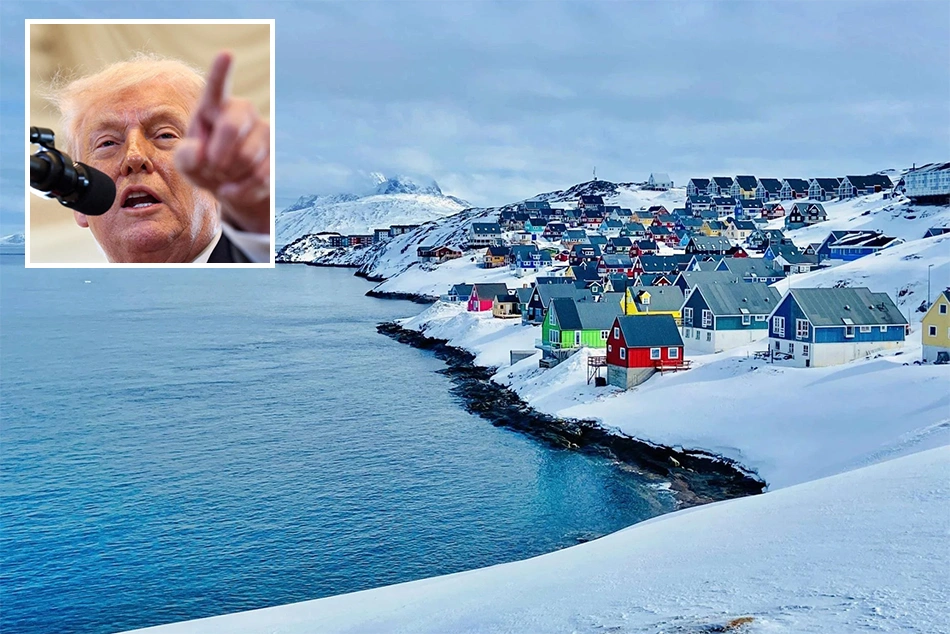
Greenland has become a focal point of international tensionsyet again, as US President Donald Trump repeated arguments that Washington must control the territory for national security reasons and has refused to rule out using military force to acquire it
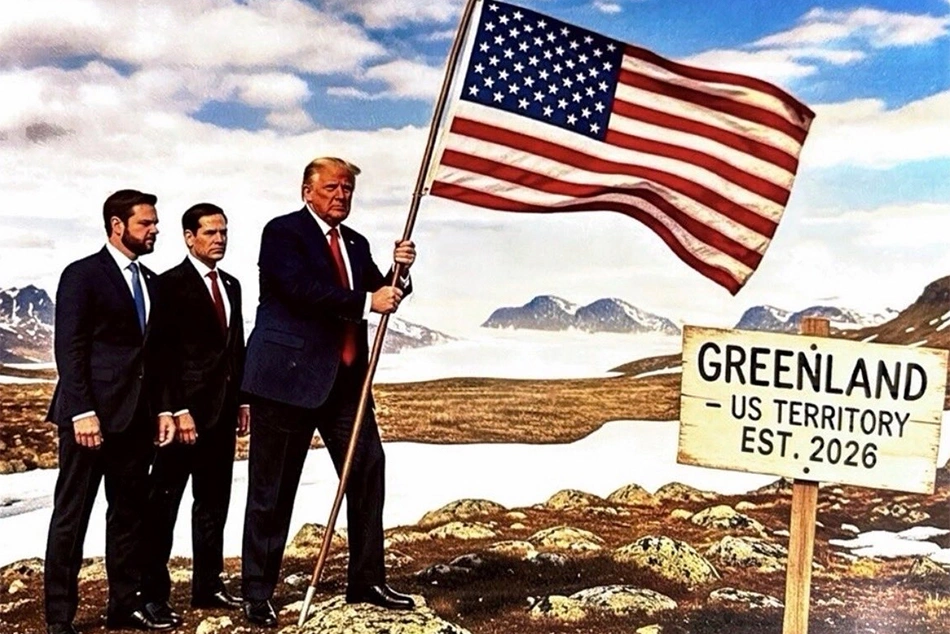
[This image has been shared by U.S. President Donald Trump on social media]
Greenland has become a focal point of international tensionsyet again, as US President Donald Trump repeated arguments that Washington must control the territory for national security reasons and has refused to rule out using military force to acquire it. Trump also announced that he will impose tariffs on those countries that had sent troops to Greenland in recent days for a Danish-led reconnaissance mission aimed at strengthening its security.
It seems that there is never going to be a dull day under President Donald Trump’s watch. After kidnapping the Venezuelan president, he has again ratchetted-up his demands for Greenland’s annexation to the United States or more control of its natural resources.
Meanwhile, European Commission President Ursula von der Leyen said in a post on X that she had discussed Greenland and US actions with NATO Secretary-General Mark Rutte, French President Emmanuel Macron, Italian Prime Minister Giorgia Meloni, UK Prime Minister Keir Starmer, and German Chancellor Friedrich Merz. She emphasised that the European union will always defend its strategic economic and security interests. “We will face these challenges to our European solidarity with steadiness and resolve,” she added.
The comments come as NATO Secretary-General Mark Rutte confirmed he had spoken with President Donald Trump on January 18 regarding the security situation in Greenland and the Arctic.
US President Donald Trump has doubled down on his threats to deploy troops to Greenland, this time accusing Denmark of not doing enough combat potential threats from Russia. "NATO has been telling Denmark, for 20 years, that ‘you have to get the Russian threat away from Greenland’ he wrote on his Truth Social platform.
EU’s response
Belgium’s defence minister has played down his country’s role in European military deployments to Greenland, saying the mission is focused on reconnaissance and coordination rather than confronting the US. Belgium is sending a single officer to the autonomous Danish territory as part of a European detachment deployed at Copenhagen’s request.
UK opposition leaders also criticised Trump's announcement. Conservative Party leader Kemi Badenoch said the tariffs were a "terrible idea", while Reform UK leader and Trump ally Nigel Farage said they "will hurt us". Liberal Democrat leader Ed Davey called Trump's behaviour "unhinged" but said how the UK responds "matters a lot".
France’s Emmanuel Macron has called for the EU to activate its most potent trade weapon against the US after President Donald Trump threatened to hit several European countries with extra tariffs in response to the dispute over Greenland.
An Élysée official said on Sunday (January 18) that the French president would request that the EU activates its so-called anti-coercion instrument that can restrict access to the single market for American companies.
Germany’s vice-chancellor and finance minister Lars Klingbeil said that “a line had been crossed”, adding that the affected nations “must not allow ourselves to be blackmailed”.
“It is unacceptable to hit countries that are now taking more responsibility for our common security in Nato,” said Troels Lund Poulsen, Denmark’s defence minister.
Lars Lokke Rasmussen, Denmark’s foreign minister, said that the tariff move was “surprising” because he had a “constructive dialogue” with vice-president JD Vance on Wednesday. He added: “It is paradoxical because what makes the president react is that we are doing what we are criticised for not doing: namely taking care of the Arctic.”
Alexander Stubb, president of Finland, who is known to have a good personal relationship with Trump, said that “tariffs would undermine the transatlantic relationship”. The Swedish and Norwegian premiers Ulf Kristersson and Jonas Gahr Støre also warned that Europe “will not allow ourselves to be blackmailed”.
EU trade commissioner Maroš Šefčovič on Sunday (January 18) that the implementation of the US-EU trade deal would be “very complicated” in light of Trump’s threats.
Trump mania over Greenland
Greenland’s strategic importance to the US dates back to the 19th century, and successive US administrations have explored acquiring the island. Since the second world war Washington has enjoyed extensive access to it under the 1951 Greenland Defence Agreement. But US Arctic engagement declined after the cold war.
Trump’s fixation on Greenland emerged during his first term, when he publicly proposed purchasing the island. European leaders largely treated the episode as a curiosity rather than a warning. Yet Trump’s interest persisted. He reopened a US consulate in Nuuk in 2020 and officials who worked with him described his focus on acquiring Greenland as unusually intense and enduring. Upon returning to office in 2025, Trump framed it as a national security necessity and accused Denmark of failing to defend the territory adequately.
Greenland is home to a massive deposit of rare earths, which are crucial to US efforts to maintain its technological lead over China. But tapping these important minerals crucial for modern technologyisn’t easy, according to experts.
The US Geological Survey identifies 60 minerals as critical for the American economy and national security. A subset of these minerals, termed “rare earth elements,” like neodymium and dysprosium, are necessary for manufacturing the magnets and motors that power America’s tech industry, while others are key for the semiconductors driving the artificial intelligence boom.
Access to rare earth minerals is seen as a key choke point for many of today’s high-tech supply chains. China, one of America’s tech rivals, has grown to dominate the rare earths production and refining market and has used access to rare earths as a negotiating chip with Trump.
Due to ancient geological processes, Greenland hosts a variety of valuable ore and mineral deposits, from gold and iron to copper and graphite. Yet much of the country’s resources remain untapped due to the island’s isolation, harsh conditions, environmental stewardship, and the mining industry’s price sensitivity.
In addition to its rare earth supply, which is the world’s third-largest known land deposit, Greenland also boasts extensive stores of germanium and gallium, two critical minerals needed for high-tech applications.
Germanium is a key component in fiber-optic wires, while gallium is used in semiconductors required for many consumer electronics, power supplies, data centers and even quantum devices. China currently controls around 98% of gallium and around 60% of germanium supplies worldwide, with particular dominance in the refining of minerals once they have been extracted, and leverages this dominance in trade negotiations with the U.S.
What should be the European response
Europeans have real leverage in the face of Donald Trump’s threats towards Greenland—and time is on their side. They must use it to raise the prospective costs of annexation.
Basically, Trump thrives on empty space, ambiguity, and fear of US power. Europe’s task is to fill the space calmly, collectively and pre-emptively. The joint statement on January 6, by European leaders was a good start and a strong statement of resolve. So too is the ongoing deployment of troops to Greenland by some governments. But more is needed.
By acting fast, Europeans can outflank the US administration. Overall, Europeans have leverage. In Trump’s language, they have cards. Time is the major factor. Trump wants to move soon. He already faces bipartisan criticism in Congress for his coercive diplomacy, midterm elections in November and the end of his presidential term in three years.
Political shifts within Greenland and any commercial benefits of US annexation would take much longer to materialise (if they materialise at all).
By acting fast, European leaders can outflank the administration. They are right to be cautious in what they say—but must be clear-eyed about the challenge and decisive in curbing the chances of escalation.
Follow ummid.com WhatsApp Channel for all the latest updates.
Select Language to Translate in Urdu, Hindi, Marathi or Arabic