Ibrahim Traore: Generating Contours Of A New Pan-African Identity
Ibrahim Traoré, the interim leader of Burkina Faso since a 2022 coup, is increasingly viewed as a voice for a new, anti-imperialist world order in Africa.
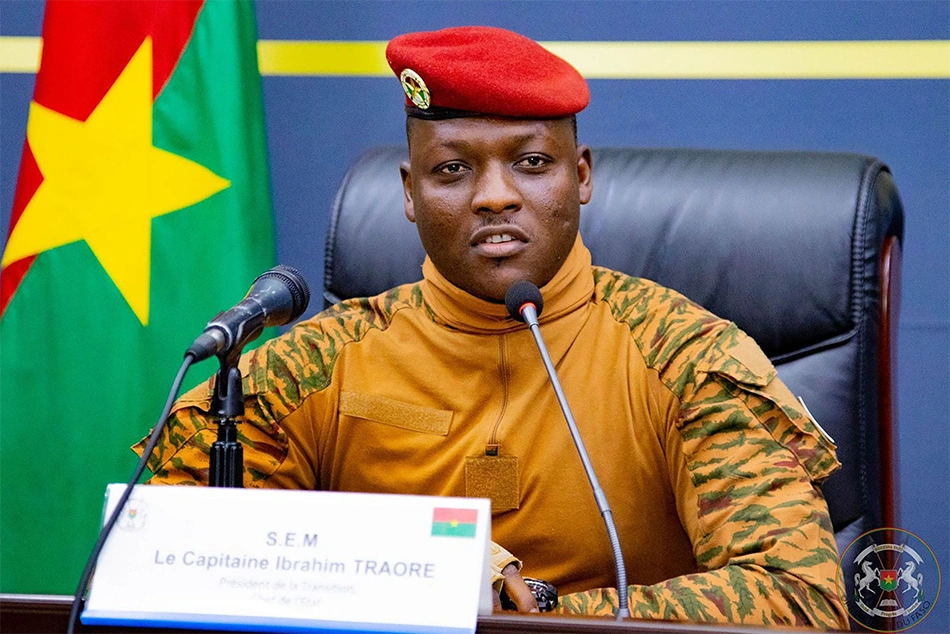
Ibrahim Traoré, the interim leader of Burkina Faso since a 2022 coup, is increasingly viewed as a voice for a new, anti-imperialist world order in Africa. By rejecting Western influence, particularly from France, expelling foreign troops, and forging tighter ties with Russia, he is pushing for complete economic and security sovereignty.
Traore is widely compared to Thomas Isidore Noël Sankara (21 December 1949 – 15 October 1987) who was a Burkinabé military officer, Marxist and Pan-Africanist revolutionary, finally assassinated in 1987.
Traoré is a modern-day Sankara. Each discarded French troops, challenged the CFA franc – a currency used by 14 African nations as of 2023 for a population of over 210 million people and pushing for resource nationalism including nationalizing gold mines as rebuffing neo-colonialism.
Traore contends that the CFA franc system in Burkina Faso, in place since 1945, is a neo-colonial arrangement imposed by France that has restricted the economic sovereignty of its former colonies. Ibrahim Traoré, is actively seeking to move away from this tool of French influence.
Traoré focus on self-reliance and development as a development paradigm encourages local talent, and youth as the apparatuses to build infrastructure (roads, schools, hospitals), thus seeking deletion of reduction of reliance on foreign aid.
Traore has reinforced his self-reliance mode of governance by mobilizing his “Volunteers for the Defence of the Homeland” to combat extremist insurgency. Traoré’s government is actively implementing a policy of resource nationalism to assert economic sovereignty, specifically by reordering the nation’s gold sector to reduce reliance on foreign entities.
A rough and dangerous path to assertion of selfhood through anti-imperialism
Since seizing power in September 2022, Traoré has survived at least four assassinations linked to foreign interests. It has to be stated too that internal dissent against Traoré is intensifying with his junta under mounting pressure from within the military, civil society, and the political opposition, particularly in light of deterioration security conditions with increased militant Islamist violence and jihadist groups controlling roughly 40% to 60% of the country. Militant-linked fatalities have nearly tripled compared to the three years prior to his 2022 coup. worsening security conditions.
As a revolutionary leader his regime has taken restrictive measures, including the dissolution of all political parties and the extension of military rule. Traoré’s authority is challenged by a fragmented military, with lingering opposition from senior officers and members of the former regime. By officially dissolving all political parties, Traore faces internal tension with his actions forcing critics into exile, prison, or to the frontlines of the insurgency.
In January 2026, the junta announced a foiled plot involving a “grave” destabilization plan by military and civilian actors, featuring, for the first time, televised “confessions”. The government has used a 2023 “general mobilization” law to forcibly conscript critics, including activists, journalists, and members of civil society, into the army, effectively sending them to the frontlines as punishment.
Scholars and historians are deeply divided on Ibrahim Traoré’s role in Burkina Faso, with views ranging from seeing him as a genuine anti-imperialist, pan-Africanist leader to a populist military ruler whose actions have worsened the country’s security crisis.
Under these complex circumstances, Traoré, has emerged as a prominent voice in West Africa, issuing severe warnings to Western nations while strongly affirming African identity and sovereignty. His supporters view him as a target of foreign powers seeking to exploit African resources. Traoré has also denounced and faced pressure from the United States regarding the transition of power in Burkina Faso.
It is important to note that many of these claims arise from highly charged, pro-Traoré social media narratives and online video reports, rather than official, substantiated, verify international diplomatic reports.
Cautioning the West and Neo-Colonialism
Traoré has accused “imperialists” of perpetuating “cold and bloody” warfare in West Africa to maintain control over natural resources.
He has explicitly stated that Africa must break free from Western influence, particularly from France, which he argues has not brought peace or development, but rather dependence.
Traore knows that such a stance comes with threats to his personal safety and Burkina Faso.
African Identity and Unity – The “Revolution” Vision
Traoré frames his leadership as a “popular, progressive revolution” aimed at restoring African dignity and self-reliance. He strongly advocates for unity among African nations, particularly urging the youth to stop relying on foreign countries and to build their own continent.
He has driven the creation of the AES (Burkina Faso, Mali, Niger), which focuses on security and economic cooperation independent of traditional regional bodies like ECOWAS, which he views as influenced by Western powers.
His government has taken steps to nationalize key industries, such as gold, to ensure wealth stays within the country and thus guarantee economic sovereignty. Traoré’s message is that Africa must cease to be a “warehouse of raw materials” for the West and instead take control of its own destiny.
Contextual Factors
Following an alleged assassination attempt and increasing security threats, his government has shifted its focus to a “Ministry of War and Patriotic Defense”. Burkina Faso has distanced itself from French military aid, relying more on Russia for security support.
Critics have pointed out that his anti-imperialist stance is accompanied by the suspension of democratic processes and the restriction of media freedoms, raising concerns about a shift toward authoritarianism.
Traoré defends his suspension of democratic processes and strict control over media in Burkina Faso by framing his rule not as a military dictatorship, but as a “popular progressive revolution” necessary to salvage a nation besieged by jihadist violence and neo-colonial influence. Traoré has explicitly stated that democracy is a long-term goal rather than a means to solve immediate crises.
The War on Terror as Priority
Traoré took power with the promise of ending the jihadist insurgency, justifying the suspension of democratic, civilian-led governance by arguing that security must take precedence over political freedom.
By suspending the constitution, transferring the duties of the Election Commission to the Interior Ministry, and banning political parties, he argues he is eliminating “divisive” politics.
Traoré has justified the expulsion of foreign journalists (specifically French) and the suspension of international media outlets (BBC, VOA, Africa 24) by accusing them of spreading disinformation and undermining national morale.
He has warned that media houses “communicating for the enemy” would pay for it, often treating critical reporting as a national security threat. The media crackdown is defended as necessary to build an “African-led narrative” and a “new Burkina Faso”.
The Transition to African Democracy
Traore argues that Western-style democracy does not work for developing nations confronting security crises, viewing it as irrelevant to Africa’s culture and political exigencies- much too unhurried and ineffective.
Traore’s immediate goal is to “reclaim sovereignty” and break free from “imperialist” influence – France, in particular and all Western influences with a sense of urgency.
Traore asserts that his nation is in a state of “popular progressive revolution”. He is quite plain when he asserts that “revolution” necessitates a concentration of power to ensure security and sovereignty.
Traoré often bypasses traditional democratic institutions and political parties, framing his actions as a direct mandate from the people and the youth, positioning himself as a successor to the anti-colonial leader Thomas Sankara.
Despite trumped up international concern over authoritarianism, Traoré holds significant popular support, often using patriotic rallies to justify the suspension of democratic, western-backed structures. He defends his oft-erratic economic policies (such as forced civilian conscription or seizing control of natural resources) as necessary for “total territorial recapture and industrial sovereignty”.
African democracy, says Traore, cannot be modelled after Western systems, mostly associated with histories of colonialism, racism, and slavery, a line of thought in debates regarding decoloniality and African political thought.
Redefining democracy with roots in African culture
African democracy is characterized by a strong popular commitment to democratic principles alongside significant challenges in implementation, with many nations transitioning since the 1990s. While countries like Ghana, Senegal, and Botswana are often cited as stable examples, the continent faces issues such as weak institutions, term-limit evasions, and uneven, sometimes declining, electoral quality.
The argument that Western-style democracy is incompatible with African culture centres on the mismatch between liberal, individualistic democratic models and deeply rooted African traditional values, which tend to be communal, consensus-based, and respectful of hierarchy. Critics suggest that transplanting Western systems without adapting them to local realities has contributed to political instability, corruption, and a disconnect between leadership and the populace.
Individualism vs. Communitarianism
Traditional African societies are largely communal. As noted by scholar George Ayittey, the foundational concept is, “I am because we are” (Ubuntu), where the collective good of the community (family, clan, village) often takes precedence over individual rights.
Western democracy focuses on individual voting, while African cultures may prioritize communal representation. While the Western model operates on a “winner-takes-all” (majoritarian) system, where 51% can override 49%, Indigenous African governance often focuses on dialogue, negotiation, and consensus-building until a decision is reached that satisfies all parties, or at least has broad acceptance. Majoritarianism turn elections into “tribal” contests where losing groups feel excluded, leading to conflict rather than unity.
Colonial powers drew arbitrary borders that lumped together unrelated ethnic groups or split cohesive ones, creating artificial nation-states that lack the natural solidarity required for Western-style democratic competition. This duality means modern democratic structures often feel alien and detached from rural, grassroots realities.
The “Ubuntu” Paradigm
The African ruling paradigm based on Ubuntu – the philosophy of “I am because we are” – centres on humanism, communal interdependence, and restorative justice to heal relationships rather than merely punish offenders. It advocates for participatory democracy, equitable resource sharing, and environmental stewardship, ensuring governance prioritizes collective well-being and social harmony.
Justice is aimed at repairing breaches in social harmony, with a focus on reconciliation and the reintegration of offenders into the community. ‘This paradigm challenges the accumulation of capital in favour of a community where everyone shares and works together’. (Desmond Tutu)
Also Read: Decoding Ibrahim Traore in the context of Imperialism
The prevailing consensus among many African scholars is that for democracy to flourish on the continent, it must be re-imagined to align with African realities. Burkina Faso, may just fit the bill on this collective consent for now.
Objectively, Traoré represents a bold, high-stakes gamble in the Sahel. While he has successfully shifted the geopolitical landscape and boosted the morale of a section of the population, his inability to secure the country and the rising trend of human rights abuses could well threaten the long-term future of his administration. Will Traore’s struggle see him prevail his aspirations?
An Afterword
Traoré’s experiment is still unfolding. Whether he becomes a genuine architect of sovereignty or another strongman shaped by circumstance will depend less on rhetoric and more on institutions he builds.
Burkina Faso’s struggle is not merely against Western dominance, but against the deeper legacies of dependency and instability. History will judge him not by defiance alone, but by democratic resilience and security delivered to his people.
[The writer, Ranjan Solomon, has worked in social justice movements since he was 19 years of age. After an accumulated period of 58 years working with oppressed and marginalized groups locally, nationally, and internationally, he has now turned a researcher-freelance writer focussed on questions of global and local/national justice. Since the First Intifada in 1987, Ranjan Solomon has stayed in close solidarity with the Palestinian struggle for freedom from Israeli occupation, and the cruel apartheid system. Ranjan Solomon can be contacted at ranjan.solomon@gmail.com.]
Follow ummid.com WhatsApp Channel for all the latest updates.
Select Language to Translate in Urdu, Hindi, Marathi or Arabic