US-Cuba Stalemate: Sovereignty, Sanctions and Shadow of Intervention
For Cuba and the United States, the path forward likely lies not in pressure alone nor in rhetorical escalation, but in negotiated coexistence.
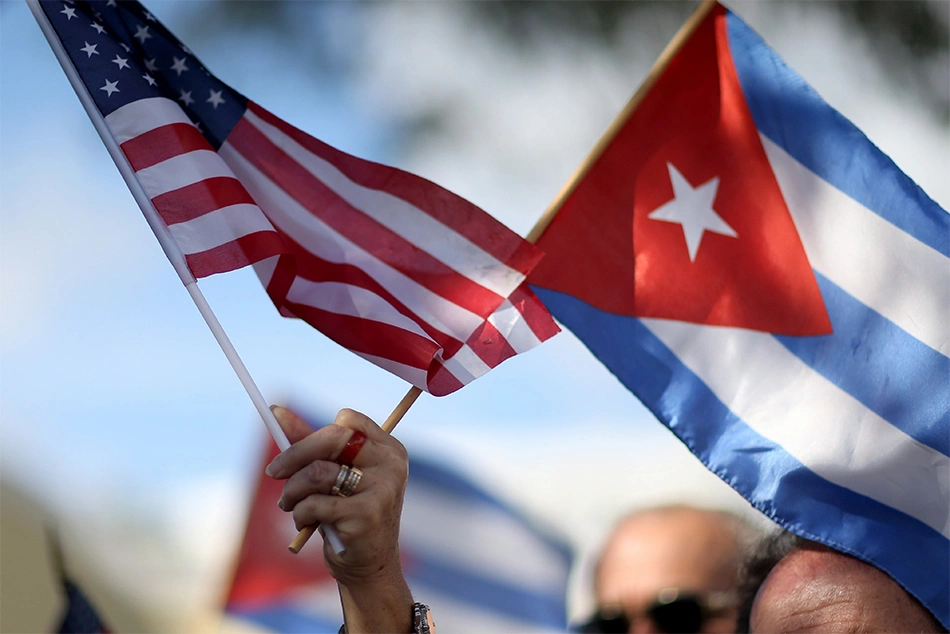
Relations between Cuba and the United States have long oscillated between confrontation and cautious engagement. More than six decades after the revolution led by Fidel Castro reshaped the island’s political system and aligned it against Washington, the fundamental dispute remains unresolved: whether external pressure can -or should – be used to force political change inside a sovereign state.
At the heart of this enduring tension lies the economic embargo imposed by the United States in the early 1960s. Though modified at various points, it remains largely intact, restricting trade, financial flows, and investment. Limited openings during the administration of Barack Obama created a brief period of diplomatic normalization. Embassies were restored, travel expanded, and remittances increased. That thaw raised cautious expectations that Cuba might gradually reintegrate into hemispheric economic life without immediate regime change.
However, the subsequent tightening of sanctions under Donald Trump reversed much of that progress. Although Joe Biden eased some restrictions, the core architecture of economic pressure remains firmly in place. The result is not open confrontation, but a hardened stalemate.
Today, Cuba faces one of its most severe economic crises since the collapse of the Soviet Union. Inflation, shortages of fuel and medicine, declining tourism revenues, and sustained outward migration have strained the island’s social fabric. Havana attributes much of this hardship to the enduring embargo and its extraterritorial effects, which complicate banking transactions and deter foreign investors wary of U.S. penalties. Washington, by contrast, argues that Cuba’s centralized economic model, limits on private enterprise, and restrictions on political pluralism are the principal drivers of stagnation.
In this sense, both governments interpret the same crisis through entirely different lenses: one as externally imposed siege, the other as internally generated dysfunction.
The Question of Interference
This divergence leads to a deeper and more sensitive question: who are the United States to interfere in Cuba? From Havana’s perspective, the answer is straightforward – no one. Cuba asserts sovereignty as a foundational principle of international law, arguing that attempts to coerce policy change through economic deprivation violate both the spirit and letter of the UN Charter. Each year, an overwhelming majority of member states in the United Nations General Assembly vote to condemn the U.S. embargo, framing it as an outdated Cold War instrument that disproportionately harms civilians. Though non-binding, these resolutions reinforce Cuba’s diplomatic narrative that it is resisting unilateral pressure from a far more powerful neighbour.
Washington frames the issue differently. U.S. officials present sanctions as a legitimate foreign policy instrument designed to promote human rights, political freedoms, and democratic governance. In this view, engagement without conditions risks entrenching authoritarian structures, while calibrated pressure creates incentives—however gradual—for reform. Domestic political calculations also shape policy. Cuban-American communities, particularly in Florida, have historically influenced electoral strategies and often favoured a hard line toward Havana.
Yet the effectiveness of this approach remains deeply contested. Six decades of sanctions have not produced regime change in Cuba, nor have they delivered a transition toward Western-style multiparty democracy. Instead, the Cuban system has demonstrated resilience. It has adapted through limited economic liberalization, expansion of small private enterprises, and strengthened ties with partners such as China and Russia.
Critics argue that prolonged economic isolation strengthens hardliners within Cuba by allowing them to attribute domestic failures to external aggression. Supporters counter that lifting sanctions unconditionally would remove incentives for structural reform and effectively reward political repression. The impasse thus persists, sustained by mutually reinforcing narratives.
The Shadow of Occupation
Overlaying this contemporary stalemate is a longer historical memory that shapes Cuban perceptions of American policy. Discussions—sometimes explicit, sometimes implied—about stronger U.S. oversight or guided transition evoke echoes of earlier eras when intervention was justified as stabilizing or benevolent.
Following the Spanish–American War, the United States occupied Cuba from 1898 to 1902. Although formal independence was granted, the Platt Amendment gave Washington the right to intervene in Cuban affairs and secured a long-term naval presence at Guantánamo Bay. A second U.S. occupation followed between 1906 and 1909. American officials described these interventions as temporary and necessary for order; Cuban nationalists regarded them as infringements on sovereignty dressed in diplomatic language.
That history casts a long shadow. When contemporary American figures speak of transitional administration, structured oversight, or externally facilitated governance—even if framed as cooperative or “friendly”—such rhetoric resonates deeply in Havana. For many Cubans, any suggestion of externally steered political arrangements recalls periods when independence was constrained by outside power.
From Washington’s standpoint, however, such proposals are often articulated as support rather than domination. Advocates argue that external guarantees could protect civil liberties, stabilize institutions during transition, or facilitate economic restructuring. They emphasize partnership, diaspora engagement, and multilateral oversight rather than unilateral control. In this narrative, the objective is managed transformation—not annexation.
The phrase “friendly occupation” thus encapsulates a paradox. It attempts to soften the language of control with assurances of goodwill. Yet history suggests that occupation, by definition, challenges sovereignty. Goodwill cannot substitute for consent.
Sovereignty vs. Human Rights
The core tension ultimately revolves around competing principles of legitimacy. International law places sovereignty at its centre; a state’s internal political order is presumed to be its own affair unless it threatens international peace or involves grave human rights violations. At the same time, powerful states have increasingly invoked human rights doctrines to justify external pressure.
The United States situates its Cuba policy within this latter framework, arguing that sanctions are intended to promote political freedoms and civil liberties. Cuba anchors its defense in the former, asserting that coercive economic measures violate sovereign equality. Neither side concedes moral ground.
Geography intensifies the dispute. Because Cuba lies only ninety miles from Florida, developments on the island have never been viewed in Washington as distant foreign policy concerns. Migration surges, ideological alignment with rival powers, and regional stability are treated as immediate strategic questions. Waves of Cuban migrants seeking entry into the United States illustrate the paradox of pressure: policies intended to destabilize or transform the Cuban system can also generate political and logistical challenges for Washington itself.
Meanwhile, ordinary Cubans often find themselves caught between geopolitical calculations. When shortages intensify and opportunities narrow, the humanitarian consequences transcend ideology. Economic deprivation, whether primarily attributable to sanctions, internal inefficiencies, or both, is experienced not in abstract debate but in daily life.
Stalemate Without Resolution
At present, there is little indication of a comprehensive reset in relations. Incremental humanitarian measures and selective economic adjustments may occur, but the broader architecture of sanctions remains embedded in U.S. law. Significant change would require legislative action, not merely executive discretion. On the Cuban side, meaningful normalization would likely require deeper structural reforms and expanded political space – steps that Havana approaches cautiously, wary of external manipulation.
Thus, the stalemate endures. It is sustained by unresolved history, clashing political systems, and divergent interpretations of legitimacy. Rhetoric about intervention—however framed – reinforces distrust. Sanctions continue without decisive effect. Reform proceeds slowly and unevenly.
If sovereignty is to retain meaning in the modern international order, durable change within any state must primarily be driven by its own citizens. External actors may influence, encourage, criticize, or support—but once influence becomes coercive control, even if described as friendly, it ceases to be neutral.
For Cuba and the United States, the path forward likely lies not in pressure alone nor in rhetorical escalation, but in negotiated coexistence. Whether future leaders choose confrontation, cautious engagement, or gradual reconciliation will shape not only bilateral relations but also the broader political landscape of the Caribbean.
For now, the relationship remains suspended between history and possibility – defined less by dramatic rupture than by a persistent inability to move beyond it. And, not a “friendly occupation” – whatever that implies.
[The writer, Ranjan Solomon, has worked in social justice movements since he was 19 years of age. After an accumulated period of 58 years working with oppressed and marginalized groups locally, nationally, and internationally, he has now turned a researcher-freelance writer focussed on questions of global and local/national justice. Since the First Intifada in 1987, Ranjan Solomon has stayed in close solidarity with the Palestinian struggle for freedom from Israeli occupation, and the cruel apartheid system. Ranjan Solomon can be contacted at ranjan.solomon@gmail.com.]
Follow ummid.com WhatsApp Channel for all the latest updates.
Select Language to Translate in Urdu, Hindi, Marathi or Arabic