Why Greenland Now?
Read why Greenland emerges as the next frontier of European dispossession — a territory geographically European, politically marginalised, and militarily instrumentalised
NATO was not born out of Europe’s strength but out of its exhaustion. The continent emerged from the Second World War physically shattered, morally traumatised, and economically ruined. Into this vacuum stepped the United States — not merely as a benefactor but as the manager of Europe’s post-war order. NATO, established in 1949, became the central mechanism through which this management was enforced. Presented as collective defence, its deeper function was more enduring and less benign: to ensure that Europe would never again act as an independent political force outside American strategic priorities.
The Marshall Plan is remembered as generosity. In reality, it was the economic precondition for political alignment. Aid came with conditions — liberalisation, access to American capital, and ideological conformity. European recovery was permitted, even encouraged, but only within a framework that tethered it firmly to Washington. NATO completed this architecture by militarising dependence. Economic revival without military autonomy ensured that Europe’s reconstruction would never translate into strategic independence.
From the outset, NATO was asymmetrical. The United States commanded; Europe complied. Supreme Allied Commanders were always Americans. Nuclear weapons deployed on European soil remained under US control. Military bases spread across Germany, Italy, Belgium, and beyond, embedding American power directly into Europe’s geography. European publics were rarely consulted. Sovereignty was not abolished; it was hollowed out — quietly, bureaucratically, and permanently, in the name of security.
This was not inevitable. In the early post-war decades, European leaders imagined alternative futures. Charles de Gaulle, for all his conservatism, understood that sovereignty could not coexist with foreign military command, prompting France’s withdrawal from NATO’s integrated military structure in 1966. Willy Brandt’s Ostpolitik recognised that peace could not be built on permanent confrontation but on dialogue and shared security. Olof Palme articulated a non-aligned vision grounded in international law, opposing American aggression in Vietnam and Soviet repression with equal moral clarity. These were not radicals; they were democrats who grasped a fundamental truth: peace requires autonomy.
Such visions were marginalised. NATO hardened the Cold War into permanence. Europe’s role was not to shape peace but to host confrontation. The Iron Curtain was mirrored by an ideological one within Western Europe, where independent foreign policy was dismissed as naïve or dangerous. European integration was encouraged economically but constrained politically. The European Community could harmonise markets, but questions of war and peace remained firmly under NATO’s jurisdiction.
The end of the Cold War should have marked NATO’s end. The Warsaw Pact dissolved. The Soviet Union collapsed. Europe stood at a historic crossroads. It could have built a collective security architecture rooted in the UN Charter—cooperative rather than confrontational, inclusive rather than expansionist. Instead, NATO expanded. Eastward enlargement was justified as stabilisation, but its effect was the opposite. The alliance moved to Russia’s borders, converted former buffer states into frontline territories, and resurrected a logic of bloc confrontation that history had already discredited.
This expansion was not driven by European popular demand but by strategic calculation in Washington. NATO’s survival required a new enemy, a new frontier, and new theatres of relevance. Eastern European states sought protection; Western Europe deepened dependency. Security ceased to be a collective political project and became a service guaranteed from outside.
NATO’s post-Cold War wars revealed its true nature. Yugoslavia was bombed without UN authorisation, fracturing a multinational state under humanitarian pretexts. Libya was destroyed after an intervention that far exceeded its mandate, unleashing instability across North Africa and the Sahel. Afghanistan exposed the hollowness of alliance rhetoric as European states followed the United States into a twenty-year war that ended in failure and humiliation. In each case, Europe sacrificed legal principle and political judgment to alliance loyalty.
The war in Ukraine has brought this contradiction into stark relief. Europe bears the economic consequences — energy shocks, inflation, industrial decline, social unrest, while the United States, geographically distant, profits strategically. Arms sales soar. Liquefied gas replaces Russian energy at inflated prices. Washington consolidates control over European policy while European leaders reframe obedience as solidarity.
This is not collective defence; it is strategic outsourcing. Europe has become a forward operating base rather than a political actor. Its diplomacy is reactive, its language scripted, its room for manoeuvre shrinking. Calls for ceasefire or negotiation — once central to Europe’s peace traditions, are dismissed as appeasement. The legacies of Brandt and Palme are treated as liabilities rather than guides.
Why Greenland?
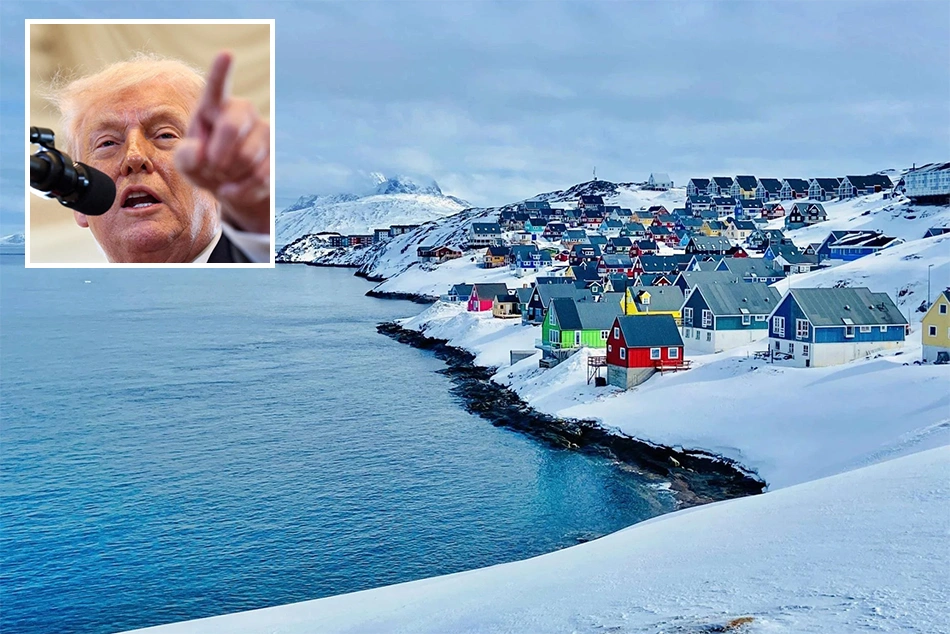
It is within this broader decline that Greenland emerges as the next frontier of European dispossession — a territory geographically European, politically marginalised, and militarily instrumentalised.
Greenland, formally part of the Kingdom of Denmark, occupies a central position in Arctic geopolitics. As climate change melts ice sheets and opens new shipping routes, the Arctic has shifted from peripheral wilderness to strategic prize. Beneath Greenland’s ice lie rare earth minerals essential to modern technologies. Its surrounding waters are becoming militarily navigable. Its location bridges North America, Europe, and Russia.
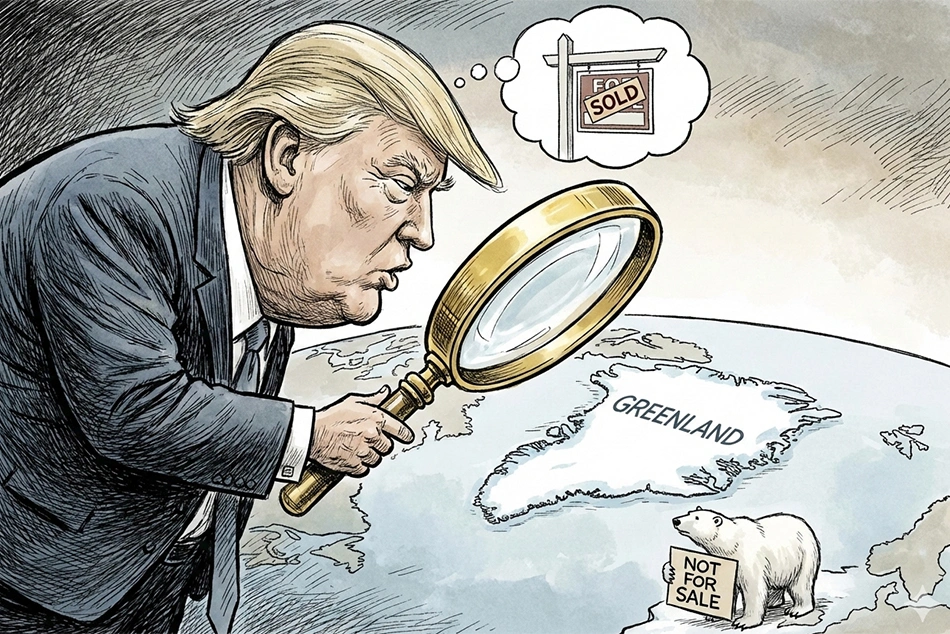
For Washington, Greenland is not a partner but an asset. The US military presence at Thule (now Pituffik Space Base) is not symbolic—it is integral to America’s missile defence and space surveillance systems. When Donald Trump openly proposed purchasing Greenland, the remark was treated as absurd theatrics. In truth, it was an unusually honest articulation of long-standing American logic: strategic territories are to be acquired, controlled, or militarised—not negotiated as equals.
Denmark’s formal sovereignty over Greenland has proved meaningless in the face of American power. Decisions about Arctic security are made in Washington and NATO headquarters, not Copenhagen or Nuuk. Greenlandic voices — particularly Indigenous Inuit perspectives, are sidelined entirely. Environmental protection gives way to military infrastructure. Climate catastrophe becomes opportunity, not warning.
NATO’s Arctic turn exposes the alliance’s deepest contradictions. It claims to defend democratic values while expanding military footprints in fragile ecosystems. It speaks of environmental responsibility while preparing the Arctic for confrontation. Greenland’s ice, already melting under the weight of climate change, now absorbs the additional burden of militarisation.
The European Union, meanwhile, reveals its impotence. While Greenland is outside the EU, its fate symbolises Europe’s broader inability to assert strategic autonomy. The EU talks of a “Green Deal” and climate leadership while silently acquiescing to Arctic militarisation. It speaks of strategic sovereignty while allowing NATO to define its security priorities. Environmental ethics collapse when confronted with alliance discipline.
The militarisation of Greenland is not an exception; it is a preview. As climate breakdown accelerates, NATO will increasingly treat ecological crises as security opportunities. Resources will be secured militarily. Shipping lanes will be defended by force. Indigenous rights will be subordinated to strategic imperatives. Europe, once a normative power advocating law and restraint, will become complicit in a new era of ecological militarism.
NATO has also distorted Europe’s moral compass. International law is invoked selectively. Invasions are condemned or excused depending on the perpetrator. Civilian deaths are tragedies when committed by adversaries and collateral damage when caused by allies. Environmental destruction is a crisis when linked to climate activists and an inconvenience when linked to military expansion. This double standard corrodes the values Europe claims to defend.
The democratic cost is profound. NATO decisions are insulated from public accountability. Parliaments rubber-stamp defence spending increases dictated by alliance targets. Social priorities—healthcare, education, climate resilience—are subordinated to rearmament. Fear is mobilised to silence dissent. Critics of NATO are accused of disloyalty, echoing the very authoritarian reflexes Europe claims to oppose.
Europe today faces a paradox. It speaks of multipolarity but behaves as if bipolarity never ended. It condemns imperialism while participating in its enforcement. NATO has locked Europe into subordination precisely at a moment when global power is shifting and independent diplomacy is most urgently required.
To criticise NATO is not to deny security concerns. It is to insist that security without sovereignty is illusion. True safety cannot rest on permanent militarisation, environmental sacrifice, or outsourced decision-making. It must be built on diplomacy, international law, regional autonomy, ecological responsibility, and democratic consent.
Europe once produced political traditions that understood this. From Scandinavian non-alignment to post-war reconciliation politics, there were paths not taken. NATO ensured those paths remained marginal.
The tragedy is not that Europe lost a war in 1945. It is that it surrendered the peace. From Berlin to Kiev, from Libya to Greenland, NATO transformed liberation into long-term tutelage. Until Europe confronts this reality – until it reclaims the right to think, negotiate, and act independently, it will remain what it has become: a proxy continent, heavily armed, environmentally compromised, morally diminished, and strategically adrift in a world moving beyond American dominance.
[Dr. Ranjan Solomon has worked in social justice movements since he was 19 years of age. After an accumulated period of 58 years working with oppressed and marginalized groups locally, nationally, and internationally, he has now turned a researcher-freelance writer focussed on questions of global and local/national justice. Since the First Intifada in 1987, Ranjan Solomon has stayed in close solidarity with the Palestinian struggle for freedom from Israeli occupation, and the cruel apartheid system. He has initiated solidarity groups in India, Afro-Asia-Pacific alliance, and at the global level. Ranjan Solomon can be contacted at: ranjan.solomon@gmail.com]
Follow ummid.com WhatsApp Channel for all the latest updates.
Select Language to Translate in Urdu, Hindi, Marathi or Arabic