Juvenile 'Sun' caught red-handed doing this
The NASA astronomers have caught a younger and juvenile version of the Sun creating a giant bubble in space
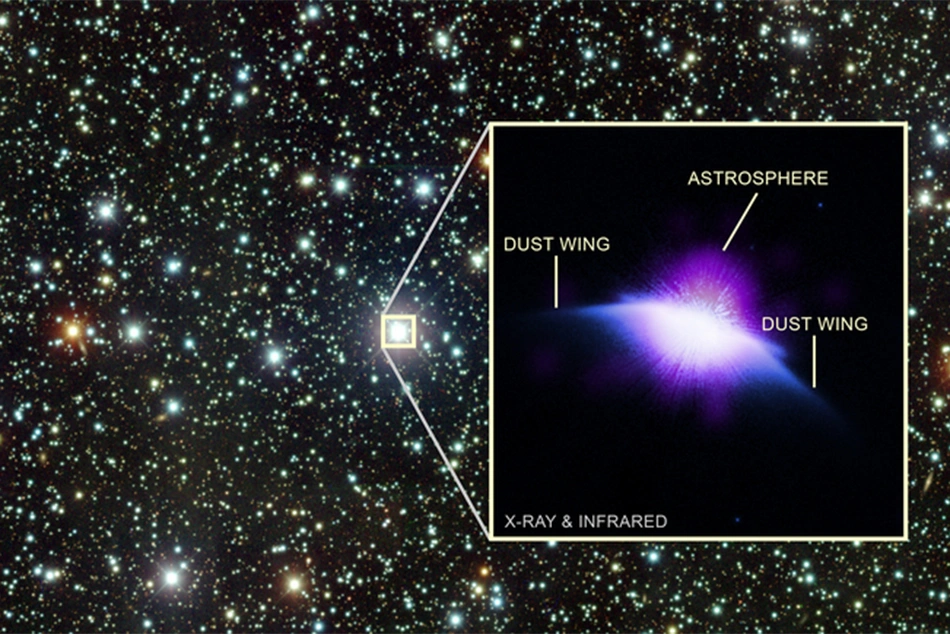
[These images show the star HD 61005 with X-rays from the Chandra X-ray Observatory as well as infrared data from Hubble Space Telescope. (NASA Image)]
The NASA astronomers have caught a younger and juvenile version of the Sun creating a giant bubble in space.
The discovery, first of its kind, was made using NASA's Chandra X-ray Observatory.
"HD 61005"
This gaseous bubble, called the "astrosphere," completely envelops the young star called HD 61005 and located about 120 light-years from Earth.
HD 61005 has roughly the same mass and temperature as the Sun, but it is much younger with an age of about 100 million years, compared to the Sun’s age of about 5 billion years.
Strong particle winds emanating from the star's surface create this bubble, filling it with hot gas. As it expands, it pushes back the cold gas and dust of the surrounding galaxy, reported NASA.
A similar envelope exists around our Sun, called the "heliosphere." It is formed by the solar wind and acts as a protective shield. It extends far beyond the planets in our solar system and shields Earth from harmful cosmic rays, the American space agency said.
“We have been studying our Sun’s astrosphere for decades, but we can’t see it from the outside,” said Carey Lisse of Johns Hopkins University in Baltimore, who led the study, which published [day of week] in the Astrophysical Journal. “This new Chandra result about a similar star’s astrosphere teaches us about the shape of the Sun’s, and how it has changed over billions of years as the Sun evolves and moves through the galaxy.”
"Moth"
Astronomers have nicknamed the HD 61005 star system the “Moth” because it is surrounded by large amounts of dust patterned similarly to the shape of a moth’s wings when viewed through infrared telescopes.
The wings are formed from material left behind after the formation of the star, similar to the Kuiper Belt in our own solar system.
Observations of these wings with NASA’s Hubble Space Telescope showed that the interstellar matter surrounding HD 61005 is about a thousand times denser than that around the Sun.
Astronomers have been trying to capture an image of an astrosphere around a Sun-like star since the 1990s. Chandra was first to do this.
And, Chandra was able to detect the astrosphere around HD 61005 because it is producing X-rays as the stellar wind runs into cooler local interstellar medium dust and gas that surrounds the star, NASA said.
“There’s a saying about a moth being drawn to a flame,” said co-author Brad Snios, formerly of CfA and now at MITRE, a non-profit that participates in federally funded research. “In the case of HD 61005, the ‘Moth’ can’t easily escape from the flame because it was born around it and might be sustained by a disk around it.”
Follow ummid.com WhatsApp Channel for all the latest updates.
Select Language to Translate in Urdu, Hindi, Marathi or Arabic