Pune Growth Story Needs A Matching, Time Bound Action Plan
The Pune district collector has formed a dedicated high-level committee with PMRDA, MIDC, MSRDC, NHAI, PWD and traffic police to fix Chakan's roads, and has ordered time-bound action plans this very month
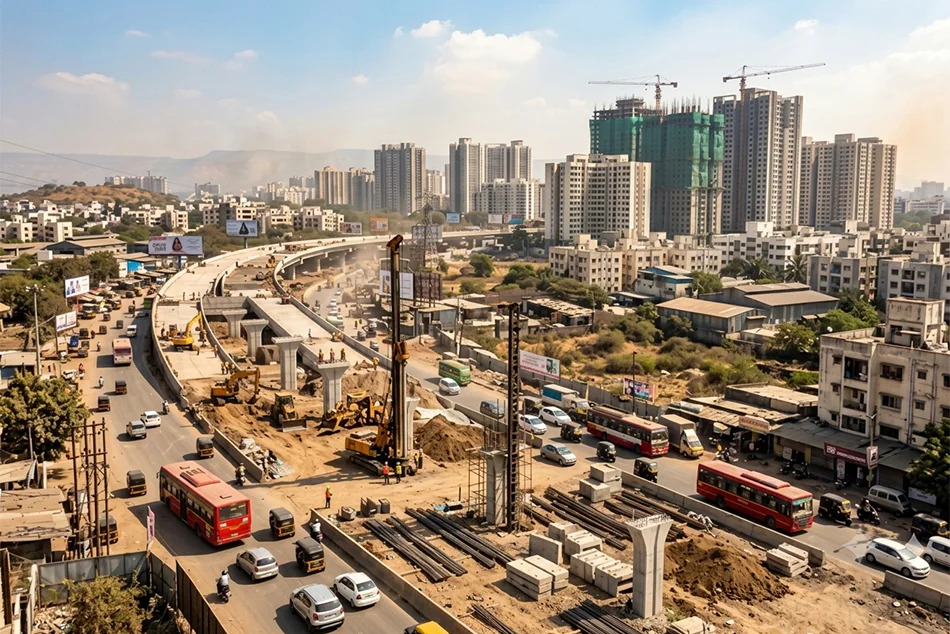
A few weeks ago, I wrote about what Hinjewadi and Chakan are going through, and about Talegaon's promise as a fresh canvas. Since then, I have watched the state machinery respond with a seriousness I genuinely want to acknowledge.
- The Pune district collector has formed a dedicated high-level committee with PMRDA, MIDC, MSRDC, NHAI, PWD and traffic police to fix Chakan's roads, and has ordered time-bound action plans this very month.
- In Hinjewadi, Rs 426 crore has been sanctioned for road and last-mile connectivity improvements, and
- PMRDA has drawn up a fresh plan for footpaths, cycle tracks, speed tables and safer pedestrian crossings near Metro stations.
These are not small gestures. They show real intent from the government to fix two of Maharashtra's most important economic engines, and that intent deserves to be welcomed rather than taken for granted.
But as a developer who has watched this region grow for decades, I also know that fixing Hinjewadi and Chakan after the fact, even though it is obviously well-intentioned, is the harder and more expensive path. The real opportunity now is to use this momentum to ask a bigger question: why do our fastest-growing belts keep reaching crisis point before the system responds?
The answer, I believe, lies less in any one authority's failure and more in the scale and structure of the planning challenge itself.
A Region the Size of a Small State
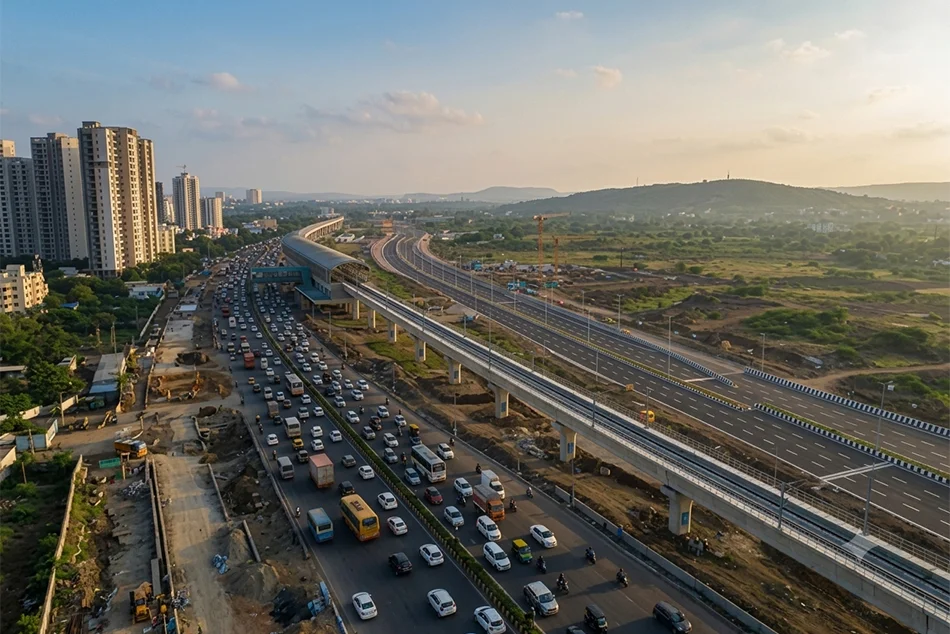
PMRDA was set up in 2015 to plan and coordinate growth across Pune and Pimpri-Chinchwad, and the villages around them. Its jurisdiction spans somewhere between 6,000 and 7,250 square kilometres, covering over 800 villages across nine talukas.
To put that in perspective - most municipal corporations in India manage areas that are a fraction of this size, with far simpler administrative boundaries, and fewer competing land uses to reconcile. We are basically asking one authority to plan land use, roads, water, power and public transport - across an area this vast, with villages, farmland, industrial belts and urban clusters all mixed together.
This is an entirely different order of administrative challenge. It demands a scale of agility and long-range vision that conventional planning tools were never built for.
That mismatch has shown up clearly in PMRDA's own planning history. Its draft Development Plan, published in August 2021, drew more than 67,000 objections and suggestions from citizens. The Bombay High Court stayed its implementation in October 2022 citing procedural concerns, and after years of legal back-and-forth, the state government formally cancelled the entire draft DP in September 2025, effectively resetting the process.
PMRDA has since been directed to prepare a Structure Plan instead, starting with the road network, before attempting a fresh Development Plan. This is not a story of neglect. It reflects, more than anything, the inherent limits of conventional master-planning processes, which routinely take 10-15 years to move from draft to ground reality.
By the time such plans are finalised, the real estate and population growth they were meant to guide has often already moved past them.
Learning From How Mumbai Is Tackling the Same Problem
Interestingly, Maharashtra is already testing a different approach elsewhere in the state. For its upcoming 'Third Mumbai' project, spanning over 320 square kilometres across 124 villages, the MMRDA has engaged Surbana Jurong, a leading Singapore-based planning agency, to prepare a complete vision document and master plan within a compressed 30-week timeline.
Whatever one's view of importing outside expertise, the underlying idea is sound - when a region needs to plan decades ahead within months rather than years, it makes sense to bring in planners who have done this at scale before, rather than relying solely on conventional in-house processes which are already stretched thin by other responsibilities.
Pune and Pimpri-Chinchwad are rapidly becoming one continuous mega-region, pulled together by automotive, electronics and technology industries expanding in every direction, from Chakan in the north to Hinjewadi in the west - and now Talegaon further along the expressway. A region of this ambition deserves a structural plan built with the same urgency and global expertise, so that the next growth belt is planned with foresight rather than retrofitted under pressure.
Four Practical Shifts Worth Considering
- PMRDA's current move towards a Structure Plan is the right moment to bring in top-tier international planning expertise, on the Third Mumbai model, to help deliver a practical, implementable framework within a defined timeline rather than over another decade.
- The fragmentation between MIDC, PMRDA, municipal corporations, PWD and gram panchayats, each controlling a different stretch of road or utility, needs to give way to a single coordinating platform. Chakan's internal roads being 70 metres wide under MIDC while connecting roads remain 8 to 12 metres wide under other agencies shows exactly what this fragmentation produces.
- Planning and execution should run in parallel rather than one after the other. Arterial roads, transit corridors and growth-centre reservations can be identified and built even as the larger structure plan is finalised, much as PMRDA's phase-one focus on roads already suggests.
- A dedicated task force modelled on how MMRDA drives execution for regional projects, with the authority to take fast decisions on land acquisition and inter-agency approvals, would help translate plans into built infrastructure far more quickly than routine bureaucratic channels allow.
Closing Thoughts
Unplanned and unregulated development does not wait for paperwork. When formal planning lags behind real-world growth, that vacuum tends to fill itself, often messily, which is exactly what unfolded in Hinjewadi and Chakan.
The good news is that the government's recent actions show this gap is being recognised and addressed head-on. If that same urgency is now channelled into structural reform, through global planning expertise, unified coordination and parallel execution, Pune's next decade of growth, in places like Talegaon and beyond, can finally match the ambition of the city it is meant to serve.
[The writer, Anil Pharande, is Chairman of Pharande Spaces, a leading real estate construction and development firm famous for its township projects in Greater Pune and beyond. Pharande Promoters & Builders, the flagship company of Pharande Spaces and an ISO 9001-2000 certified company. Established in 1994, the company has built a substantial footprint of premium gated communities, massive integrated townships and high-grade commercial office and retail projects. Thjey are widely recognized for theirs focus on modern, green township living concepts and high-quality construction.]
Follow ummid.com WhatsApp Channel for all the latest updates.
Select Language to Translate in Urdu, Hindi, Marathi or Arabic