ChatGPT as Therapist: India’s Quiet Mental Health Shift
The honest position is that ChatGPT becoming a first mental health stop is not a scandal to be shut down — it is a symptom of a system that has failed to be accessible, and a signal we should not waste.
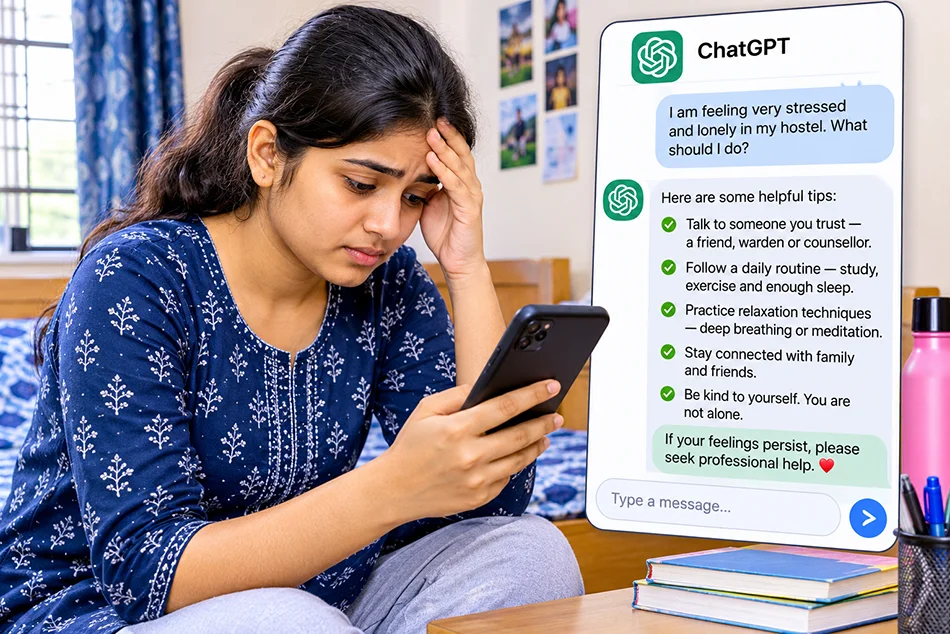
A student recently told me, almost apologetically, that she talks to ChatGPT most nights before bed. Not for assignments — for everything else. The fight with her roommate. The dread before a viva. The feeling, unnamed but familiar to most 20-year-olds, that she is behind in a race she never agreed to run. She said it helps. She also said she hadn’t told her parents, or her actual counsellor, that this was now her primary outlet.
I did not find this shocking. I found it entirely predictable, and worth taking seriously rather than dismissing.
India has, by conservative estimate, fewer than one psychiatrist for every 100,000 people, and campus counselling cells — where they exist at all — are frequently understaffed, stigmatised, or open only during hours that don’t suit a student in genuine distress. Into that gap has walked a free, always-available, non-judgmental, endlessly patient conversational partner. Of course, students are using it. The question worth asking is not whether this should be happening — it already is, at scale — but what it is doing to the psychological architecture of a generation, and what psychology as a discipline owes them in response.
Parasocial attachment is the place to start, because it is the most misunderstood part of this story. We usually reserve that term for one-sided relationships with celebrities or influencers. But a chatbot that remembers your name, mirrors your tone, and responds instantly to 2 a.m. distress is a far more potent object of attachment than a distant film star ever was. It talks back. It seems to know you. For a student who has never had a relationship with a mental health professional to compare it to, this can quietly become the template for what “being understood” feels like — one with no boundaries, no fatigue, and no capacity to actually hold a crisis.
That template feeds directly into emotional dependence. The worry is not that a student vents to an AI occasionally — most of us talk to a diary, a pet, or a long walk when we’re overwhelmed, and that’s healthy enough. The worry is when it becomes the only outlet, when a young person’s distress tolerance is built entirely around the availability of instant, frictionless reassurance. Real relationships involve delay, disagreement, and repair. An AI companion offers none of the friction that actually builds resilience — it offers comfort without cost, which is exactly what makes it so easy to over-rely on.
This is where the psychological establishment needs to be honest about what a chatbot is not: it is not a therapeutic alliance. That term describes something specific and, frankly, irreplaceable — a bond built on a trained clinician’s judgment, accountability, ethical obligation, and capacity to hold risk. A large language model has no duty of care. It cannot assess suicidality with clinical judgment, cannot break confidentiality to alert a family in a genuine emergency, and cannot be held accountable if its reassurance is dangerously wrong. Students experiencing real crises — not just stress, but depression, self-harm ideation, trauma — deserve to know this distinction before they mistake fluency for expertise.
None of this means the answer is to scold students away from these tools. It means we urgently need AI literacy built into how psychology is taught and practised in India — not literacy in the sense of “how to prompt better,” but literacy in the sense of knowing what a chatbot can and cannot do for your mind. Students should be taught, explicitly, the difference between a tool that helps you organise your thoughts and one that can hold your life. Colleges that already run digital well-being sessions should be naming AI companionship directly, rather than treating it as a subset of generic “screen time.”
This also raises a professional obligation that our field hasn’t fully reckoned with. Ethical psychology in India has spent decades building informed-consent frameworks, confidentiality protocols, and referral pathways for human practitioners. We now need equivalent thinking for the AI layer that sits in front of — and increasingly instead of — those practitioners. What should a chatbot be required to say when a user expresses suicidal ideation? Should there be a standard, India-specific disclosure that a companion app is not a mental health service? Whose responsibility is it when a vulnerable teenager’s primary emotional confidant is a product with no clinician behind it? These aren’t hypothetical questions for a future paper. They are live, right now, in hostel rooms across the country.
The honest position is that ChatGPT becoming a first mental health stop is not a scandal to be shut down — it is a symptom of a system that has failed to be accessible, and a signal we should not waste. The task ahead is not to compete with the chatbot for students’ 2 a.m. conversations. It is to make sure that when those conversations reveal something serious, there is a trained human, not just a well-phrased response, on the other end.
[The writer, Dr. Rahul Varma, is Assistant Professor, Department of Psychology, CHRIST (Deemed to be University), Delhi NCR.]
Follow ummid.com WhatsApp Channel for all the latest updates.
Select Language to Translate in Urdu, Hindi, Marathi or Arabic