Where Are The Jobs: The Question Modi Has Put To The Wrong Room
Prime Minister Narendra Modi asked industry why hiring and wages have stalled, but the government’s own data, and its advisers’ own advice, suggest the question has been put to the wrong room.
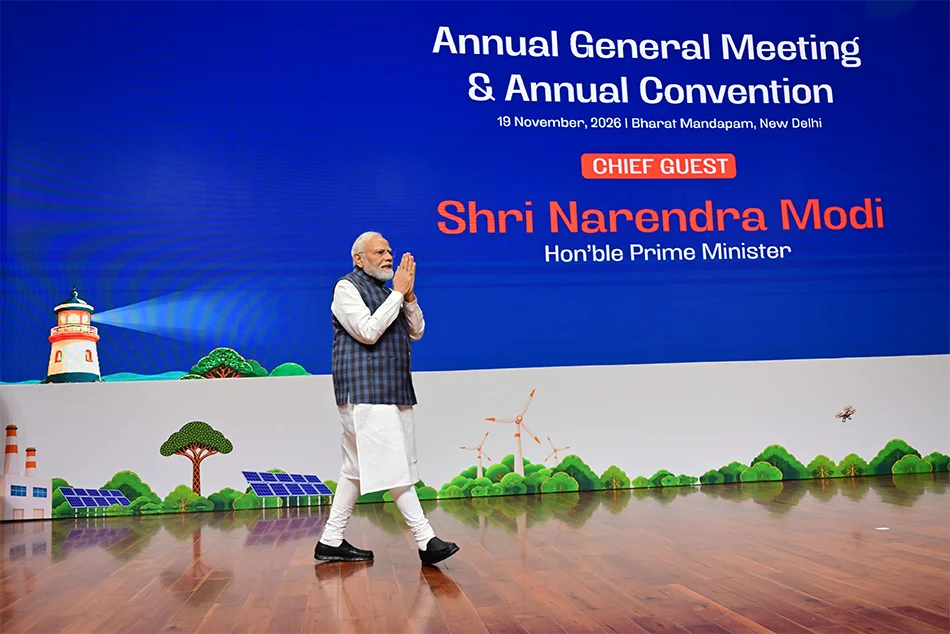
Some questions reveal more about who is asked than about what is asked. Addressing the FICCI's Centenary Convention on Thursday, in the hall at Bharat Mandapam, Prime Minister Narendra Modi put one to India’s business leaders. He had cut the corporate tax rate from 30 to 22 per cent, he reminded them, and freed incomes up to Rs 12 lakh from income tax.
“Have you increased the salaries of your employees?” he asked, and supplied the answer himself: No.
The charge has a surface logic. Tax relief is meant to buy hiring and higher pay, and if it has not, somebody is keeping the change. But an accusation is not an argument, and this one runs into three obstacles:
- What the data say about jobs
- What they say about pay, and
- The absence of a policy that would govern both.
The Numbers That Disagree
Start with jobs, where the government’s account and the labour market’s do not match. In a written reply to the Lok Sabha on 27 July, the Labour Ministry said youth unemployment, for ages 15 to 29, fell to 9.9 per cent in 2025, and that the share of the population at work rose from 38.5 to 41.4 per cent.
The latest periodic labour force reading, for June 2026, tells another story: Youth unemployment of 16.2 per cent against 5.5 per cent for all ages, as reported by Business Today. The State of Working India 2026 report finds that nearly 40 per cent of young graduates in the labour force say they are openly unemployed. And about eight million new workers arrive every year.
A single-digit headline rate flatters in an economy with no unemployment insurance, where most people cannot afford to be jobless and take any work at all. It is the graduate, who can afford to wait, who shows up as unemployed.
Jobs Without Pay
Here the evidence is Surjit Bhalla’s, set out in The Indian Express this Saturday. Salaried employment has grown from about 85 million in 2011-12 to roughly 148 million in 2025, a considerable expansion. But the average salaried worker earns less in real terms than in 2011-12, and the typical graduate’s monthly salary has fallen from Rs 41,782 to Rs 35,046.
Wages follow productivity, productivity follows investment, and investment follows incentives that are set in Delhi. Import tariffs and quality control orders raise the price of the inputs that manufacturers need. A tax burden that Bhalla finds heavier than China’s, Vietnam’s or Indonesia’s weighs on capital.
Bhalla, a former IMF Executive Director for India, argued in May that Foreign Direct Investment (FDI) had turned negative, that the 2015 bilateral investment treaty deters foreign money, and that growth has hovered near six per cent for three decades. The Prime Minister told firms that the domestic market must not become their comfort zone. The remark invites an obvious reply:
Who built the fence around it?
The Advice
The advisory layer enters here. After the Economic Survey, Chief Economic Adviser V. Anantha Nageswaran said that employment conditions had improved since the labour force survey began, with unemployment falling from six per cent to 3.2 per cent in 2023-24. In June, on ANI’s podcast with Smita Prakash, he was reported to have said that the era of software, computer science and MBA education is ending, and to have urged the young to respect and train for trades such as plumbing and carpentry. He has also defended India’s GDP estimates against criticism from economists including Abhijit Banerjee.
These messages cannot all be true at once. An economy cannot be recovering its jobs and, in the same year, be telling its graduates to leave their degrees. Skilled trades deserve respect, and AI will reshape white-collar work. But advice to eight million annual entrants to adapt is cheaper than explaining why the investment cycle has not turned. It moves the cost of policy failure from the state to the individual.
A Policy Which is Not There
The deeper gap is that India has no finalised national employment policy. In October 2025, the Labour Ministry released a draft, the Shram Shakti Niti, for public comment, promising a unified labour data platform, AI-enabled job matching and a 35 per cent female participation target by 2030. Thirteen months on, public records show no final version notified.
The government does run a hiring-incentive scheme worth about Rs 1 lakh crore, but a scheme is not a policy. A policy would have to bind trade, tariffs, investment, education and labour law to measurable job targets, and a target is a hostage to fortune. An advisory culture built on headline averages and reassuring phrases has so far declined to offer one.
Nothing is therefore at stake when a statistic flatters, and nobody can test whether the plan works.
The Politics, And The Defence
The opposition pounced. Rahul Gandhi called the speech the Prime Minister’s own confession, while Mallikarjun Kharge and Jairam Ramesh said business was being blamed for the government’s failures.
The government has real points: The corporate tax cut, production-linked incentives, trade agreements with major economies and a growing formal workforce, with about 8.2 crore net EPFO subscribers since 2017. Private investment has indeed disappointed, and industry’s lobbying record is far from spotless.
PM Modi concluded his speech by inviting industry to write to him openly about reforms still needed. It is a good invitation. The same courtesy should extend to his advisers, who should be asked to commit, in writing and in numbers, to what India’s jobs will look like by 2030.
The Prime Minister asked where are the jobs?
It is the right question. It deserves an answer from the people paid to give him one.
[The writer, Nihar Nalini Sarangi. is a professor-turned-editor and literary nomad who has traded the confines of academia for the open landscape of ideas. Unbound by professional conventions or traditional career paths, she explores the power of words through diverse forms of writing, ranging from incisive socioeconomic critiques to short fiction. Her work challenges established narratives, questions prevailing assumptions and seeks to inspire change. When the noise of the world becomes overwhelming, she retreats into the sanctuary of literature, where her creative writing finds expression in the pages of leading magazines. Driven neither by accolades nor professional ambition, she writes to explore deeper truths, provoke thought and engage with the possibilities of a more just and humane world.]
Follow ummid.com WhatsApp Channel for all the latest updates.
Select Language to Translate in Urdu, Hindi, Marathi or Arabic