Sir Syed Ahmed Khan’s political thoughts are misinterpreted
The distortion of Sir Syed’s political thought stems from the political thought of the right-wing mindset that Muslims should not be given any space in India.
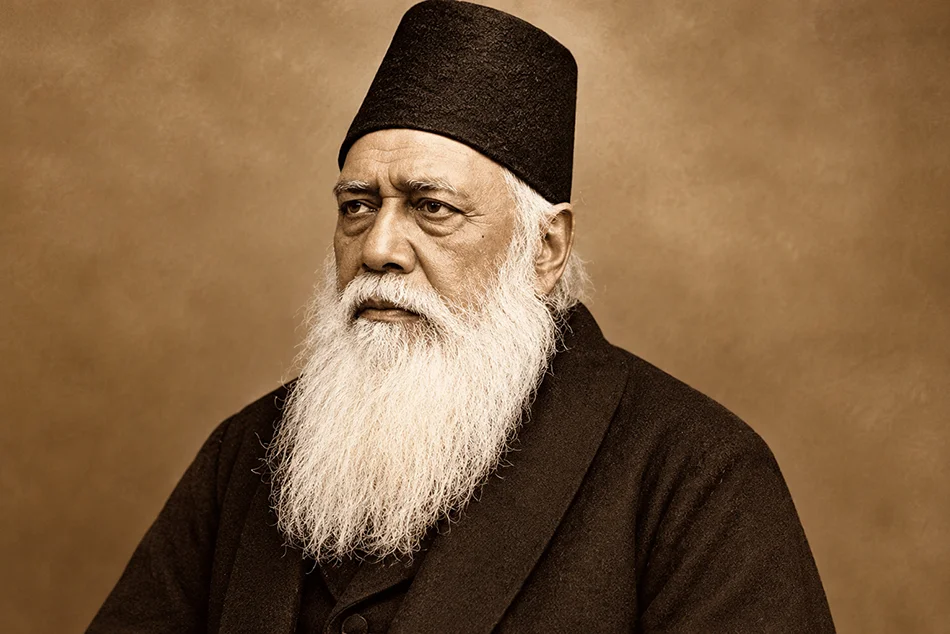
I am Aligarian! I teach in the Department of Political Science at a private University in Chennai. I teach the paper ‘Modern Indian political thinkers’. One of the thinkers is Sir Syed Ahmed Khan. I have to teach the political thoughts of Sir Syed Khan, branding him as a communal and separatist Muslim figure in India. I have huge reservations about this RSS propaganda template that I admired during my Aligarh years.
The syllabus that I teach to the undergraduate students says that Sir Syed was the first separatist Muslim leader in India. He was an ideological precursor of the Separate electorate, the Two-Nation Theory, and the ultimate demand for Pakistan.
Sir Syed’s remark that Hindu-Muslim unity is compared to the two eyes of a beautiful bride is now being interpreted as separatist. His ideas that Muslims should have a distinct political identity are termed unacceptable. His idea of separate representation for Muslims for their social and educational development is being decried.
Sir Syed’s narrative is now being interpreted in the current Hindu majority and Muslim minority binary. The fact is that his ideas were espoused when India was free from democratic politics or the majority-minority syndrome. Sir Syed was born in 1817 and died in 1898.
Sir Syed’s political thought has nothing to do with the current majoritarian politics. The distortion of Sir Syed’s political thought stems from the political thought of the right-wing mindset that Muslims should not be given any space in India. To them, Sir Syed’s political thoughts are anti-national and separatist in today’s context.
As a matter of fact, Sir Syed had no clue about separate electorates because there was no democracy in his era under colonial rule. Sir Syed had nothing to do with the two-nation theory, and it was not his brainchild.
Finally, Sir Syed had no clue about Pakistan, which came into the limelight only on March 23, 1940.
Moreover, Sir Syed was not part of the current Muslim dilemma. For decades, Indian political discourse has trapped Muslims in a false binary. When Muslims organize under their own leadership, they are swiftly branded as "communal."
Yet when they join majority-led coalitions in the name of secularism, they are expected to submerge their distinct identity and political voice—effectively becoming "Mr. Nobody.”
Sir Syed certainly dreamt of a distinct identity for Muslim, but not in separatist terms. Muslims should be part of unity in diversity.
At the heart of the predicament of the Indian Muslims is a vital democratic question:
Does a Muslim-led political identity automatically become communal, or should it be judged by their commitment to the Constitution?
[The writer, Dr Syed Ali Mujtaba, is an academic, author, journalist and filmmaker based in Chennai. He did his undergraduate and post-graduation in History from AMU in the early 80s. He lived in Nasruallh Hostel, Room No. 16, in VM Hall. The room had a small poster on the door: F-16. He played for the AMU football team. He can be contacted at syedalimujtaba2007@gmail.com. Views are personal.]
Follow ummid.com WhatsApp Channel for all the latest updates.
Select Language to Translate in Urdu, Hindi, Marathi or Arabic