Explore: Most comprehensive images of Saturn to date
NASA’s James Webb Space Telescope (JWST) and Hubble Space Telescope have released never seen before images of planet Saturn and its glowing rings
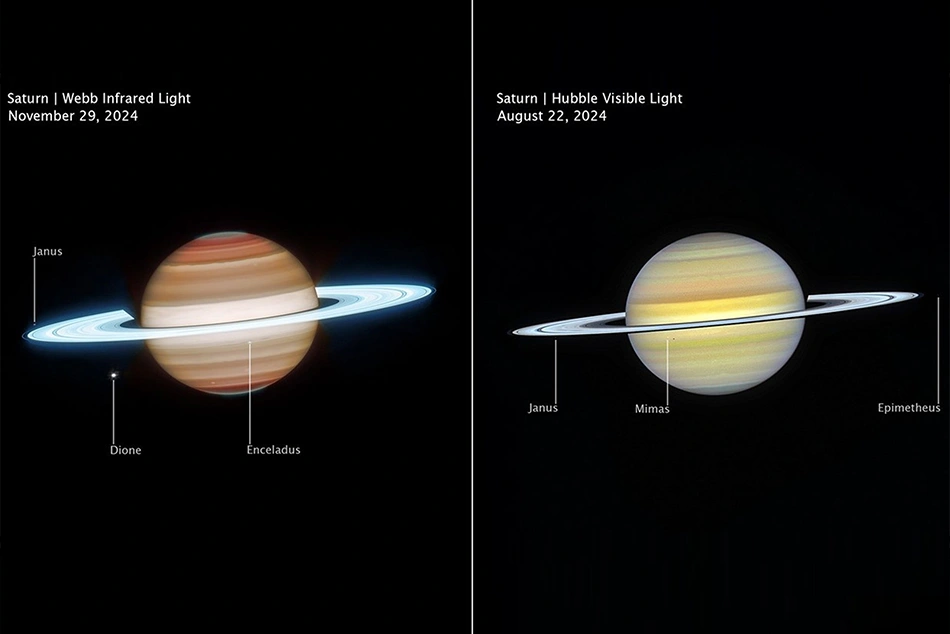
[Complementary views of Saturn from NASA’s James Webb Space Telescope and Hubble Space Telescope show a dynamic planet with atmospheric features, orbiting moons, and bright rings. (Image: NASA, ESA, CSA, STScI, Amy Simon (NASA-GSFC), Michael Wong (UC Berkeley); Image Processing: Joseph DePasquale (STScI))]
NASA’s James Webb Space Telescope (JWST) and Hubble Space Telescope have released never seen before images of planet Saturn and its glowing rings.
Observing in complementary wavelengths of light, the two space observatories provide scientists with a richer, more layered understanding of the gas giant’s atmosphere.
Both the telescopes sense sunlight reflected from Saturn’s banded clouds and hazes, but where Hubble reveals subtle color variations across the planet, Webb’s infrared view senses clouds and chemicals at many different depths in the atmosphere, from the deep clouds to the tenuous upper atmosphere, NASA said in a blog post.
The Hubble image was captured as part of a more than a decade long monitoring program called OPAL (Outer Planet Atmospheres Legacy) in August 2024, while the Webb image was captured a few months later using Director’s Discretionary Time.
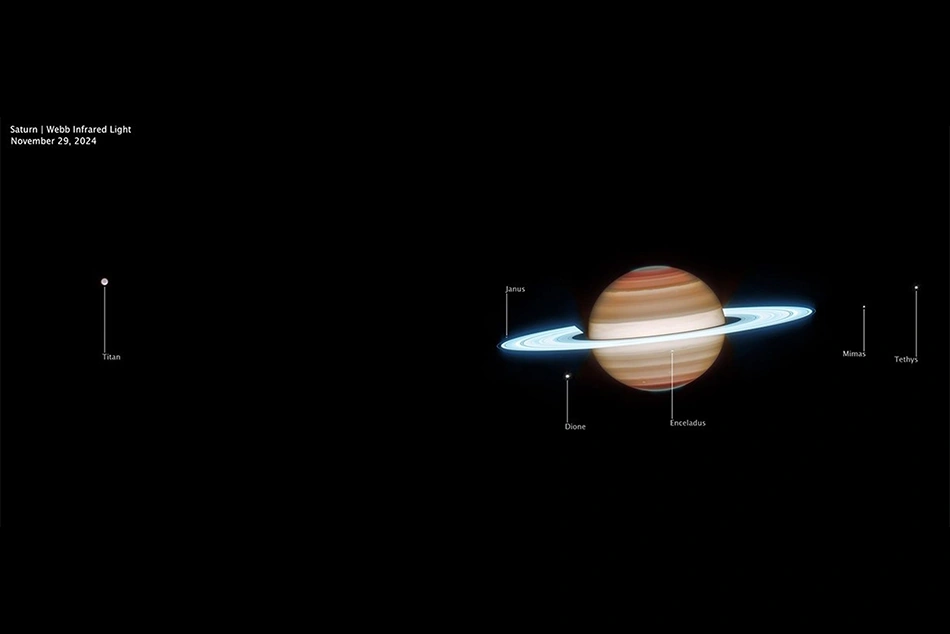
[A wider view of Saturn from NASA’s James Webb Space Telescope shows six of Saturn’s larger moons, including the largest, Titan, at far left. (Image: NASA, ESA, CSA, STScI; Image Processing: Joseph DePasquale (STScI))]
Together, the two telescopes provide a layered, three-dimensional understanding of Saturn’s atmosphere, allowing scientists to “slice” through different altitudes much like peeling an onion.
NASA’s Hubble and Webb have already explored Saturn’s auroras, provided insights into Jupiter’s spectacular auroras also seen with Hubble, confirmed the auroras of Uranus glimpsed in 2011 by Hubble, and detected Neptune’s auroras for the first time with Webb.
The images also capture dynamic weather systems. A long-lived jet stream known as the “ribbon wave” winds through the northern hemisphere, while remnants of a massive storm that occurred between 2010 and 2012 are still visible.
Several smaller storms dot the southern hemisphere, showing the planet’s turbulent atmosphere.
Follow ummid.com WhatsApp Channel for all the latest updates.
Select Language to Translate in Urdu, Hindi, Marathi or Arabic