Gujarat Uniform Civil Code defies principles of inheritance: Jamiat Ulama
Announcing to challenge the Gujarat Uniform Civil Code (UCC) before Supreme Court of India, Jamiat Ulama i Hind said the newly passed legislation nullifies the Muslim Personal laws and defies the principles of inheritance
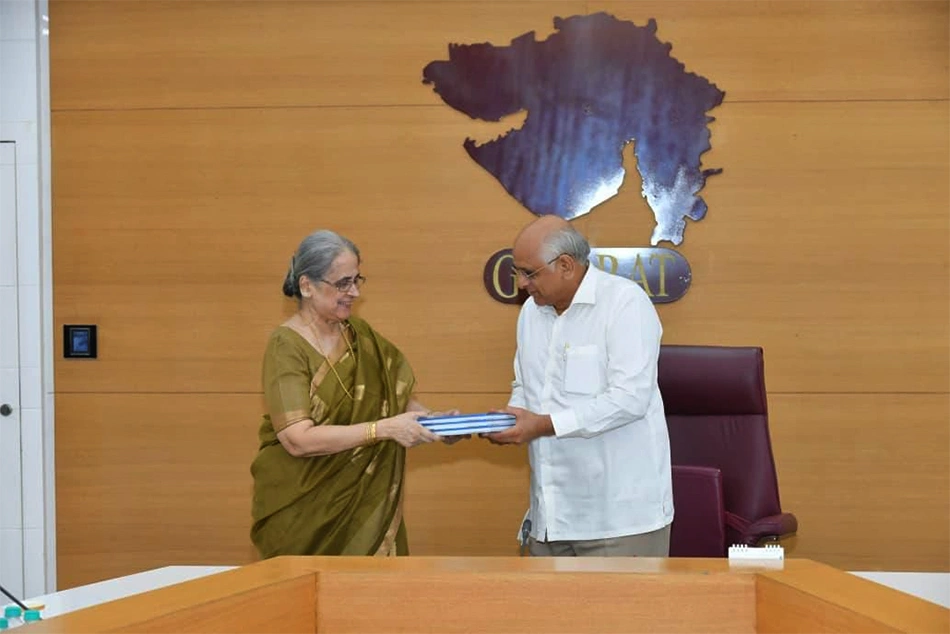
[Retired Supreme Court Justice Ranjana Desai, who headed a five-member panel, handed over the Gujarat UCC Bill draft to the state Chief Minister Bhupendra Bhai Patel before it was tabled and passed by the assembly.]
New Delhi: Announcing to challenge the Gujarat Uniform Civil Code (UCC) before Supreme Court of India, Jamiat Ulama i Hind said the newly passed legislation nullifies the Muslim Personal laws and defies the principles of inheritance.
"The Uniform Civil Code (UCC) passed by the Gujarat Assembly seeks to effectively nullify Muslim personal laws — particularly the clearly defined principles of inheritance, which are recognized under the Constitution of India. Being derived from Qur’an and Sunnah, these are not mere social customs but constitute binding religious obligations", President of Jamiat Ulama-i-Hind, Maulana Mahmood Madani, said.
He said that no government has the constitutional authority to interfere in matters of religious beliefs and essential religious practices.
"Furthermore, the abolition of personal laws under the pretext of a Uniform Civil Code amounts to legislative overreach, which will not withstand strict constitutional scrutiny before the Supreme Court", he said.
Jamiat flags 3 core aspects
Following a comprehensive examination of the Gujarat UCC, Jamiat’s legal panel has identified at least three core aspects that are in direct conflict with explicit Islamic injunctions.
Foremost among these is the Islamic law of inheritance, the shares of which are clearly defined in the Holy Qur’an and are immutable.
Each heir’s share has been individually prescribed and declared as part of the “limits set by Allah,” with any transgression termed as injustice.
"Therefore, these provisions are not merely components of Muslim personal law but divine commandments, compliance with which is obligatory upon every Muslim", the Jamiat said.
"Any attempt to nullify or dilute these injunctions is not only condemnable but also constitutes a violation of the fundamental principles of justice and a breach of the assurances given to Muslims by the framers of the Constitution", the largest representative body of Indian Muslims said.
Similarly, the blanket prohibition on polygamy effectively criminalizes a recognized religious permission, amounting to a direct interference in religious freedom.
"Moreover, provisions imposing a complete ban on all forms of divorce outside court procedures, prescribing up to three years of imprisonment, and imposing a fine of ₹60,000 for failure to register a marriage within sixty days, are neither consistent with constitutional principles nor aligned with established legal and ethical standards", the Jamiat said.
"These measures are manifestly disproportionate and represent a serious and unjustified shift of civil matters into the criminal domain", it added.
Why STs expempted?
While slamming the Gujarat UCC, Maulana Madani termed as “absurd” the statement of the Chief Minister of Gujarat that “one nation must have one law,” questioning why Scheduled Tribes have been exempted from the purview of this law.
“Are they not part of the nation?” he asked.
He stated that such differential treatment constitutes a clear violation of Article 14 (Right to Equality) of the Constitution.
He announced that Jamiat Ulama-i-Hind will challenge this law before the Supreme Court and will pursue all available constitutional and legal remedies to ensure the full protection of the religious and constitutional rights of Muslims, and to prevent any infringement upon the essential injunctions of Islamic Shariah.
Follow ummid.com WhatsApp Channel for all the latest updates.
Select Language to Translate in Urdu, Hindi, Marathi or Arabic