Austrian researchers develop QR code thinner than human hair
Researchers from TU Wien, a public research university in Vienna, Austria have developed a QR code which is thinner than human hair, setting a new benchmark in miniaturization
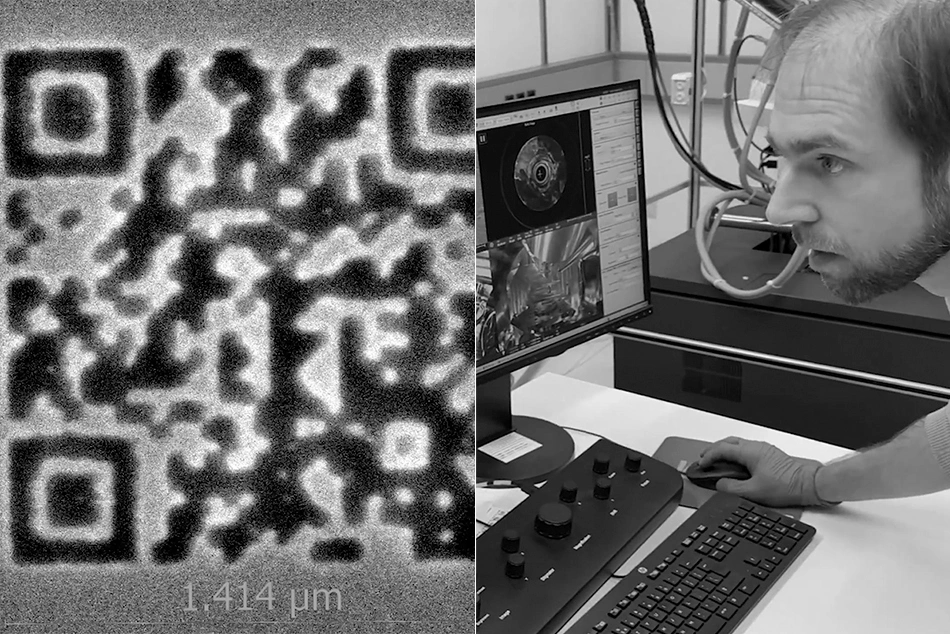
Researchers from TU Wien, a public research university in Vienna, Austria have developed a QR code which is thinner than human hair, setting a new benchmark in miniaturization.
The Austrian researchers’ QR code was created by cutting a thin layer of chromium nitride with the help of a focused ion beam.
Its size is only 1.977 square micrometers (1.414 by 1.398 micrometers), making it among the smallest QR codes of its kind.
Watch Video
Researchers from researchers from TU Wien in Austria have created a QR code smaller than the width of a human hair.
— Guinness World Records (@GWR) April 1, 2026
It was created by cutting a chromium nitride thin film using a focused ion beam and measured an area of 1.977 square micrometres. pic.twitter.com/cuRSpZrAM1
“Researchers from researchers from TU Wien in Austria have created a QR code smaller than the width of a human hair.
“It was created by cutting a chromium nitride thin film using a focused ion beam and measured an area of 1.977 square micrometers”, Guinness World Records wrote in a social media post while sharing a video clip.
A QR (Quick Response) code is a two-dimensional barcode consisting of black squares arranged on a white grid, designed to store data that can be quickly scanned and interpreted by a smartphone camera. Invented in 1994 by Denso Wave, QR codes act as fast, physical-to-digital shortcuts to URLs, contact info, or payments.
The microscopic QR code establishes vital progress in nanotechnology, demonstrating that latest fabrication techniques can achieve unprecedented precision, opening doors to future innovations in data storage, security, and material science.
Follow ummid.com WhatsApp Channel for all the latest updates.
Select Language to Translate in Urdu, Hindi, Marathi or Arabic