The Quiet Denial of Justice to Dalit Converts
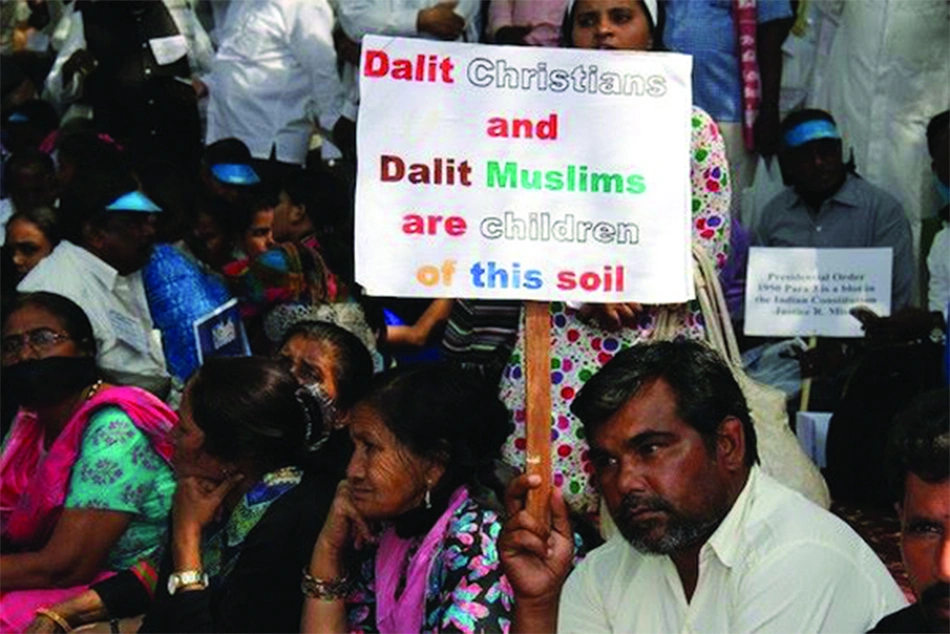
Dalit Christians and Dalit Muslims across India continue to face forms of discrimination that are unmistakably caste-based, and to suggest that conversion erases caste is to ignore this lived reality
India often takes pride in being the world’s largest democracy, a constitutional republic anchored in rights, representation, and the promise of equality. But as B. R. Ambedkar warned, political democracy without social democracy is fragile – perhaps even hollow. Nowhere is this contradiction starker than in the experience of Dalits who convert out of Hinduism, seeking dignity, only to find that the law withdraws its protection the moment they do so.
Ambedkar powerfully expressed this sentiment:
“Turn in any direction you like, caste is the monster that crosses your path”.
In India’s long and unfinished struggle with caste, there exists a paradox so glaring that it ought to trouble the conscience of any constitutional democracy. A Dalit may change their religion, but not their social reality. Yet, in the eyes of the law, that act of conversion is treated as if it dissolves centuries of oppression. The result is a quiet but profound injustice — one that is not always loudly proclaimed, but deeply felt.
At the heart of this paradox lies a legal and constitutional anomaly, upheld and sustained over decades, including by the Supreme Court of India. The issue concerns Dalits who convert to Islam or Christianity and, in doing so, lose their Scheduled Caste (SC) status — and with it, the protective safeguards and affirmative action benefits designed to address historical discrimination.
The question that demands asking is simple:
Does conversion erase caste?
And if not, can a constitutional democracy justify withdrawing protection from those who continue to suffer its consequences?
A Legal Framework Built on a Narrow Assumption
The origins of this exclusion lie in the Constitution (Scheduled Castes) Order, 1950, which initially restricted SC status to Hindus. Subsequent amendments extended this recognition to Sikhs and Buddhists, but conspicuously left out Muslims and Christians. The rationale offered has been that caste – and specifically “untouchability”, is a phenomenon unique to Hindu society.
This reasoning, though convenient, is increasingly difficult to defend. It relies on a theological abstraction rather than a sociological reality. Courts, including the Supreme Court of India, have often deferred to this framework, as seen in cases such as Soosai v. Union of India, where the burden of proof was placed on demonstrating that caste-based disabilities persist after conversion.
But decades of scholarship, lived experiences, and community testimony suggest that caste does not disappear – it adapts, survives, and often reasserts itself in new forms.
The Persistence of Caste Beyond Religion
Dalit Christians and Dalit Muslims across India continue to face forms of discrimination that are unmistakably caste-based. Segregated burial grounds, separate seating in places of worship, endogamous marriage practices, and social exclusion are not uncommon. These are not isolated incidents but patterns that have been documented by sociologists, activists, and even government-appointed commissions.
To suggest that conversion erases caste is to ignore this lived reality. It is to privilege doctrinal ideals over empirical truth. And when such an assumption informs policy and judicial reasoning, it risks turning the Constitution’s promise of equality into a selective guarantee.
The legal and social status of Dalit converts in India – particularly those who convert to Christianity or Islam, represents a critical intersection of religious freedom, constitutional rights, and enduring social reality. While conversion is intended as an act of liberation, it often leads to a “quiet denial of justice,” where individuals lose state-mandated protections against caste discrimination without escaping the stigma of their birth. A Penalty for Seeking Dignity (The Wire)
Perhaps the most troubling aspect of this framework is the implicit message it sends: that a Dalit who seeks to escape caste through conversion must pay a price for that choice.
By losing SC status, the convert is effectively stripped of access to reservations in education and employment, as well as other safeguards intended to level a historically uneven playing field. The act of seeking dignity — of rejecting a system that has long dehumanised, is met not with support, but with withdrawal.
This creates a perverse situation. Those who remain within the fold of the caste system are eligible for protection, while those who attempt to leave it behind are rendered invisible to the law. It is a paradox that borders on coercion, subtly discouraging religious freedom by attaching material consequences to it.
The Constitutional Tension
This framework sits uneasily with the broader principles enshrined in the Constitution, particularly Article 14 of the Constitution of India and Article 15 of the Constitution of India. If two individuals suffer the same social and economic disadvantages rooted in caste, can the State justify treating them differently solely on the basis of religion?
The answer, from a strictly moral standpoint, would seem to be no. Yet, legally, the distinction persists.
The judiciary, including the Supreme Court of India, has often adopted a cautious approach, refraining from issuing sweeping directions and instead deferring to the executive or calling for further study. While judicial restraint has its place, there are moments when restraint can appear indistinguishable from reluctance.
The Burden of Proof and the Politics of Delay
One of the recurring features of this issue has been the insistence on “adequate data” to establish that caste discrimination persists among converts. While the demand for evidence is not unreasonable in itself, it has, in practice, contributed to a cycle of delay.
Commissions are appointed, reports are commissioned, and findings are debated—but the status quo remains unchanged. In the meantime, generations of Dalit converts continue to navigate a system that acknowledges their marginalisation in society but not in law.
This raises a difficult question: how much evidence is enough? And at what point does the demand for further proof become a means of postponing a necessary decision?
Between Law and Justice
It would be simplistic to attribute this entire situation to judicial failure. The framework itself is rooted in legislation and executive orders, and any comprehensive reform would likely require political will as much as judicial intervention. Yet, the role of the judiciary in interpreting and, where necessary, challenging unjust frameworks cannot be overlooked.
The Supreme Court of India has, in other contexts, expanded the scope of rights and read the Constitution in ways that respond to evolving social realities. It has recognised privacy as a fundamental right, decriminalised same-sex relationships, and affirmed the dignity of individuals in numerous landmark judgments.
In this context, its cautious approach to the question of Dalit converts stands out. It is not that the Court has acted unjustly in a direct sense, but that it has stopped short of addressing an injustice that is both visible and persistent.
A Question of Moral Imagination
Ultimately, the issue of Dalit converts and SC status is not merely a technical legal question. It is a test of the State’s moral imagination—its ability to recognise that social realities do not always conform to neat legal categories.
If caste is understood as a system of social stratification that extends beyond religious boundaries, then the logic of restricting SC status to certain religions begins to unravel. What remains is a framework that appears increasingly out of step with the lived experiences of those it seeks to govern.
Towards a More Inclusive Understanding of Justice
Revisiting the Constitution (Scheduled Castes) Order, 1950 would be a necessary step towards addressing this anomaly. Whether through legislative amendment or judicial reinterpretation, the goal must be to align the law with the realities of caste as it exists today—not as it is imagined in doctrinal terms.
Such a move would not be without challenges. It would raise questions about the criteria for identifying beneficiaries, the allocation of resources, and the potential expansion of reservation categories. But these are administrative questions, not insurmountable obstacles.
What is at stake is something more fundamental: the credibility of the Constitution as a living document that responds to injustice wherever it is found.
Conclusion: Justice Deferred, Justice Denied
The denial of SC status to Dalit converts is not always visible in headlines or courtrooms. It operates quietly, through eligibility lists and administrative rules, shaping lives in ways that are often overlooked.
But its impact is real. It affects access to education, employment, and representation. It influences the choices individuals make about faith, identity, and dignity. And it raises uncomfortable questions about the limits of India’s commitment to equality.
The Supreme Court of India may not have created this framework, but its continued existence reflects a broader institutional hesitation to confront it decisively.
In a democracy that aspires to justice, such hesitation carries a cost. For those who continue to live at the intersection of caste and conversion, that cost is measured not in abstract principles, but in opportunities lost and dignity deferred.
And as history has often shown, justice that is deferred for too long begins to resemble justice denied.
[The writer, Ranjan Solomon, has worked in social justice movements since he was 19 years of age. After an accumulated period of 58 years working with oppressed and marginalized groups locally, nationally, and internationally, he has now turned author- researcher-freelance writer focussed on questions of global and local/national justice., Ranjan Solomon has stayed in close solidarity with the Palestinian struggle for freedom from Israeli occupation, and the cruel apartheid system since 1987. Ranjan Solomon can be contacted at ranjan.solomon@gmail.com.]
Follow ummid.com WhatsApp Channel for all the latest updates.
Select Language to Translate in Urdu, Hindi, Marathi or Arabic