Why India is Failings Its Activists on Hunger Strikes?
The present regime has repeatedly shown itself willing to absorb prolonged public criticism, withstand moral condemnation and allow protests to dissipate without making substantive concessions
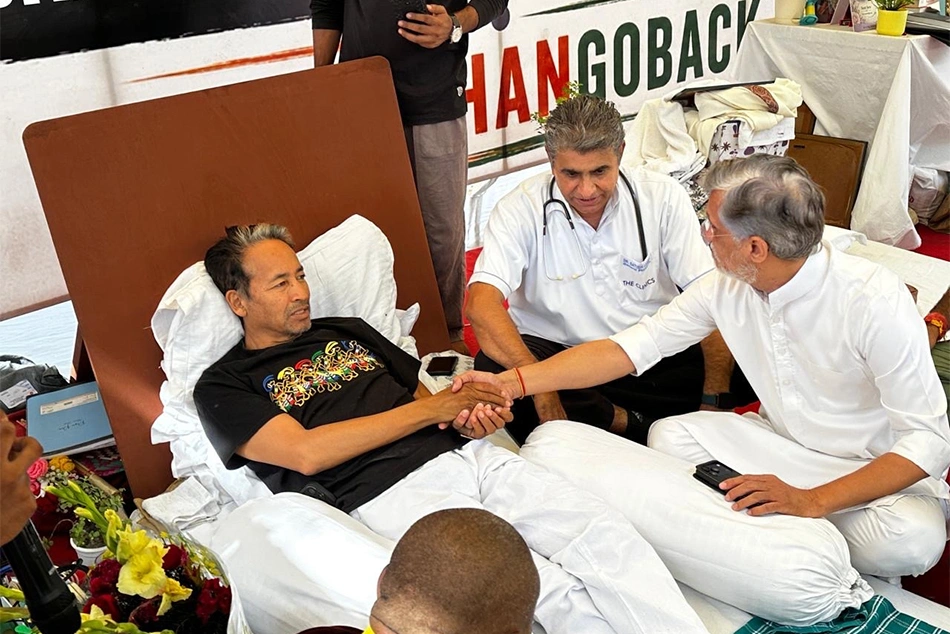
The prolonged protest at Delhi’s Jantar Mantar demanding the resignation of Union Education Minister Dharmendra Pradhan raises some disturbing questions.
Why has a movement centred on the future of millions of students failed to evoke widespread public participation? Why are the youth, in whose name the protest is being waged, largely absent? Why have their parents remained passive despite repeated examination scandals and rising unemployment? And why has Sonam Wangchuk’s fast unto death — now stretching into weeks amid mounting concern over his health, failed to generate the moral urgency that such acts once commanded?
These questions deserve serious reflection because the issue at stake extends far beyond one minister or one protest. It touches the very condition of democratic politics in contemporary India.
Let me state at the outset that I stand in solidarity with every struggle against arbitrary power and therefore fully sympathize with those gathered at Jantar Mantar. Sympathy, however, cannot substitute for political judgment. A movement’s moral legitimacy does not exempt it from scrutiny of its strategy. Indeed, the greater the cause, the greater the obligation to ask whether the methods adopted are capable of achieving it.
In this respect, both the principal demand and the chosen mode of struggle appear strategically misconceived. Demanding the resignation of the Education Minister personalizes what is fundamentally a structural crisis. The repeated leakage of examination papers, irregularities in recruitment, the commercialization of education and the despair of unemployed youth are not the consequences of one minister’s failure alone. They are symptoms of a wider political and institutional order. Even if the minister were to resign tomorrow, the underlying conditions that produced these crises would remain substantially unchanged.
The same may be said of the decision to culminate the movement in a fast unto death. Ironically, the movement began with an act of remarkable political imagination. The slogan, “What if all the cockroaches come together?” — a response to the Chief Justice’s demeaning remarks about unemployed youth — briefly created a fresh political vocabulary. It transformed humiliation into collective defiance and carried the potential to unite scattered grievances into a broader democratic challenge. It spoke not merely to students but to an entire generation living under the shadow of unemployment, insecurity and diminishing opportunities.
Yet that initial creativity gradually gave way to a familiar repertoire of protest, which the regime is well prepared to deal with. Instead of developing new creative forms of collective action capable of broadening participation, the movement culminated in the most traditional of Gandhian methods: the fast unto death. Whatever its moral appeal, this shift also returned the initiative to a regime that has repeatedly demonstrated its capacity to outlast precisely such forms of protest. The disruptive political imagination of the opening moment yielded to a method whose effectiveness depends upon assumptions that no longer command the same historical validity.
As I write, Sonam Wangchuk’s health is reportedly deteriorating. Appeals from well-wishers urging him to end the fast are becoming more frequent—not because they question the justice of his cause, but because they see little possibility of the government responding. Such assessments are not expressions of cynicism. They arise from the accumulated experience of the past decade. The present regime has repeatedly shown itself willing to absorb prolonged public criticism, withstand moral condemnation and allow protests to dissipate without making substantive concessions. It remained unmoved by Professor G. D. Agrawal’s fatal fast to protect the Ganga. During the year-long farmers’ agitation, it held its ground despite the enormous human cost borne by the protesters, retreating only when sustained mobilization imposed significant political costs. Time and again, dissent has been met less with dialogue than with delegitimization, delay or repression.
This raises a larger question that goes well beyond the immediate fate of the Jantar Mantar protest.
Why do methods that once appeared capable of shaking governments now seem increasingly incapable of moving them? Has the moral force of Gandhian politics itself diminished? Or have the conditions that once gave it political efficacy fundamentally changed?
These questions cannot be answered by invoking Gandhi as an article of faith, nor by dismissing satyagraha as obsolete. They require us to examine both the historical circumstances that made Gandhian protest effective and the profound transformation that has since occurred in the character of the Indian state. Only then can we understand not merely why this particular movement has struggled to become a people’s movement, but why democratic protest itself appears to be entering a new and uncertain phase.
Why Gandhian Politics Worked—and Why It No Longer Does?
The efficacy of Gandhian satyagraha has perhaps been romanticized by both its admirers and its critics. Whether fasting and voluntary suffering possess any intrinsic capacity to compel political change is doubtful. Unlike a strike, a fast halts no production. Unlike a boycott, it imposes no economic cost. Unlike civil disobedience, it need not obstruct the functioning of the state. By itself, a fast exerts no coercive pressure. Its force lies entirely in moral persuasion.
But moral persuasion is not an abstract ethical principle; it is a political relationship. It becomes effective only when the voluntary suffering of the protester generates wider public sympathy, transforms that sympathy into collective action, and ultimately imposes political costs upon those in power. A fast, therefore, is not itself an instrument of political pressure. It is merely a catalyst that may create the conditions under which such pressure can emerge.
This is why even Gandhi’s success cannot be understood apart from the exceptional historical circumstances in which he operated. His fasts were never solitary acts of self-sacrifice. They occurred within the framework of a vast national movement sustained by the Congress organization, an extensive nationalist press, international attention, and the support of influential sections of the Indian bourgeoisie. Above all, Gandhi possessed an unparalleled moral authority that transformed every fast into a national political event. Millions did not support the freedom movement because Gandhi fasted. Rather, Gandhi’s fasts acquired extraordinary political force because they were embedded in an already expanding mass movement.
The character of the colonial state also mattered. However coercive British rule undoubtedly was, it remained vulnerable to public opinion in ways that are often forgotten. The British Government sought legitimacy not only before Indian subjects but also before Parliament, the British public and international opinion. A prolonged fast by Gandhi therefore threatened political embarrassment that extended well beyond India. Colonial rulers could imprison Gandhi, but they could not entirely ignore the moral and political repercussions of his suffering.
To universalize Gandhian satyagraha while overlooking these exceptional historical conditions is to mistake a contingent political strategy for a timeless method of struggle. Gandhi did not discover an eternal law of politics. He developed a repertoire of action uniquely suited to the political circumstances of his time.
The experience of independent India bears this out. Potti Sriramulu, himself a devoted Gandhian, died after a 58-day fast demanding the creation of Andhra State. Jawaharlal Nehru did not concede while he lived. Andhra was created only after Sriramulu’s death provoked widespread unrest, administrative paralysis and mounting political instability. It was not the fast itself but the mass upheaval that followed which compelled the government to act.
The same pattern recurred in later decades. Darshan Singh Pheruman died after a prolonged fast without securing his principal demands. Irom Sharmila sustained an extraordinary 16-year hunger strike against the Armed Forces (Special Powers) Act, only to be repeatedly arrested, force-fed and eventually compelled to abandon the struggle without achieving repeal of the law. More recently, Professor G. D. Agrawal (Swami Sanand) died after fasting to protect the Ganga, yet the government remained unmoved. These episodes suggest that even governments claiming democratic legitimacy have proved fully capable of outlasting individual acts of moral witness.
The historical lesson is sobering. Fasting becomes politically effective only when it ignites a broader social movement capable of imposing electoral, administrative or political costs upon those in power. Where such mobilization does not materialize, the fast risks becoming an act of solitary martyrdom. The failure lies not in the courage of the protester but in the mistaken belief that moral witness, by itself, can move a determined state.
The real question, therefore, is not whether Gandhian politics has lost its moral appeal. It is whether the political conditions that once enabled moral appeal to influence power still exist. That question leads directly to the transformation of the Indian state itself. For if the nature of the state has changed fundamentally, then the repertoire of democratic struggle must change with it.
The Transformation of the Indian State
If Gandhian methods appear increasingly ineffective today, the explanation lies less in any decline of moral courage than in a profound transformation of the state they confront. Every repertoire of political struggle presupposes a particular relationship between rulers and the ruled. When that relationship changes, inherited methods of resistance can lose much of their efficacy.
The Indian state that emerged after Independence was far from ideal. It often suppressed popular movements, resorted to police violence and imprisoned political opponents. Yet it continued to derive much of its legitimacy from the institutions of constitutional democracy. Governments remained comparatively sensitive to parliamentary criticism, an independent press, judicial scrutiny and public opinion. Electoral uncertainty meant that sustained popular mobilization could impose real political costs. Protest, therefore, retained the capacity—however imperfectly—to influence the calculations of those in power.
That political ecology has altered significantly over the past decade. Electoral competition has increasingly been supplemented by the manufacture of consent through an unprecedented concentration of political communication, the centralization of executive authority, the weakening of institutional checks and balances, and the systematic delegitimization of dissent. The objective is no longer merely to win elections but to shape the political environment in ways that reduce the costs of governing and diminish the disruptive potential of collective action. In such circumstances, governments become progressively insulated from the moral pressure that Gandhian protest presupposes.
The record of the present regime illustrates this shift with remarkable consistency. The anti-CAA movement was met with police action, internet shutdowns and prolonged refusal to engage with its central demands. The wrestlers’ agitation, protests over recruitment irregularities and examination scandals, the Agnipath demonstrations, and Sonam Wangchuk’s previous movement for Ladakh were variously ignored, delayed or contained through preventive policing and sustained efforts to discredit the protesters. Across these movements, the state’s instinctive response has been less to negotiate than to outlast, fragment or delegitimize opposition.
The year-long farmers’ movement stands as the principal exception, but even this ultimately reinforces the broader pattern. The government initially rejected the demands for repeal, fortified protest sites with barricades and trenches, imposed internet shutdowns, employed force, and repeatedly portrayed the movement as infiltrated by extremists. The three farm laws were withdrawn only after more than a year of sustained resistance, considerable human suffering and the approach of politically significant state elections. The retreat bore the character of a tactical recalibration rather than an acknowledgment of the protesters’ moral claims. It demonstrated not the responsiveness of the state to dissent but the extraordinary scale of mobilization required before political concessions became unavoidable.
Recognizing this transformation is not an argument for political despair. On the contrary, it is the beginning of political realism. Every successful movement begins by understanding the terrain on which it struggles. To continue deploying methods fashioned for a different historical relationship between state and society, while ignoring the altered architecture of power, is to mistake nostalgia for strategy. Democratic politics cannot rely indefinitely upon inherited repertoires of protest when the conditions that once made them effective have fundamentally changed.
This changing political landscape also helps explain the puzzle with which we began. If citizens increasingly believe that governments can withstand prolonged protest without meaningful concession, public participation itself is likely to diminish. The problem is no longer simply fear of repression. It is the gradual erosion of confidence that collective action can alter political outcomes. Once that belief weakens, even causes commanding widespread sympathy struggle to become genuine mass movements.
The Crisis of Democratic Politics
The transformation of the state also helps explain the most troubling feature of the Jantar Mantar protest: its failure to become a genuine people’s movement. The issue it raises—the collapse of examination integrity, chronic unemployment and the shrinking horizons of an entire generation—touches millions of families. Yet public participation has remained remarkably limited. The explanation lies not simply in organizational weakness but in a wider transformation of society’s relationship with politics itself.
Fear is undoubtedly one element. The repeated use of criminal law, investigative agencies, preventive detention, surveillance and public vilification has created an atmosphere in which participation in protest carries increasing personal risk. Repression need not be universal to be effective. A few exemplary punishments are often sufficient to deter thousands who might otherwise have joined. Fear, however, is only part of the story.
Equally important is the growing insecurity of everyday life. Unemployment, precarious work, indebtedness, inflation and the relentless struggle for economic survival have left large sections of society with little emotional or material capacity for sustained political engagement. People may recognize injustice and sympathize with those who resist it, yet feel unable to bear the additional risks that public action entails. Survival itself becomes a full-time occupation.
Beyond fear and insecurity lies an even deeper problem: the erosion of political efficacy. Over the past decade, citizens have repeatedly witnessed large movements ignored, prolonged protests outlasted, and dissenting voices delegitimized or criminalized. Many have gradually come to believe that protest no longer changes outcomes. This is not political indifference but political resignation. When people cease to believe that collective action can alter the course of events, they retreat into the private sphere, not because they no longer care, but because they no longer expect to make a difference.
Seen in this light, the tragedy of the Jantar Mantar protest is not simply that it may fail to secure the resignation of one minister. It is that it reflects a wider crisis of democratic politics. The moral conviction of protesters increasingly confronts a political order that has become insulated from moral appeal, while those who might naturally join them have grown uncertain that protest itself remains an effective instrument of change. The widening gulf between public grievance and collective action is perhaps the most serious democratic challenge confronting India today.
This does not mean that resistance has become futile. It means that democratic politics must rethink its inherited repertoire. Every generation inherits methods of struggle shaped by the political conditions of an earlier age. Gandhi’s satyagraha emerged in confrontation with a colonial state vulnerable to questions of legitimacy. It retained some efficacy in the early decades of the constitutional republic. But no political method remains permanently effective merely because it once succeeded. As the nature of the state changes, so too must the forms through which citizens organize, mobilize and exercise democratic power.
The challenge before India’s youth, therefore, is much larger than securing the resignation of one minister. It is to discover forms of political action equal to the realities of the present. Moral courage remains indispensable, but courage without strategy risks becoming martyrdom. The task is not to abandon Gandhi, but to recover the spirit of political creativity that made him effective in his own time.
The real lesson of Jantar Mantar is thus not that democratic protest has become impossible. It is that democratic protest can no longer succeed simply by reenacting the repertories of the past. If democracy is to be renewed, it will require new forms of organization, new languages of solidarity and new strategies capable of confronting a state that has fundamentally altered the relationship between power and public dissent. Until then, even the noblest acts of self-sacrifice may inspire admiration without generating the political force needed to bring about change.
Gen-Z needs to be creative enough to defy imagination of the arrogant regime.
[The writer, Anand Teltumbde, is a Political Theorist.]
Follow ummid.com WhatsApp Channel for all the latest updates.
Select Language to Translate in Urdu, Hindi, Marathi or Arabic