NATO's Bipolar Summit in Ankara
Donald Trump turned NATO's Ankara summit into a one-man show - reviving Iran hostilities, threatening Spain, demanding Greenland, and needling allies - while Secretary-General Mark Rutte's flattery-and-spending strategy kept the alliance intact.
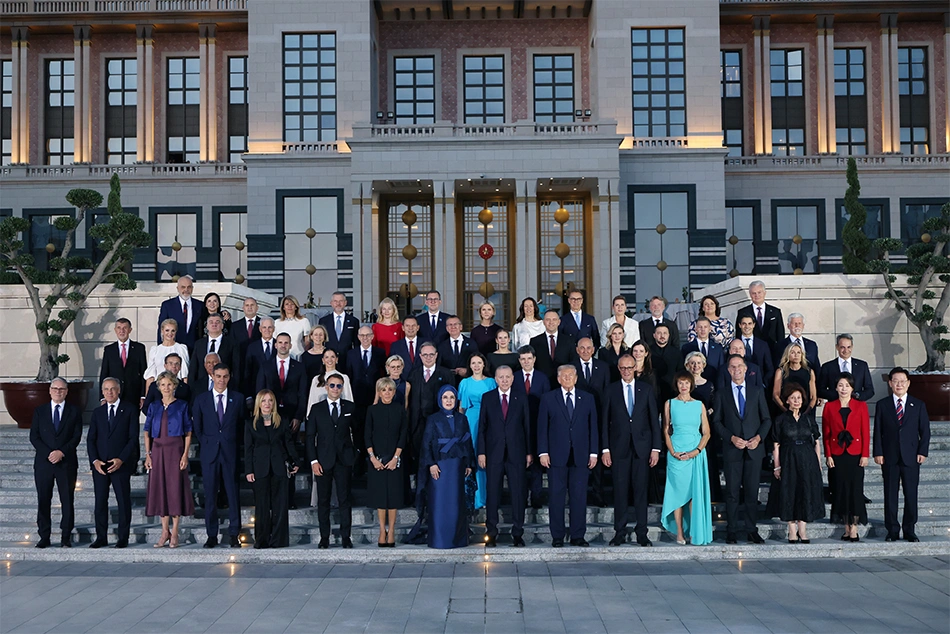
Donald Trump turned NATO's Ankara summit into a one-man show - reviving Iran hostilities, threatening Spain, demanding Greenland, and needling allies - while Secretary-General Mark Rutte's flattery-and-spending strategy kept the alliance intact. The summit exposed a NATO that survives not through unity, but through the careful, anxious management of one man's moods.
When Donald Trump landed in Ankara this week for NATO's annual summit, the alliance's carefully choreographed script survived roughly as long as his motorcade took to reach the venue. What followed was, by multiple accounts, a "marathon, high-energy performance" - the White House's own words - that left NATO with tangible wins, several bruised allies, and a renewed sense that the alliance's survival now depends less on treaty commitments than on one man's temperament.
The Behaviour: Grievance as Statecraft
Trump's two days in Turkey followed a now-familiar pattern: escalate, demand, humiliate, then declare victory. He announced that the Iran ceasefire was "over" calling Tehran's leadership "scum" and boasting of American strikes conducted, in his telling, at a ratio of "20 to one."
He revived his demand for Greenland, insisting the Arctic territory "should be controlled by the United States, not by Denmark," and invoked a revisionist account of Nazi-era history to justify the claim - reopening a diplomatic wound that had already forced Danish Prime Minister Mette Frederiksen to publicly pledge her country would defend its territory earlier this year.
But it was Spain that bore the sharpest edge of his anger. Furious that Madrid had declined to let US forces use its bases to strike Iran, Trump branded Spain "a terrible partner in NATO" and threatened to sever all trade with the country, mockingly imitating Spanish officials "begging" to resume business with Washington.
He also reportedly renewed a grudge against Italian Prime Minister Giorgia Meloni, having previously mocked her online, and pre-empted British Prime Minister Keir Starmer's resignation announcement weeks earlier a habit of publicly upstaging or undercutting individual leaders that has become a signature move.
Most striking was Trump's own admission that his combative posture was strategic rather than impulsive. "I was really testing" allies over their response to Greenland and Iran, he told reporters - casting NATO's unity itself as an experiment he was running, and declaring that the alliance had "failed" on both counts.
This is a notable rhetorical shift: rather than merely reacting to perceived slights, Trump now frames confrontation as a deliberate tool for extracting compliance, a posture that unsettles allies far more than spontaneous outbursts would, because it suggests premeditation and repeatability.
Underneath the theatrics, though, sat real business. Trump told Ukrainian President Volodymyr Zelensky that the United States would license Ukraine to manufacture its own Patriot air-defence interceptors domestically - a long-sought capability given the acute global shortage of interceptor missiles as Russian bombardments intensify.
He also met Syria's president, Ahmed al-Sharaa, signalled openness to selling F-35 jets to Turkey, and announced the lifting of sanctions linked to Ankara's earlier purchase of Russian S-400 defence systems. NATO's own communiqué touted tens of billions of dollars in new defence-industry procurement and a pledge of €70 billion for Ukraine in 2026 alone.
European and NATO Leaders: Managed, Not Convinced
The European response has settled into a pattern that officials and analysts increasingly describe not as diplomacy but as psychological management. Secretary-General Mark Rutte - dubbed NATO's "Trump Whisperer" - has built his entire tenure around a single mission: keeping the American president engaged rather than persuaded.
Ahead of the summit, Rutte reportedly presented Trump with a chart titled "the Trump Trillion," crediting the president personally for $1.2 trillion in European and Canadian defence spending since 2017, and afterward praised the summit's defence commitments as proof NATO was "made stronger" by Trump's demands.
That strategy produced results of a sort: Trump left Ankara calling his NATO partners "a nice group of people" and touting alliance "unity," even as he was actively undermining it hours earlier.
Analysts at the Atlantic Council and the Center for Strategic and International Studies have characterised recent summits as exercises in "smoke and mirrors" designed to get through the season without a rupture, rather than genuine strategic alignment - a description that captures the mood in Ankara precisely.
One think-tank director bluntly noted that the goal was avoiding "the Transatlantic Alliance fracturing and breaking apart," a considerably lower bar than the alliance would have set for itself a decade ago.
Individual leaders, meanwhile, absorbed Trump's attacks with visibly uneven composure. Spain, singled out repeatedly, offered no dramatic public rebuttal, appearing to calculate that outlasting the outburst was wiser than escalating it.
Denmark's government, by contrast, has shown more willingness to draw a hard line on Greenland, treating Trump's territorial rhetoric as a genuine sovereignty threat rather than posturing.
French President Emmanuel Macron pushed back gently on the substance, insisting that diplomatic talks with Iran would continue despite Trump's declaration that the ceasefire was finished - a rare moment of a European leader publicly contradicting Trump's framing without provoking a direct confrontation.
Turkey's Recep Tayyip Erdoğan, hosting the summit, played the opposite role, cultivating Trump's favour and declaring the gathering a "historic summit" that laid NATO's stronger foundations - a reminder that flattery, not friction, has become the more reliably effective diplomatic currency inside the alliance.
What It Forebodes for NATO
Taken together, the Ankara summit crystallises a structural shift in how the alliance now functions - one that analysts have converged on describing as survival through appeasement rather than cohesion through shared purpose. Three implications stand out.
First, NATO's internal culture has been reoriented around anticipating and absorbing one leader's moods rather than building collective strategy. When an alliance's secretary-general's chief skill becomes flattery management, and when summit "success" is redefined downward to mean simply avoiding rupture, the organisation's strategic muscle atrophies even as its spending figures grow.
The substantive commitments - the Ukraine funding pledge, the defence-industry contracts - are real, but they increasingly look like tribute paid to keep Washington in the room rather than the product of genuine consensus-building.
Second, the drawdown of US troops in Europe, described by observers as the most significant shift in the continent's defence posture since the Cold War, is proceeding in parallel with the rhetorical fireworks - and may prove more consequential than any single Trump outburst.
Threats and insults are, in a sense, survivable theatre; a shrinking American troop presence is a structural fact that will outlast any single summit's news cycle, forcing European capitals to accelerate their own military build-up regardless of how warmly Trump speaks about them on any given day.
Third, the pattern of singling out individual members - Spain over trade, Denmark over Greenland, implicitly others over Iran - tests something NATO has historically avoided: treating collective defence commitments as conditional on bilateral political loyalty.
If allies internalise that support is contingent on personal deference to Washington rather than treaty obligation, the psychological foundation of Article 5 - the promise that an attack on one is an attack on all - becomes harder to take for granted, even if it remains legally intact on paper.
The alliance that emerged from Ankara is, by most accounts, still standing, better funded, and nominally united. But it is an alliance increasingly defined by its skill at managing an unpredictable partner rather than by confidence in a shared strategic vision - a distinction that may matter little in calm times, but could prove decisive the next time NATO faces a genuine crisis requiring fast, unified resolve.
[The writer, Asad Mirza, is Delhi based Journalist and Author.]
Follow ummid.com WhatsApp Channel for all the latest updates.
Select Language to Translate in Urdu, Hindi, Marathi or Arabic