Released: Open Source AI Model to Support Lunar Exploration
Tech giant IBM and American space agency NASA Thursday announced the open-source release of the NASA‑IBM Lunar Foundation Model, one of the first publicly available foundation models for scientific exploration of the Moon.
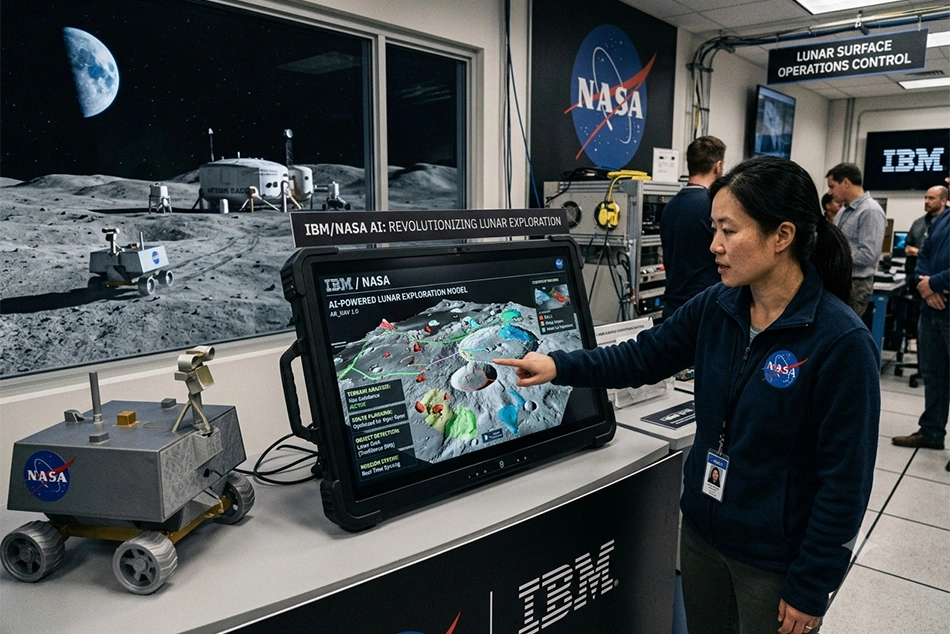
Tech giant IBM and American space agency NASA Thursday announced the open-source release of the NASA‑IBM Lunar Foundation Model, one of the first publicly available foundation models for scientific exploration of the Moon.
Trained on an extensive lunar observation dataset curated by IBM and NASA researchers, the model can help scientists turn decades of complex, multi-instrument data into insights to support the establishment of a sustained human presence on the Moon.
Why Lunar Exploration is Important?
Explaining why Lunar Exploration is important, NASA and IBM said that the Moon's topography is ever-changing, and the Lunar surface has over time formed craters, distributed ice and even experienced volcanic activity.
For decades, sensors and instruments have continuously observed the Moon, generating petabytes of data, but to study the Moon's surface, scientists need to either sift through maps and images by hand or use low resolution, task specific machine learning models. These methods can be computationally intensive and can lack the degree of scientific accuracy needed to identify and analyze geographic features.
"The newly released NASA-IBM Lunar Foundation Model will help researchers accelerate scientific progress by identifying hidden relationships between many different types and resolutions of lunar data", IBM and NASA said in a joint statement.
Scope of NASA-IBM Lunar Foundation Model
Researchers could use the NASA-IBM Lunar Foundation Model to investigate multiple lunar phenomena, including Potential Lunar Ice Deposits, Volcanic History and Crater Detection.
"NASA has spent decades building an extraordinary scientific record of the Moon, but collecting data is only part of the job," said Kevin Murphy, chief science data officer and acting chief data and AI officer at NASA Headquarters in Washington. "We also have to make data easier for scientists to explore and use. The NASA-IBM Lunar Foundation Model shows what's possible when we bring AI to NASA's petabytes of scientific data. That's a real opportunity we see with AI: turning large-scale data into new discoveries."
"Uncovering the mysteries of the Moon requires an ability to learn from an extraordinary volume of scientific data," said Juan Bernabe-Moreno, Director of IBM Research Europe, UK and Ireland. "The NASA-IBM Lunar Foundation Model gives scientists a foundation to explore the Moon at scale, connecting observations across instruments, revealing patterns that are difficult to see in isolation, and providing an open platform the global research community can build on."
Follow ummid.com WhatsApp Channel for all the latest updates.
Select Language to Translate in Urdu, Hindi, Marathi or Arabic