Inside The Israeli-Palestinian Banking Relationship
Since October 2023, Israel has withheld the portion of clearance revenue earmarked for Gaza altogether, with billions of shekels frozen on the pretext that the money could reach Hamas
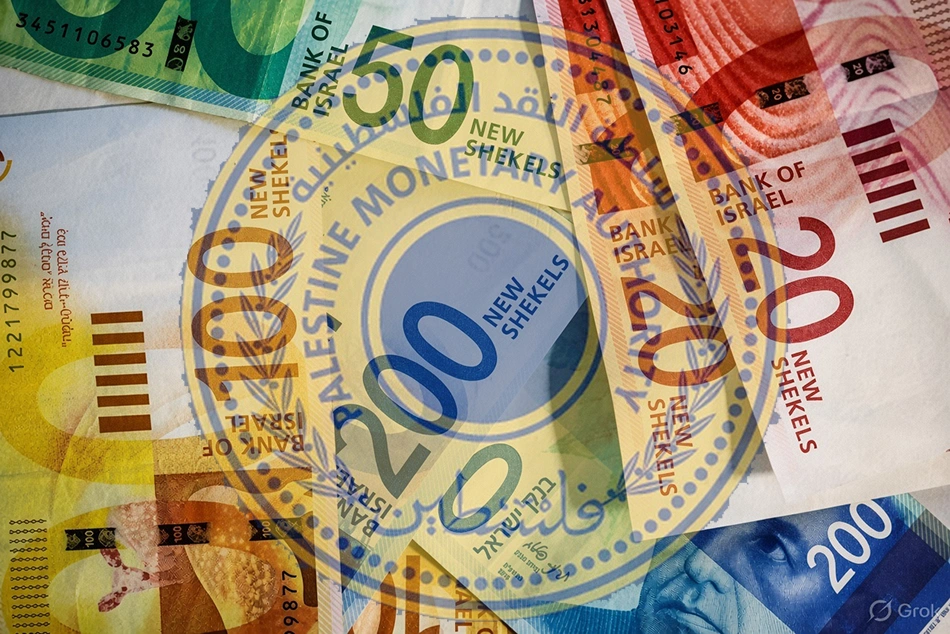
There is no Palestinian currency. Walk into a shop in Ramallah, Nablus, or Gaza, and the coins in your pocket carry the words “Bank of Israel”. That single fact, that close to five million Palestinians conduct nearly all of their commerce in a currency issued and controlled by the government occupying them, is the starting point for understanding one of the least visible and most consequential dimensions of the occupation: money, and who controls its movement.
Since 1967, the occupied Palestinian territories have used the Israeli shekel as their primary legal tender, alongside the Jordanian dinar and the US dollar for larger transactions. The Palestinian Authority has never been permitted to issue its own currency. The Palestine Monetary Authority, established in Ramallah in 1994, functions as a central-bank-like regulator, licensing and supervising the roughly fourteen banks operating across the occupied West Bank and Gaza, yet it cannot print money, cannot set an independent interest rate, and cannot act as a genuine lender of last resort, because there is no Palestinian currency behind it. Palestinian economists call this monetary dependency without monetary sovereignty: the Authority absorbs Israeli inflation, Israeli interest-rate decisions, and the physical scarcity or surplus of a currency it does not issue, with no seat at the table where any of those decisions are made.
The entire financial relationship rests on a single document, the Paris Protocol on Economic Relations, signed in 1994 between Israel and the PLO and folded into the Oslo framework. It was negotiated between an occupying power and a people under occupation, and was meant to be a temporary five-year bridge to a Palestinian state. Three decades on, that state never came, the occupation never ended, and the protocol remains the operating system of Palestinian economic life. Palestinians describe it not as a partnership but as a customs cage, an occupation administered through paperwork and bank ledgers rather than only through soldiers and checkpoints. Even the limited obligations it places on Israel, to transfer revenue on schedule, to accept shekel repatriations, to keep the banking channel open, have been suspended, delayed, or unilaterally rewritten by Israel again and again, with no equivalent obligation or penalty ever running the other way.
Because Israel controls every border and crossing, every Palestinian import and export passes through Israeli hands, and Israel collects the customs duties, VAT, and purchase taxes owed on goods bound for Palestinian markets, even goods that never touch Israeli soil. It is contractually obliged to hand this money, known as clearance revenue or al-muqassa, to the Palestinian Authority every month.
Israel can also raise or lower its own VAT rate and bind the Authority to follow automatically, a one-directional transmission of fiscal policy Palestinians call taxation without representation, and it withholds a quarter of the income tax owed to Palestinians who work inside Israel plus a further three percent of the entire sum as a “handling fee.”
Clearance revenue is not a footnote in this relationship; it is the relationship, supplying between sixty and seventy percent of the Authority’s total public revenue, the money that pays teachers, doctors, police, and municipal workers from Jenin to Rafah. Israel, a direct party to the conflict, effectively signs off on the Palestinian public payroll every single month.
Because it physically holds this money before it reaches Ramallah, Israel has turned clearance revenue into the most frequently used pressure tool in the entire relationship, what Palestinians call fiscal siege or tax blackmail. Since 2019, an Israeli law has permitted the automatic deduction of sums equal to the stipends the Authority pays to Palestinian prisoners and the families of martyrs, with cumulative deductions on that basis reaching roughly a billion dollars by 2024. In January 2023, Israel’s security cabinet froze tens of millions in transfers within days of the Authority asking the International Court of Justice to rule on the legality of the occupation, describing the move openly as “political and legal war.”
Since October 2023, Israel has withheld the portion of clearance revenue earmarked for Gaza altogether, with billions of shekels frozen on the pretext that the money could reach Hamas. The crisis then deepened sharply: in May 2025, Finance Minister Bezalel Smotrich moved to “zero out” transfers almost entirely, and by May 2026 the total sum Israel was holding had climbed to roughly 15 billion shekels, close to five billion dollars, growing by about a billion shekels every month because trade and customs collection never stopped even as the transfers did.
Also Read: Now, Palestinians in Gaza found their bank accounts frozen, inaccessible
That June, the Knesset passed legislation authorizing the outright freezing and confiscation of Palestinian clearance funds, which the Authority called an expansion of the theft of the Palestinian people. Palestinians are insistent on the framing: this is not aid, not a subsidy, not a gift from a generous neighbor. It is their own money, collected on their behalf by the party that controls their borders, and periodically held hostage.
A second crisis runs alongside the tax dispute, and it concerns the physical cash itself. No Palestinian bank can function without an Israeli one standing behind it, and that dependency runs through exactly two Israeli institutions: Bank Hapoalim and Israel Discount Bank. Because Palestine has no seaport, no independently controlled airport, and no central bank empowered to issue currency or hold a seat in the international payment system, every Palestinian bank must route its cross-border transactions, trade payments, remittances, wire transfers, and humanitarian funding, through a correspondent account at one of those two Israeli banks, which then carries the transaction onto the global financial network. Nothing crosses a Palestinian border in either direction, financially, without passing through Hapoalim or Discount first.
Because Palestinians earn, spend, and save almost entirely in shekels, physical cash accumulates in Palestinian bank vaults far faster than it can be recirculated locally. The Paris Protocol addresses this by requiring Palestinian banks to ship their surplus shekel banknotes back into the Israeli banking system in four quarterly installments, up to an annual ceiling of 18 billion shekels, a ceiling Israel sets and that has stayed essentially frozen since the 1990s even as the Palestinian economy grew many times over.
By 2026 the mismatch had become an acute crisis: Palestinian banks needed to repatriate an estimated 28 billion shekels a year just to keep pace with normal cash accumulation, ten billion more than Israel would accept, and by mid-2026 roughly 17 billion shekels sat idle in Palestinian vaults, money that legally belonged to depositors but could not be lent, invested, or converted into anything productive.
In August 2026, under mounting pressure, Israel approved an emergency early repatriation of 4.5 billion shekels, about 1.5 billion dollars, which the Authority’s monetary governor Yahya Shunnar welcomed but Palestinian commentators called “temporary oxygen,” since the underlying ceiling was left untouched. There is a quieter cost buried inside the crisis: because the banks are sitting on shekel cash they cannot profitably deploy, several have cut the interest they pay depositors on shekel savings, saving the sector an estimated 140 million shekels a year, which means ordinary Palestinian savers now earn less on money that is structurally trapped behind a foreign-set ceiling they had no part in negotiating.
Nor is any of this guaranteed to continue from one month to the next, because the correspondent-banking relationship runs not on settled law but on periodic Israeli government waivers. Hapoalim and Discount will only serve Palestinian banks if the Israeli Finance Ministry issues an indemnity shielding them from legal liability, and that waiver is renewed again and again, sometimes for startlingly short windows. In late 2024 it was renewed for just thirty days, prompting the foreign ministers of the UK, France, and Germany to jointly warn that cutting the relationship would create significant economic turmoil in the West Bank.
In March 2026 the extension shrank to two weeks. Then in July 2026 the two banks formally notified their Palestinian counterparts that they intended to end correspondent services altogether, citing legal and reputational risk, with cutoff dates in August and September. The World Bank warned the move would disrupt the financing of food, fuel, and medicine and could leave the Authority unable to pay salaries at all. Smotrich, who personally oversees the waiver, signed an extension through the end of 2026, and even then the banks were reported to be still weighing whether to honor it, doing so only after the Bank of Israel intervened, worried that an uncontrolled shutdown could trigger a broader collapse next door. For Palestinian bankers this is not an exception but how the system has always run: a rolling, revocable permission slip renewed in increments of weeks or months, never a guaranteed right.
Strip away the technical vocabulary, and what remains is a plain question of power. In Palestine, moving money between Palestinian banks is close to frictionless, because that traffic never leaves the domestic system. The moment money needs to cross a border, everything routes through Hapoalim or Discount and everything slows down, as wires face extended compliance reviews and paperwork that can turn a same-day transfer into a process stretching a week or more.
Palestinian bankers call the broader pattern de-risking, banks quietly narrowing their exposure to Palestinian counterparties to avoid legal blowback, and the effect lands hardest on the remittances Palestinian families depend on and the humanitarian transfers meant to reach hospitals and aid agencies in Gaza, exactly when the need is greatest. The same narrow corridor once carried one of the economy’s largest income streams, the wages of more than 200,000 Palestinians employed inside Israel and its settlements, worth an estimated 5.5 billion dollars a year, until Israel barred the overwhelming majority of them from their jobs after October 7, 2023, severing that channel almost overnight.
Israel presents none of this as occupation. Its officials and banks describe every measure in the language of security and legal caution: the banking risk is framed as exposure to lawsuits, the confiscation law as a tool against terror financing, the deductions as a moral and security necessity. But that framing does not change the underlying reality: Israel, not Palestine, holds the legal and physical levers over Palestinian public money, and has used them, unilaterally and without Palestinian recourse, to withhold funds that the Paris Protocol itself defines as Palestinian.
Israel holds the valve on nearly every pipe at once, the customs revenue collected at its ports, the physical shekels that must be shipped back on its schedule, the correspondent accounts that are the sole gateway to the world, and, for decades, the wages of the workers who crossed daily into Israel. The relationship is not a partnership between two banking systems; it is one system holding the only door to the outside world and deciding, waiver by waiver, quarter by quarter, whether to keep it open.
That is what the paper says, exactly as it is written: protocols, ceilings, waivers, quarterly schedules, everything tidied up and repackaged in the language of “monetary cooperation” and “economic partnership.” Behind that paper, what I actually see is different. Every time I read another measured report on correspondent-banking relationships, repatriation ceilings, and Finance Ministry waivers, I cannot help noticing how much linguistic elegance gets wrapped around something so simple at its core.
What, really, is the difference between a soldier who raids a Palestinian home under the pretext of an arrest and leaves with the cash and gold from the drawers, and an Israeli Finance Ministry that “detains” billions of shekels in clearance revenue? None worth mentioning, except that one wears a uniform and gets filed as an isolated incident, while the other wears a suit and gets filed as monetary policy. Both are, at their core, acts of looting. Both belong to the same carefully engineered project: stripping Palestinians, as individuals and as institutions, of any capacity to sustain themselves.
As for the currency monopoly, the confiscated clearance revenue, and a shekel ceiling frozen since the 1990s, all of it is “financial engineering” only when narrated in English, in a composed academic register. Said plainly, it is organized theft, documented with signatures, seals, an official protocol, and quarterly schedules, purely to keep it dressed in a tidy legal costume.
And when the Paris Protocol is described as resembling a customs union between two self-sufficient, equal economies, that is perhaps the single funniest irony in this entire file: one economy with an army, borders, a currency, a port, and a central bank, entering a “union” with an economy that has none of those things. This is not an agreement in any legal sense of the word. It is a surrender, stamped with an official seal, and nothing more.
[The writer, Haneen Ghaleb, is a Political Commentator. The above article is originally published by Quds News Network.]
Follow ummid.com WhatsApp Channel for all the latest updates.
Select Language to Translate in Urdu, Hindi, Marathi or Arabic